
Ch 36: Diffraction
Young & Freedman Calc - University Physics 14th Edition
Young & Freedman Calc14th EditionUniversity PhysicsISBN: 9780321973610당신이 사용하는 게 아니라요?교과서 변경
36장, 문제 15b

A slit 0.240 mm wide is illuminated by parallel light rays of wavelength 540 nm. The diffraction pattern is observed on a screen that is 3.00 m from the slit. The intensity at the center of the central maximum (θ = 0°) is 6.00 x 10⁻⁶ W/m2. What is the intensity at a point on the screen midway between the center of the central maximum and the first minimum?

검증된 단계별 안내
1
Understand the problem: This is a single-slit diffraction problem. The intensity of light at a point on the screen is determined by the diffraction pattern, which depends on the slit width, wavelength, and the angle of observation. The goal is to find the intensity at a point midway between the central maximum and the first minimum.
Recall the formula for the intensity in a single-slit diffraction pattern: \( I(\theta) = I_0 \left( \frac{\sin(\beta)}{\beta} \right)^2 \), where \( \beta = \frac{\pi a \sin(\theta)}{\lambda} \), \( a \) is the slit width, \( \lambda \) is the wavelength, and \( \theta \) is the angle of observation. \( I_0 \) is the intensity at the central maximum.
Determine the angle \( \theta \) midway between the central maximum and the first minimum. The first minimum occurs when \( \sin(\theta) = \frac{\lambda}{a} \). Midway between the central maximum and the first minimum corresponds to \( \sin(\theta) = \frac{1}{2} \cdot \frac{\lambda}{a} \). Substitute \( \lambda = 540 \; \text{nm} = 540 \times 10^{-9} \; \text{m} \) and \( a = 0.240 \; \text{mm} = 0.240 \times 10^{-3} \; \text{m} \) to calculate \( \sin(\theta) \).
Calculate \( \beta \) for this angle using \( \beta = \frac{\pi a \sin(\theta)}{\lambda} \). Substitute the values of \( a \), \( \lambda \), and \( \sin(\theta) \) into the equation to find \( \beta \).
Substitute \( \beta \) into the intensity formula \( I(\theta) = I_0 \left( \frac{\sin(\beta)}{\beta} \right)^2 \). Use \( I_0 = 6.00 \times 10^{-6} \; \text{W/m}^2 \) to calculate the intensity at the specified point. This will give the desired result.

비슷한 문제에 대한 검증된 영상 답변:

이 영상 해법은 위 문제에 도움이 된다고 튜터들이 추천한 것입니다.
영상 길이:
10m
도움이 되었나요?

주요 개념

질문에 올바르게 답하기 위해 반드시 이해해야 하는 핵심 개념들은 다음과 같습니다.

Diffraction

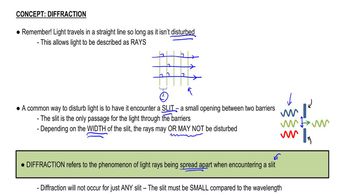
Diffraction is the bending of waves around obstacles and the spreading of waves when they pass through narrow openings. In the context of light, diffraction patterns arise when light encounters a slit, leading to the formation of bright and dark regions on a screen due to constructive and destructive interference of the light waves.
추천 영상:

Intensity of Light

The intensity of light is defined as the power per unit area carried by a wave. It is proportional to the square of the amplitude of the wave and is measured in watts per square meter (W/m²). In diffraction patterns, intensity varies with position, being highest at the center and decreasing towards the minima.
추천 영상:

Position of Minima in Single-Slit Diffraction

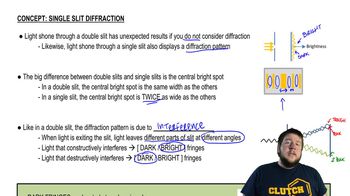
In single-slit diffraction, the positions of the minima can be calculated using the formula a sin(θ) = mλ, where 'a' is the slit width, 'θ' is the angle of the minima, 'm' is the order of the minimum (m = ±1, ±2,...), and 'λ' is the wavelength of light. The first minimum occurs at the angle where the first dark fringe appears, which is crucial for determining intensity at specific points on the screen.
추천 영상:
가이드 코스
12:33
Single Slit Diffraciton
관련 실천
교과서 질문

A single-slit diffraction pattern is formed by monochromatic electromagnetic radiation from a distant source passing through a slit 0.105 mm wide. At the point in the pattern 3.25° from the center of the central maximum, the total phase difference between wavelets from the top and bottom of the slit is 56.0 rad. What is the wavelength of the radiation?

1856
views
교과서 질문

A series of parallel linear water wave fronts are traveling directly toward the shore at 15.0 cm/s on an otherwise placid lake. A long concrete barrier that runs parallel to the shore at a distance of 3.20 m away has a hole in it. You count the wave crests and observe that 75.0 of them pass by each minute, and you also observe that no waves reach the shore at ±61.3 cm from the point directly opposite the hole, but waves do reach the shore everywhere within this distance. At what other angles do you find no waves hitting the shore?

1682
views
교과서 질문

A slit 0.240 mm wide is illuminated by parallel light rays of wavelength 540 nm. The diffraction pattern is observed on a screen that is 3.00 m from the slit. The intensity at the center of the central maximum (θ = 0°) is 6.00 x 10⁻⁶ W/m2. What is the distance on the screen from the center of the central maximum to the first minimum?

1732
views
교과서 질문

Monochromatic light of wavelength 592 nm from a distant source passes through a slit that is 0.0290 mm wide. In the resulting diffraction pattern, the intensity at the center of the central maximum (θ = 0°) is 4.00x10⁻⁵ W/m2. What is the intensity at a point on the screen that corresponds to θ = 1.20°?

2251
views
교과서 질문

A single-slit diffraction pattern is formed by monochromatic electromagnetic radiation from a distant source passing through a slit 0.105 mm wide. At the point in the pattern 3.25° from the center of the central maximum, the total phase difference between wavelets from the top and bottom of the slit is 56.0 rad. What is the intensity at this point, if the intensity at the center of the central maximum is I0?

1697
views
교과서 질문

Monochromatic light of wavelength 580 nm passes through a single slit and the diffraction pattern is observed on a screen. Both the source and screen are far enough from the slit for Fraunhofer diffraction to apply. (a) If the first diffraction minima are at ±90.0°, so the central maximum completely fills the screen, what is the width of the slit? (b) For the width of the slit as calculated in part (a), what is the ratio of the intensity at θ = 45.0° to the intensity at θ = 0?

1952
views