

Ch 36: Diffraction
Young & Freedman Calc - University Physics 14th Edition
Young & Freedman Calc14th EditionUniversity PhysicsISBN: 9780321973610당신이 사용하는 게 아니라요?교과서 변경
36장, 문제 18

Parallel rays of monochromatic light with wavelength 568 nm illuminate two identical slits and produce an interference pattern on a screen that is 75.0 cm from the slits. The centers of the slits are 0.640 mm apart and the width of each slit is 0.434 mm. If the intensity at the center of the central maximum is 5.00 x 10⁻⁴ W/m2, what is the intensity at a point on the screen that is 0.900 mm from the center of the central maximum?

검증된 단계별 안내
1
Step 1: Understand the problem. This is a double-slit interference problem where we need to calculate the intensity at a point on the screen that is 0.900 mm from the center of the central maximum. The given parameters include the wavelength of light (λ = 568 nm), the distance between the slits (d = 0.640 mm), the slit width (a = 0.434 mm), the distance to the screen (L = 75.0 cm), and the intensity at the central maximum (I₀ = 5.00×10⁻⁴ W/m²).
Step 2: Calculate the path difference. The path difference between the light from the two slits at a point on the screen is given by Δx = (d * y) / L, where y is the distance from the central maximum on the screen. Substitute the values: d = 0.640 mm, y = 0.900 mm, and L = 75.0 cm. Ensure all units are consistent (convert mm to meters where necessary).
Step 3: Determine the phase difference. The phase difference (Δϕ) is related to the path difference by the formula Δϕ = (2π / λ) * Δx, where λ is the wavelength of the light. Use the calculated path difference from Step 2 and λ = 568 nm (convert to meters) to find Δϕ.
Step 4: Use the intensity formula for interference. The intensity at a point on the screen is given by I = I₀ * cos²(Δϕ / 2), where I₀ is the intensity at the central maximum and Δϕ is the phase difference. Substitute the values of I₀ and Δϕ to find the intensity at the given point.
Step 5: Account for the single-slit diffraction envelope. The double-slit interference pattern is modulated by the single-slit diffraction envelope. The single-slit diffraction factor is given by sinc²(β), where β = (π * a * y) / (λ * L). Calculate β using the given slit width (a = 0.434 mm), y = 0.900 mm, λ = 568 nm, and L = 75.0 cm. Multiply the interference intensity by sinc²(β) to get the final intensity at the point.

비슷한 문제에 대한 검증된 영상 답변:

이 영상 해법은 위 문제에 도움이 된다고 튜터들이 추천한 것입니다.
영상 길이:
10m
도움이 되었나요?

주요 개념

질문에 올바르게 답하기 위해 반드시 이해해야 하는 핵심 개념들은 다음과 같습니다.

Interference of Light

Interference occurs when two or more coherent light waves overlap, resulting in a new wave pattern. In the context of the double-slit experiment, constructive interference leads to bright fringes, while destructive interference results in dark fringes. The positions of these fringes depend on the wavelength of the light and the geometry of the slits.
추천 영상:
가이드 코스
03:47
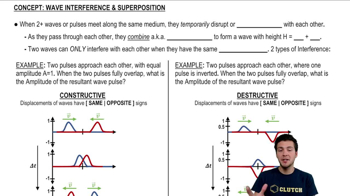
Wave Interference & Superposition

Intensity of Light

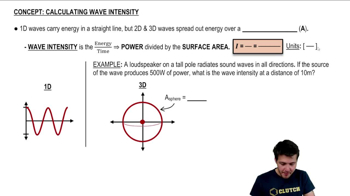
The intensity of light is defined as the power per unit area, typically measured in watts per square meter (W/m²). In interference patterns, the intensity varies depending on the position relative to the central maximum, influenced by the phase difference between the light waves from the slits. The intensity at any point can be calculated using the formula that incorporates the amplitude of the waves and their interference.
추천 영상:

Young's Double-Slit Experiment

Young's double-slit experiment demonstrates the wave nature of light through the creation of an interference pattern. The distance between the slits, the wavelength of the light, and the distance to the screen are critical parameters that determine the spacing and intensity of the interference fringes. This experiment is foundational in understanding wave optics and the behavior of light.
추천 영상:
가이드 코스
12:00
Young's Double Slit Experiment
관련 실천
교과서 질문

A single-slit diffraction pattern is formed by monochromatic electromagnetic radiation from a distant source passing through a slit 0.105 mm wide. At the point in the pattern 3.25° from the center of the central maximum, the total phase difference between wavelets from the top and bottom of the slit is 56.0 rad. What is the wavelength of the radiation?

1856
views
교과서 질문

Laser light of wavelength 500.0 nm illuminates two identical slits, producing an interference pattern on a screen 90.0 cm from the slits. The bright bands are 1.00 cm apart, and the third bright bands on either side of the central maximum are missing in the pattern. Find the width and the separation of the two slits.

2071
views
1
rank
교과서 질문

When laser light of wavelength 632.8 nm passes through a diffraction grating, the first bright spots occur at ±17.8° from the central maximum. (a) What is the line density (in lines/cm) of this grating? (b) How many additional bright spots are there beyond the first bright spots, and at what angles do they occur?

383
views
교과서 질문

If a diffraction grating produces its third-order bright band at an angle of 78.4° for light of wavelength 681 nm, find (a) the number of slits per centimeter for the grating and (b) the angular location of the first-order and second-order bright bands. (c) Will there be a fourth-order bright band? Explain.

261
views
교과서 질문

Monochromatic light of wavelength 592 nm from a distant source passes through a slit that is 0.0290 mm wide. In the resulting diffraction pattern, the intensity at the center of the central maximum (θ = 0°) is 4.00x10⁻⁵ W/m2. What is the intensity at a point on the screen that corresponds to θ = 1.20°?

2251
views
교과서 질문

A single-slit diffraction pattern is formed by monochromatic electromagnetic radiation from a distant source passing through a slit 0.105 mm wide. At the point in the pattern 3.25° from the center of the central maximum, the total phase difference between wavelets from the top and bottom of the slit is 56.0 rad. What is the intensity at this point, if the intensity at the center of the central maximum is I0?

1697
views