
Ch 37: Special Relativity
Young & Freedman Calc - University Physics 14th Edition
Young & Freedman Calc14th EditionUniversity PhysicsISBN: 9780321973610당신이 사용하는 게 아니라요?교과서 변경
37장, 문제 33

A proton (rest mass 1.67×10271.67\(\times\)10^{-27} kg) has total energy that is 4.004.00 times its rest energy. What are (a) the kinetic energy of the proton; (b) the magnitude of the momentum of the proton; (c) the speed of the proton?

검증된 단계별 안내
1
Step 1: Understand the concept of total energy in relativistic physics. The total energy \( E \) of a particle is given by \( E = \gamma m_0 c^2 \), where \( \gamma \) is the Lorentz factor, \( m_0 \) is the rest mass, and \( c \) is the speed of light. In this problem, the total energy is 4 times the rest energy, so \( E = 4 m_0 c^2 \).
Step 2: Calculate the kinetic energy \( K \) of the proton. The kinetic energy in relativistic physics is given by \( K = E - m_0 c^2 \). Substitute the expression for total energy from Step 1 to find \( K = 4 m_0 c^2 - m_0 c^2 = 3 m_0 c^2 \).
Step 3: Determine the magnitude of the momentum \( p \) of the proton. The relativistic momentum is given by \( p = \gamma m_0 v \), where \( v \) is the velocity of the particle. Alternatively, you can use the relation \( E^2 = (pc)^2 + (m_0 c^2)^2 \) to solve for \( p \). Substitute \( E = 4 m_0 c^2 \) into the equation to find \( p \).
Step 4: Calculate the speed \( v \) of the proton. Use the Lorentz factor \( \gamma = \frac{E}{m_0 c^2} = 4 \) to find \( v \) using the relation \( \gamma = \frac{1}{\sqrt{1 - \frac{v^2}{c^2}}} \). Solve for \( v \) in terms of \( c \).
Step 5: Review the steps and ensure understanding of the relativistic relationships used. The key concepts include the Lorentz factor, relativistic energy, momentum, and the relationship between speed and energy. These are crucial for solving problems involving particles moving at speeds close to the speed of light.

비슷한 문제에 대한 검증된 영상 답변:

이 영상 해법은 위 문제에 도움이 된다고 튜터들이 추천한 것입니다.
영상 길이:
12m
도움이 되었나요?

주요 개념

질문에 올바르게 답하기 위해 반드시 이해해야 하는 핵심 개념들은 다음과 같습니다.

Relativistic Energy

Relativistic energy accounts for the total energy of a particle, including its rest energy and kinetic energy. The total energy is given by E = γmc², where γ is the Lorentz factor, m is the rest mass, and c is the speed of light. In this problem, the total energy is four times the rest energy, indicating significant relativistic effects.
추천 영상:
04:10
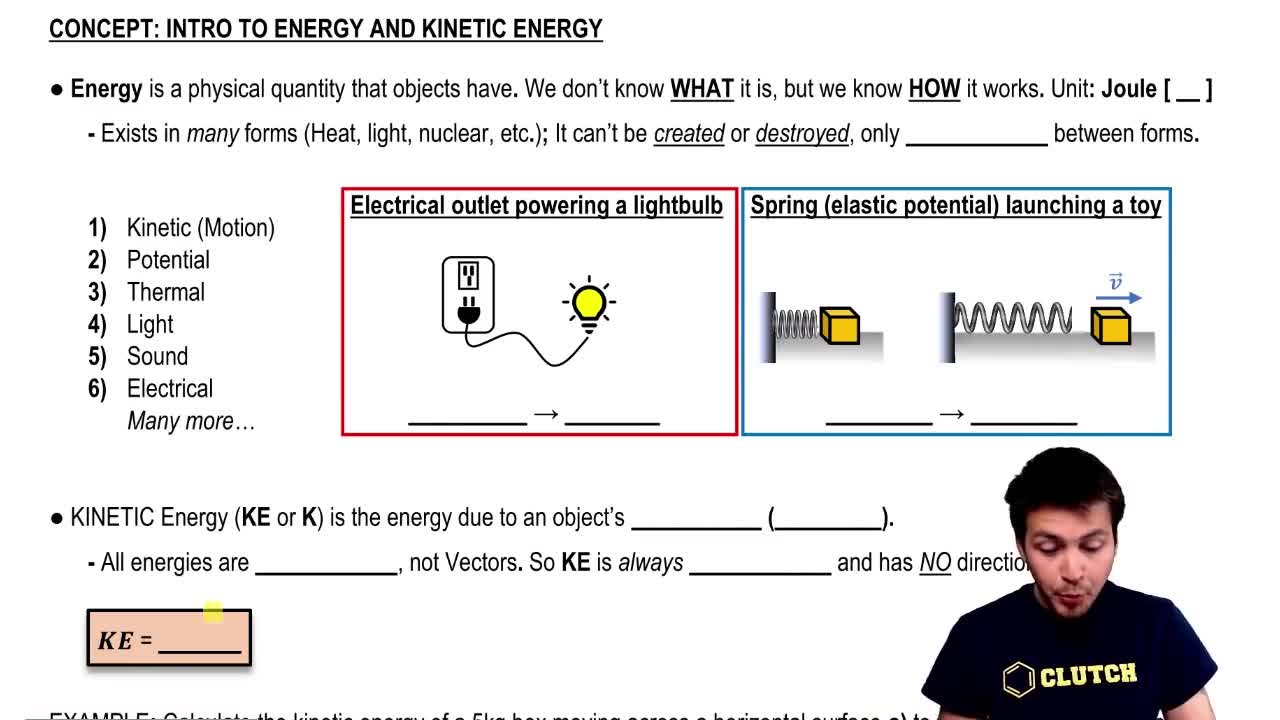
Intro to Energy & Types of Energy

Lorentz Factor

The Lorentz factor, γ, is crucial in relativistic physics, defined as γ = 1/√(1-v²/c²), where v is the velocity of the particle and c is the speed of light. It describes how time, length, and relativistic mass change for an object moving at a significant fraction of the speed of light. It helps determine the kinetic energy and momentum of the proton in this scenario.
추천 영상:
14:16
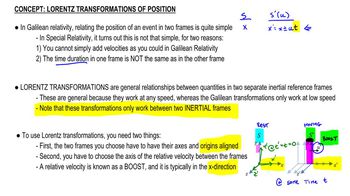
Lorentz Transformations of Position

Relativistic Momentum

Relativistic momentum extends the classical concept of momentum to high-speed particles, calculated as p = γmv, where m is the rest mass, v is the velocity, and γ is the Lorentz factor. This concept is essential for finding the momentum of the proton, as its speed is a significant fraction of the speed of light, requiring adjustments from classical mechanics.
추천 영상:
05:17
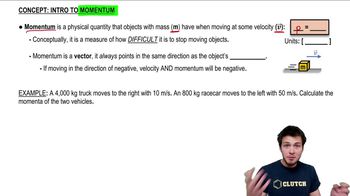
Intro to Momentum
관련 실천
교과서 질문

A particle has rest mass 6.64×10276.64\(\times\)10^{-27} kg and momentum 2.10×10182.10\(\times\)10^{-18} kgm/s.

(a) What is the total energy (kinetic plus rest energy) of the particle?

(b) What is the kinetic energy of the particle?

(c) What is the ratio of the kinetic energy to the rest energy of the particle?

1498
views
1
rank
교과서 질문

A proton has momentum with magnitude p0 when its speed is 0.400c. In terms of p0, what is the magnitude of the proton's momentum when its speed is doubled to 0.800c?

1473
views
교과서 질문

Electrons are accelerated through a potential difference of 750750 kV, so that their kinetic energy is 7.50×1057.50\(\times\)10^5 eV.

(a) What is the ratio of the speed vv of an electron having this energy to the speed of light, cc?

(b) What would the speed be if it were computed from the principles of classical mechanics?

1941
views
교과서 질문

A force is applied to a particle along its direction of motion. At what speed is the magnitude of force required to produce a given acceleration twice as great as the force required to produce the same acceleration when the particle is at rest? Express your answer in terms of the speed of light.

1424
views
교과서 질문

Relativistic Baseball. Calculate the magnitude of the force required to give a 0.145 kg baseball an acceleration a = 1.00 m/s2 in the direction of the baseball's initial velocity when this velocity has a magnitude of (a) 10.0 m/s; (c) 0.990c.

1349
views
교과서 질문

An observer in frame S′ is moving to the right (+x-direction) at speed u = 0.600c away from a stationary observer in frame S. The observer in S′ measures the speed v′ of a particle moving to the right away from her. What speed v does the observer in S measure for the particle if (a) v′ = 0.400c; (b) v′ = 0.900c; (c) v′ = 0.990c?

1479
views