
Ch 37: Special Relativity
Young & Freedman Calc - University Physics 14th Edition
Young & Freedman Calc14th EditionUniversity PhysicsISBN: 9780321973610당신이 사용하는 게 아니라요?교과서 변경
37장, 문제 39a

Compute the kinetic energy of a proton (mass 1.67×10271.67\(\times\)10^{-27} kg) using both the nonrelativistic and relativistic expressions, and compute the ratio of the two results (relativistic divided by nonrelativistic) for speeds of (a) 8.00×1078.00\(\times\)10^7 m/s and (b) 2.85×1082.85\(\times\)10^8 m/s.

검증된 단계별 안내
1
Step 1: Understand the concept of kinetic energy. Kinetic energy is the energy that an object possesses due to its motion. The nonrelativistic kinetic energy (KE) is given by the formula: KE=12mv2, where m is the mass and v is the velocity.
Step 2: Calculate the nonrelativistic kinetic energy for the proton at speed (a) 8.00 * 10^7 m/s. Use the formula: KE=12mv2. Substitute m=1.67×10⁻²⁷ kg and v=8.00×10⁷ m/s.
Step 3: Calculate the relativistic kinetic energy using the formula: KE=mc(2)(1-v2c2-1), where c is the speed of light (3.00×10⁸ m/s). Substitute the values for m and v as in Step 2.
Step 4: Repeat Steps 2 and 3 for speed (b) 2.85 * 10^8 m/s. Substitute v=2.85×10⁸ m/s into both the nonrelativistic and relativistic kinetic energy formulas.
Step 5: Compute the ratio of the relativistic kinetic energy to the nonrelativistic kinetic energy for both speeds (a) and (b). This involves dividing the relativistic result by the nonrelativistic result for each speed.

비슷한 문제에 대한 검증된 영상 답변:

이 영상 해법은 위 문제에 도움이 된다고 튜터들이 추천한 것입니다.
영상 길이:
9m
도움이 되었나요?

주요 개념

질문에 올바르게 답하기 위해 반드시 이해해야 하는 핵심 개념들은 다음과 같습니다.

Kinetic Energy

Kinetic energy is the energy possessed by an object due to its motion, calculated using the formula KE = 0.5 * m * v^2 for nonrelativistic speeds. It is a measure of the work needed to accelerate an object from rest to its current velocity, and is dependent on both mass and velocity.
추천 영상:
가이드 코스
06:07
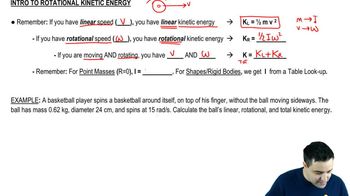
Intro to Rotational Kinetic Energy

Relativistic Kinetic Energy

Relativistic kinetic energy accounts for the effects of special relativity at high speeds, close to the speed of light. It is calculated using the formula KE = (γ - 1) * m * c^2, where γ is the Lorentz factor, m is mass, and c is the speed of light. This formula reflects how energy increases significantly as an object's speed approaches the speed of light.
추천 영상:
가이드 코스
06:07
Intro to Rotational Kinetic Energy

Lorentz Factor

The Lorentz factor, denoted as γ, is a crucial component in relativistic physics, defined as γ = 1 / sqrt(1 - v^2/c^2). It quantifies the amount of time dilation, length contraction, and relativistic mass increase experienced by an object moving at velocity v relative to the speed of light c. It becomes significant when v approaches c, affecting calculations of relativistic kinetic energy.
추천 영상:
가이드 코스
14:16
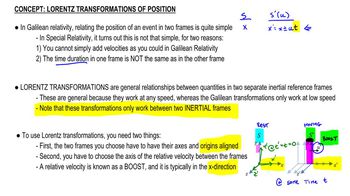
Lorentz Transformations of Position