Ch 39: Particles Behaving as Waves
Young & Freedman Calc - University Physics 14th Edition
Young & Freedman Calc14th EditionUniversity PhysicsISBN: 9780321973610당신이 사용하는 게 아니라요?교과서 변경
39장, 문제 1

(a) An electron moves with a speed of 4.70×1064.70\(\times\)10^6 m/s. What is its de Broglie wavelength?
(b) A proton moves with the same speed. Determine its de Broglie wavelength.

검증된 단계별 안내
1
Step 1: Recall the de Broglie wavelength formula: λ = h / (m * v), where λ is the wavelength, h is Planck's constant (6.626 × 10^-34 J·s), m is the mass of the particle, and v is its velocity.
Step 2: For part (a), substitute the mass of the electron (m_e = 9.11 × 10^-31 kg) and the given velocity (v = 4.70 × 10^6 m/s) into the formula. The expression becomes: λ_e = (6.626 × 10^-34) / ((9.11 × 10^-31) * (4.70 × 10^6)).
Step 3: For part (b), substitute the mass of the proton (m_p = 1.67 × 10^-27 kg) and the same velocity (v = 4.70 × 10^6 m/s) into the formula. The expression becomes: λ_p = (6.626 × 10^-34) / ((1.67 × 10^-27) * (4.70 × 10^6)).
Step 4: Compare the results for the electron and proton. Note that the de Broglie wavelength is inversely proportional to the mass of the particle, so the proton (being much more massive than the electron) will have a significantly smaller wavelength.
Step 5: To find the numerical values of λ_e and λ_p, calculate the denominators and divide Planck's constant by these values. Ensure consistent units throughout the calculation.

비슷한 문제에 대한 검증된 영상 답변:

이 영상 해법은 위 문제에 도움이 된다고 튜터들이 추천한 것입니다.
영상 길이:
4m
도움이 되었나요?

주요 개념

질문에 올바르게 답하기 위해 반드시 이해해야 하는 핵심 개념들은 다음과 같습니다.

de Broglie Wavelength

The de Broglie wavelength is a fundamental concept in quantum mechanics that describes the wave-like behavior of particles. According to de Broglie's hypothesis, every moving particle has an associated wavelength, which can be calculated using the formula λ = h/p, where λ is the wavelength, h is Planck's constant, and p is the momentum of the particle.
추천 영상:
가이드 코스
05:42
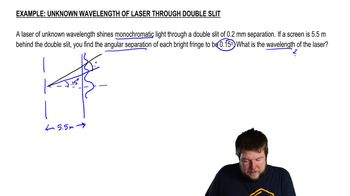
Unknown Wavelength of Laser through Double Slit

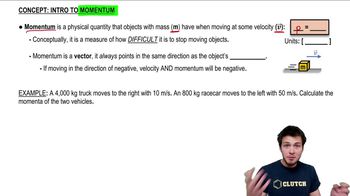
Momentum

Momentum is a vector quantity defined as the product of an object's mass and its velocity (p = mv). In the context of the de Broglie wavelength, momentum is crucial because it directly influences the wavelength of a particle. For an electron and a proton moving at the same speed, their different masses will result in different momenta and, consequently, different de Broglie wavelengths.
추천 영상:
가이드 코스
05:17
Intro to Momentum

Planck's Constant

Planck's constant (h) is a fundamental physical constant that relates the energy of a photon to its frequency. It plays a critical role in quantum mechanics, particularly in the calculation of the de Broglie wavelength. The value of Planck's constant is approximately 6.626 x 10^-34 Js, and it serves as a bridge between the macroscopic and quantum worlds, highlighting the wave-particle duality of matter.
추천 영상:
가이드 코스
08:59
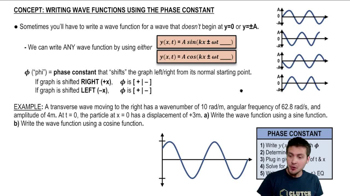
Phase Constant of a Wave Function