Ch 40: Quantum Mechanics I: Wave Functions
Young & Freedman Calc - University Physics 14th Edition
Young & Freedman Calc14th EditionUniversity PhysicsISBN: 9780321973610당신이 사용하는 게 아니라요?교과서 변경
40장, 문제 39

For the ground level of a harmonic oscillator, xpx=ħ/2∆x∆p_x = ħ/2. Do a similar analysis for an excited level that has quantum number nn. How does the uncer­tainty product xpx∆x∆p_x depend on nn?

검증된 단계별 안내
1
Start by recalling the uncertainty principle: \( \Delta x \Delta p_x \geq \frac{\hbar}{2} \). For the ground state of a quantum harmonic oscillator, the uncertainty product \( \Delta x \Delta p_x \) is exactly \( \frac{\hbar}{2} \). For excited states, we need to analyze how the uncertainties in position and momentum change with the quantum number \( n \).
The wavefunctions of a quantum harmonic oscillator are described by Hermite polynomials multiplied by a Gaussian envelope. The quantum number \( n \) determines the energy level \( E_n = \left(n + \frac{1}{2}\right) \hbar \omega \), where \( \omega \) is the angular frequency of the oscillator. As \( n \) increases, the wavefunction spreads out, leading to larger uncertainties in position \( \Delta x \).
The position uncertainty \( \Delta x \) can be estimated from the spatial extent of the wavefunction. For higher \( n \), the wavefunction's spread increases approximately as \( \sqrt{n} \), so \( \Delta x \propto \sqrt{n} \).
The momentum uncertainty \( \Delta p_x \) is related to the position uncertainty by the oscillator's energy. Since \( E_n = \frac{1}{2} m \omega^2 (\Delta x)^2 + \frac{1}{2} \frac{(\Delta p_x)^2}{m} \), and \( E_n \propto n \), it follows that \( \Delta p_x \propto \sqrt{n} \) as well.
Combining the dependencies of \( \Delta x \) and \( \Delta p_x \) on \( n \), the uncertainty product becomes \( \Delta x \Delta p_x \propto n \). Thus, the uncertainty product increases linearly with the quantum number \( n \).

비슷한 문제에 대한 검증된 영상 답변:

이 영상 해법은 위 문제에 도움이 된다고 튜터들이 추천한 것입니다.
영상 길이:
6m
도움이 되었나요?

주요 개념

질문에 올바르게 답하기 위해 반드시 이해해야 하는 핵심 개념들은 다음과 같습니다.

Harmonic Oscillator

A harmonic oscillator is a system that experiences a restoring force proportional to the displacement from its equilibrium position. In quantum mechanics, it is described by quantized energy levels, where the ground state corresponds to the lowest energy level. The behavior of a harmonic oscillator is fundamental in understanding various physical systems, including molecular vibrations and quantum fields.
추천 영상:
가이드 코스
07:52
Simple Harmonic Motion of Pendulums

Heisenberg Uncertainty Principle

The Heisenberg Uncertainty Principle states that certain pairs of physical properties, like position (∆x) and momentum (∆p_x), cannot be simultaneously measured with arbitrary precision. Specifically, the product of the uncertainties in these measurements is bounded by ħ/2, where ħ is the reduced Planck's constant. This principle highlights the intrinsic limitations of measurement in quantum mechanics and is crucial for understanding the behavior of quantum systems.
추천 영상:
가이드 코스
14:47
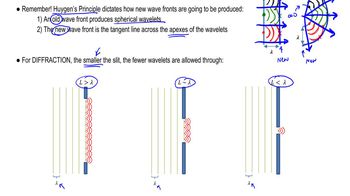
Diffraction with Huygen's Principle

Quantum Number n

The quantum number n is a non-negative integer that quantizes the energy levels of a quantum system, such as a harmonic oscillator. Each value of n corresponds to a specific energy level, with higher values indicating higher energy states. The dependence of the uncertainty product ∆x∆p_x on n reflects how the spatial and momentum uncertainties change as the system transitions between different energy levels, illustrating the wave-particle duality of quantum mechanics.
추천 영상:
가이드 코스
07:19
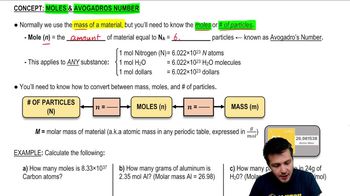
Moles & Avogadro's Number
관련 실천
교과서 질문

An electron with initial kinetic energy 6.06.0 eV encounters a barrier with height 11.011.0 eV. What is the probability of tunneling if the width of the barrier is (a) 0.800.80 nm and (b) 0.40 0.40 nm?

45
views
교과서 질문

An electron is in a box of width 3.0*10^-10 m. What are the de Broglie wavelength and the magnitude of the momentum of the electron if it is in (a) the n = 1 level; (b) the n = 2 level; (c) the n = 3 level? In each case how does the wavelength compare to the width of the box?

47
views
교과서 질문

A free particle moving in one dimension has wave function ψ(x,t) = A[e^i(kx-ωt) -e^i(2kx-4ωt)] where k and v are positive real constants. (c) Calculate v_av as the distance the maxima have moved divided by the elapsed time.

65
views
교과서 질문

An electron with initial kinetic energy 5.05.0 eV encoun­ters a barrier with height U0U_0 and width 0.600.60 nm. What is the transmission coefficient if (a) U0=7.0U_0 = 7.0 eV; (b) U0=9.0U_0 = 9.0 eV; (c) U0=13.0U_0 = 13.0 eV?

49
views
교과서 질문

While undergoing a transition from the n=1n = 1 to the n=2n = 2 energy level, a harmonic oscillator absorbs a photon of wavelength 6.506.50 μμm. What is the wavelength of the absorbed photon when this oscillator undergoes a transition (a) from the n=2n = 2 to the n=3n = 3 energy level and (b) from the n=1n = 1 to the n=3n =3 energy level?

(c) What is the value of (k/m)\(\sqrt{(k^{\prime}\)/m)}, the angular oscillation frequency of the corresponding Newtonian oscillator?

55
views