
Ch 40: Quantum Mechanics I: Wave Functions
Young & Freedman Calc - University Physics 14th Edition
Young & Freedman Calc14th EditionUniversity PhysicsISBN: 9780321973610당신이 사용하는 게 아니라요?교과서 변경
40장, 문제 16

Recall that (ψ2)dx(|ψ|^2)dx is the probability of finding the par­ticle that has normalized wave function ψ(x)ψ(x) in the interval xx to x+dxx+dx. Consider a particle in a box with rigid walls at x=0x = 0 and x=Lx = L. Let the particle be in the ground level and use ψnψ_n as given in Eq. (40.3540.35) ψn(x)=2Lsin[(nπxL)]\(\psi\)_{n}(x)=\(\sqrt{\frac{2}{L}\)}sin[(\(\frac{n\pi x}{L}\))] where n=1,2,3,n=1,2,3,\(\ldots\).
(a) For which values of xx, if any, in the range from 00 to LL is the probability of finding the particle zero?
(b) For which values of xx is the probability highest?
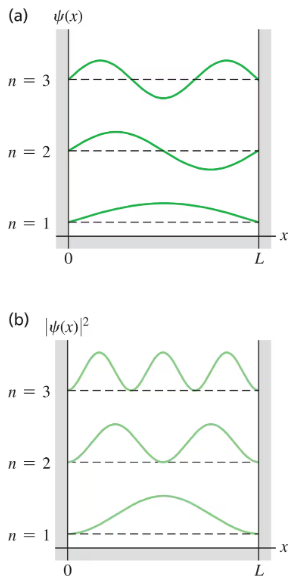
(c) In parts (a) and (b) are your answers consistent with Fig. 40.1240.12? Explain.
Graphs showing wave functions and their probabilities for a particle in a box, labeled by quantum number n.

검증된 단계별 안내
1
Step 1: Understand the problem and the given wave function. The wave function ψ_n(x) = √(2/L) sin⁡[(nπx/L)] describes the quantum state of a particle in a box with rigid walls at x = 0 and x = L. The probability density is given by |ψ(x)|², and the probability of finding the particle in a small interval dx is |ψ(x)|² dx.
Step 2: Analyze part (a). To find where the probability of finding the particle is zero, we need to determine where the wave function ψ_n(x) is zero. Since ψ_n(x) = √(2/L) sin⁡[(nπx/L)], the sine function is zero when its argument is an integer multiple of π. Solve sin⁡[(nπx/L)] = 0 for x in the range 0 ≤ x ≤ L.
Step 3: Analyze part (b). To find where the probability is highest, we need to determine where |ψ_n(x)|² is maximized. Since |ψ_n(x)|² is proportional to sin²[(nπx/L)], the sine squared function is maximized when sin[(nπx/L)] = ±1. Solve for x in the range 0 ≤ x ≤ L where this condition is met.
Step 4: Address part (c). Compare the results from parts (a) and (b) with the graphical representation of the wave function in Fig. 40.12. Check if the nodes (where ψ_n(x) = 0) and antinodes (where |ψ_n(x)|² is maximum) match the expected behavior of the ground state wave function (n = 1).
Step 5: Summarize the findings. For part (a), the probability is zero at the nodes of the wave function, which occur at specific x values. For part (b), the probability is highest at the antinode, which is the midpoint of the box for the ground state (n = 1). Confirm that these results align with the physical interpretation and Fig. 40.12.

비슷한 문제에 대한 검증된 영상 답변:

이 영상 해법은 위 문제에 도움이 된다고 튜터들이 추천한 것입니다.
도움이 되었나요?

주요 개념

질문에 올바르게 답하기 위해 반드시 이해해야 하는 핵심 개념들은 다음과 같습니다.

Wave Function and Probability Density

The wave function, denoted as ψ(x), describes the quantum state of a particle. The square of its absolute value, |ψ(x)|², represents the probability density of finding the particle at a specific position x. In a one-dimensional box, this probability density is crucial for determining where the particle is likely to be located within the confines of the box.
추천 영상:
가이드 코스
08:30
Intro to Wave Functions

Boundary Conditions in Quantum Mechanics

In quantum mechanics, boundary conditions define the behavior of a wave function at the edges of a system. For a particle in a box with rigid walls, the wave function must be zero at the boundaries (x = 0 and x = L). This condition leads to quantized energy levels and specific forms of the wave function, which are essential for solving problems related to confined particles.
추천 영상:
가이드 코스
06:24
Conservation Of Mechanical Energy

Nodes and Antinodes in Standing Waves

In the context of a particle in a box, the wave function can be visualized as a standing wave. Nodes are points where the wave function is zero, indicating zero probability of finding the particle, while antinodes are points of maximum amplitude, corresponding to the highest probability. Understanding the distribution of nodes and antinodes helps in identifying where the particle is most likely to be found within the box.
추천 영상:
가이드 코스
05:17
Standing Sound Waves
관련 실천
교과서 질문

When a hydrogen atom undergoes a transition from the n=2n = 2 to the n=1n = 1 level, a photon with λ=122λ=122 nm is emitted.

(a) If the atom is modeled as an electron in a one-­dimensional box, what is the width of the box in order for the n=2n = 2 to n=1n = 1 transi­tion to correspond to emission of a photon of this energy?

(b) For a box with the width calculated in part (a), what is the ground­ state energy? How does this correspond to the ground ­state energy of a hydrogen atom?

(c) Do you think a one­-dimensional box is a good model for a hydrogen atom? Explain. (Hint: Compare the spacing between adjacent energy levels as a function of nn.)

40
views
교과서 질문

(a) An electron with initial kinetic energy 3232 eV encoun­ters a square barrier with height 4141 eV and width 0.250.25 nm. What is the probability that the electron will tunnel through the barrier?

(b) A proton with the same kinetic energy encounters the same barrier. What is the probability that the proton will tunnel through the barrier?

36
views
교과서 질문

A proton is in a box of width LL. What must the width of the box be for the ground­-level energy to be 5.05.0 MeV, a typi­cal value for the energy with which the particles in a nucleus are bound? Compare your result to the size of a nucleus — that is, on the order of 101410^{-14} m.

39
views
교과서 질문

(a) Find the excitation energy from the ground level to the third excited level for an electron confined to a box of width 0.3600.360 nm.

(b) The electron makes a transition from the n=1n = 1 to n=4n = 4 level by absorbing a photon. Calculate the wave­length of this photon.

80
views
교과서 질문

An electron in a one­-dimensional box has ground ­state energy 2.002.00 eV. What is the wavelength of the photon absorbed when the electron makes a transition to the second excited state?

162
views
교과서 질문

An electron is in a box of width 3.0×10103.0\(\times\)10^{-10} m. What are the de Broglie wavelength and the magnitude of the momentum of the electron if it is in (a) the n=1n = 1 level; (b) the n=2n = 2 level; (c) the n=3n = 3 level? In each case how does the wavelength compare to the width of the box?

42
views