Ch 42: Molecules and Condensed Matter
Young & Freedman Calc - University Physics 14th Edition
Young & Freedman Calc14th EditionUniversity PhysicsISBN: 9780321973610당신이 사용하는 게 아니라요?교과서 변경
42장, 문제 9c

The rotational energy levels of CO are calculated in Example 42.242.2. If the energy of the rotating molecule is described by the classical expression K=(12)Iω2K=(\(\frac\)12)I\(\omega\)^2, for the l=1 l = 1 level, what is the rotational period (the time for one rotation)?

검증된 단계별 안내
1
Step 1: Understand the relationship between rotational energy and angular velocity. The classical expression for rotational kinetic energy is given as: K = 122, where K is the rotational kinetic energy, I is the moment of inertia, and ω is the angular velocity.
Step 2: Use the quantum mechanical energy levels for rotation. For the rotational level l = 1, the energy is given by E = h8π2l2, where h is Planck's constant, l is the quantum number, and I is the moment of inertia.
Step 3: Equate the classical rotational energy expression to the quantum mechanical energy for l = 1. This allows you to solve for the angular velocity ω.
Step 4: Once you have the angular velocity ω, calculate the rotational period using the relationship T = 2πω, where T is the rotational period.
Step 5: Substitute the values for the moment of inertia I, Planck's constant h, and other constants into the equations to compute the rotational period. Ensure all units are consistent during substitution.

비슷한 문제에 대한 검증된 영상 답변:

이 영상 해법은 위 문제에 도움이 된다고 튜터들이 추천한 것입니다.
도움이 되었나요?

주요 개념

질문에 올바르게 답하기 위해 반드시 이해해야 하는 핵심 개념들은 다음과 같습니다.

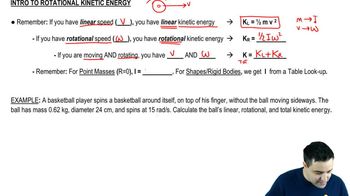
Rotational Kinetic Energy

Rotational kinetic energy is the energy possessed by an object due to its rotation. It is given by the formula K = (1/2)Iω², where K is the rotational kinetic energy, I is the moment of inertia, and ω is the angular velocity. This concept is crucial for understanding how energy is distributed in rotating systems, such as molecules.
추천 영상:
가이드 코스
06:07
Intro to Rotational Kinetic Energy

Moment of Inertia

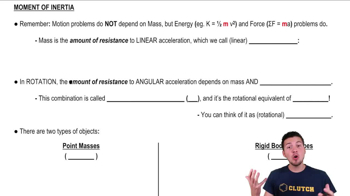
The moment of inertia (I) is a measure of an object's resistance to changes in its rotation about an axis. It depends on the mass distribution relative to the axis of rotation. For a diatomic molecule like CO, the moment of inertia can be calculated based on the masses of the atoms and the distance between them, influencing the rotational energy levels.
추천 영상:
가이드 코스
11:47
Intro to Moment of Inertia

Angular Velocity

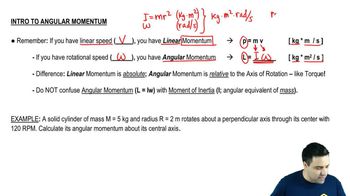
Angular velocity (ω) is a vector quantity that represents the rate of rotation of an object around an axis. It is measured in radians per second and is essential for calculating rotational kinetic energy. In the context of molecular rotation, angular velocity helps determine how quickly a molecule rotates, which is directly related to its energy levels and rotational period.
추천 영상:
가이드 코스
06:18
Intro to Angular Momentum
관련 실천
교과서 질문

The rotational energy levels of CO are calculated in Example 42.242.2. If the energy of the rotating molecule is described by the classical expression K=(12)Iω2K=(\(\frac\)12)I\(\omega\)^2, for the l=1 l = 1 level, what is the angular speed of the rotating molecule?

1385
views

교과서 질문

The rotational energy levels of CO are calculated in Example 42.242.2. If the energy of the rotating molecule is described by the classical expression K=(12)Iω2K=(\(\frac\)12)I\(\omega\)^2, for the l=1 l = 1 level, what is the linear speed of each atom?

1451
views
교과서 질문

The average kinetic energy of an ideal-gas atom or molecule is (32)kT\(\left\)(\(\frac\)32\(\right\))kT, where TT is the Kelvin temperature (Chapter 1818). The rotational inertia of the H2 molecule is 4.6×10484.6\(\times\)10^{-48} kg-m2. What is the value of TT for which (32)kT\(\left\)(\(\frac\)32\(\right\))kT equals the energy separation between the l=0l = 0 and l=1l = 1 energy levels of H2? What does this tell you about the number of H2 molecules in the l=1l = 1 level at room temperature?

1896
views
교과서 질문

Two atoms of cesium (Cs) can form a Cs2Cs_2 molecule. The equilibrium distance between the nuclei in a Cs2Cs_2 molecule is 0.447 0.447 nm. Calculate the moment of inertia about an axis through the center of mass of the two nuclei and perpendicular to the line joining them. The mass of a cesium atom is 2.21×10252.21\(\times\)10^{-25} kg.

1171
views
교과서 질문

The maximum wavelength of light that a certain silicon photocell can detect is 1.111.11 mm. What is the energy gap (in electron volts) between the valence and conduction bands for this photocell?

1503
views
교과서 질문

Potassium bromide (KBr) has a density of 2.75×1032.75\(\times\)10^3 kg/m3 and the same crystal structure as NaCl. The mass of a potassium atom is 6.49×10266.49\(\times\)10^{-26} kg, and the mass of a bromine atom is 1.33×10251.33\(\times\)10^{-25} kg. Calculate the average spacing between adjacent atoms in a KBr crystal.

312
views