
Ch 42: Molecules and Condensed Matter
Young & Freedman Calc - University Physics 14th Edition
Young & Freedman Calc14th EditionUniversity PhysicsISBN: 9780321973610당신이 사용하는 게 아니라요?교과서 변경
42장, 문제 3

For the H2 molecule the equilibrium spacing of the two protons is 0.0740.074 nm. The mass of a hydrogen atom is 1.67×10271.67\(\times\)10^{-27} kg. Calculate the wavelength of the photon emitted in the rotational transition l=2 l = 2 to l=1l = 1.

검증된 단계별 안내
1
Step 1: Understand the problem. The question involves calculating the wavelength of a photon emitted during a rotational transition in a hydrogen molecule (H₂). This requires using the energy difference between rotational levels and the relationship between energy and wavelength.
Step 2: Recall the formula for the energy of rotational levels in a diatomic molecule: \( E_l = \frac{l(l+1)h^2}{8\pi^2I} \), where \( l \) is the rotational quantum number, \( h \) is Planck's constant, and \( I \) is the moment of inertia of the molecule. The moment of inertia is given by \( I = \mu r^2 \), where \( \mu \) is the reduced mass and \( r \) is the equilibrium spacing.
Step 3: Calculate the reduced mass \( \mu \) of the H₂ molecule using \( \mu = \frac{m_1 m_2}{m_1 + m_2} \). Since both atoms are hydrogen, \( m_1 = m_2 = 1.67 \times 10^{-27} \, \text{kg} \). Substitute these values into the formula.
Step 4: Substitute the reduced mass \( \mu \) and the equilibrium spacing \( r = 0.074 \times 10^{-9} \, \text{m} \) into the formula for the moment of inertia \( I = \mu r^2 \). Compute \( I \).
Step 5: Use the energy formula \( E_l \) to calculate the energy difference \( \Delta E = E_2 - E_1 \) between the rotational levels \( l = 2 \) and \( l = 1 \). Then, use the relationship \( \lambda = \frac{hc}{\Delta E} \) to express the wavelength \( \lambda \) of the emitted photon, where \( c \) is the speed of light.

비슷한 문제에 대한 검증된 영상 답변:

이 영상 해법은 위 문제에 도움이 된다고 튜터들이 추천한 것입니다.
영상 길이:
9m
도움이 되었나요?

주요 개념

질문에 올바르게 답하기 위해 반드시 이해해야 하는 핵심 개념들은 다음과 같습니다.

Rotational Transitions

Rotational transitions refer to changes in the rotational energy levels of a molecule. In quantum mechanics, molecules can occupy discrete rotational states, characterized by quantum numbers. The transition from one state to another, such as from l = 2 to l = 1, involves the emission or absorption of a photon, with energy corresponding to the difference in rotational energy levels.
추천 영상:
가이드 코스
14:03
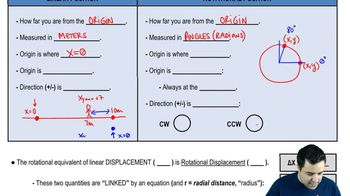
Rotational Position & Displacement

Energy of a Photon

The energy of a photon is given by the equation E = hν, where E is energy, h is Planck's constant (6.626 x 10^-34 J·s), and ν (nu) is the frequency of the photon. This relationship shows that the energy of the emitted photon during a transition is directly related to the frequency of the light, which can also be expressed in terms of wavelength using the equation c = λν, where c is the speed of light and λ (lambda) is the wavelength.
추천 영상:
가이드 코스
04:10
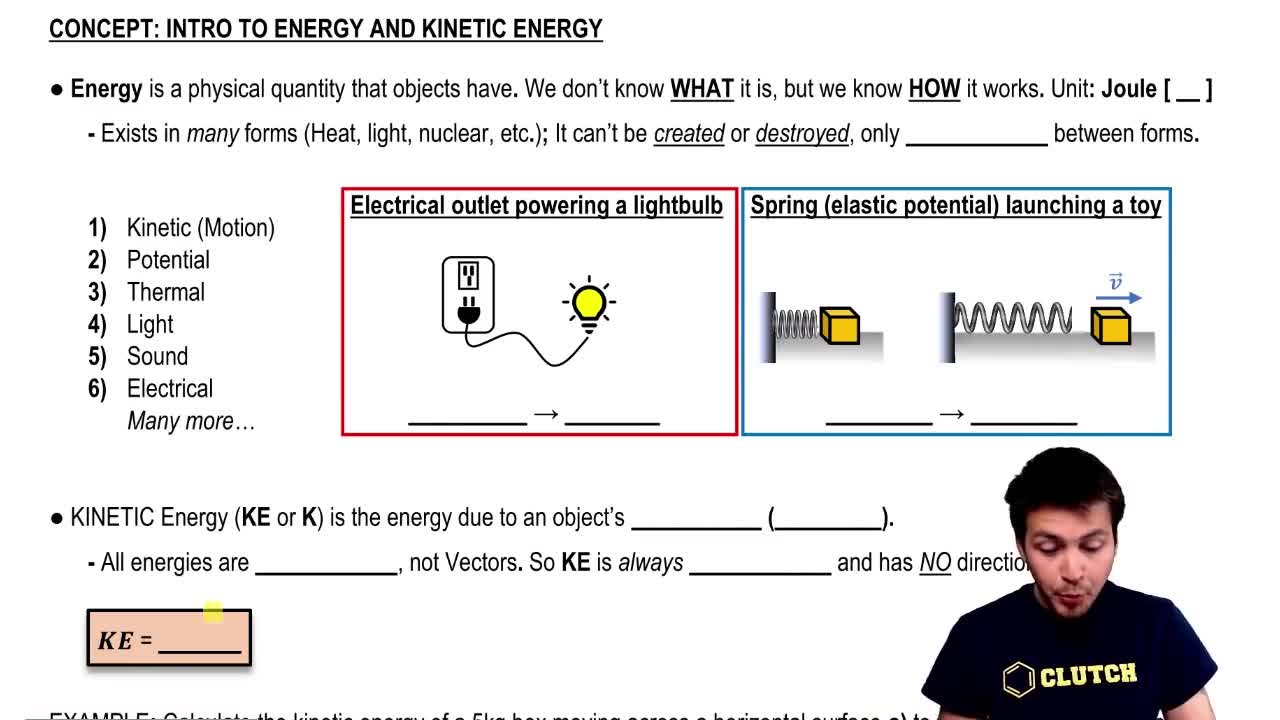
Intro to Energy & Types of Energy

Moment of Inertia

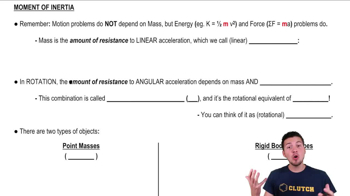
The moment of inertia is a measure of an object's resistance to changes in its rotational motion. For diatomic molecules like H2, the moment of inertia can be calculated using the formula I = μr², where μ is the reduced mass of the two atoms and r is the equilibrium bond length. This value is crucial for determining the rotational energy levels and, consequently, the energy of the emitted photon during transitions.
추천 영상:
가이드 코스
11:47
Intro to Moment of Inertia