
Ch 26: Direct-Current Circuits
Young & Freedman Calc - University Physics 15th Edition
Young & Freedman Calc15th EditionUniversity PhysicsISBN: 9780135159552당신이 사용하는 게 아니라요?교과서 변경
26장, 문제 21b

Light Bulbs in Series and in Parallel. Two light bulbs have constant resistances of 400Ω and 800Ω. If the two light bulbs are connected in series across a 120 V line, find the power dissipated in each bulb.

검증된 단계별 안내
1
First, understand that when resistors (or light bulbs in this case) are connected in series, the total resistance is the sum of the individual resistances. Use the formula: Rtotal=R1+R2.
Calculate the total resistance in the series circuit using the given resistances: Rtotal=400Ω+800Ω.
Next, use Ohm's Law to find the current flowing through the circuit. Ohm's Law states: I=VRtotal, where V is the voltage across the circuit.
Once you have the current, calculate the power dissipated in each bulb using the formula for power: P=I2R. Apply this formula separately for each bulb using their respective resistances.
Finally, substitute the values of current and resistance for each bulb into the power formula to find the power dissipated in the 400Ω bulb and the 800Ω bulb.

비슷한 문제에 대한 검증된 영상 답변:

이 영상 해법은 위 문제에 도움이 된다고 튜터들이 추천한 것입니다.
영상 길이:
5m
도움이 되었나요?

주요 개념

질문에 올바르게 답하기 위해 반드시 이해해야 하는 핵심 개념들은 다음과 같습니다.

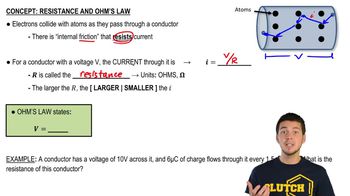
Ohm's Law

Ohm's Law states that the current through a conductor between two points is directly proportional to the voltage across the two points, given by the formula I = V/R, where I is the current, V is the voltage, and R is the resistance. This principle is essential for calculating the current flowing through the bulbs when connected in series.
추천 영상:
가이드 코스
03:07
Resistance and Ohm's Law

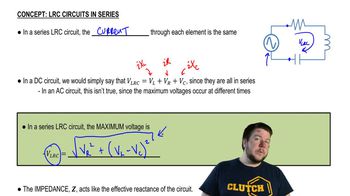
Series Circuit

In a series circuit, components are connected end-to-end, so the same current flows through each component. The total resistance is the sum of individual resistances, R_total = R1 + R2. Understanding series circuits is crucial for determining the total resistance and current in the circuit with the two light bulbs.
추천 영상:
가이드 코스
05:55
LRC Circuits in Series

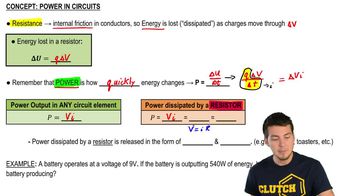
Power Dissipation

Power dissipation in an electrical component is the rate at which it converts electrical energy into heat and light, calculated using P = I^2R or P = VI. For each bulb, knowing the current and resistance allows us to find the power dissipated, which is essential for understanding how much energy each bulb uses.
추천 영상:
가이드 코스
06:18
Power in Circuits
관련 실천
교과서 질문

Power Rating of a Resistor. The power rating of a resistor is the maximum power the resistor can safely dissipate without too great a rise in temperature and hence damage to the resistor. A 100.0 Ω and a 150.0 Ω resistor, both rated at 2.00 W, are connected in series across a variable potential difference. What is the greatest this potential difference can be without overheating either resistor, and what is the rate of heat generated in each resistor under these conditions?

3130
views
교과서 질문

Light Bulbs in Series and in Parallel. Two light bulbs have constant resistances of 400Ω and 800Ω. The two light bulbs are now connected in parallel across the 120 V line. Find the power dissipated in each bulb.

1403
views
1
rank
교과서 질문

Light Bulbs in Series and in Parallel. Two light bulbs have constant resistances of 400Ω and 800Ω. If the two light bulbs are connected in series across a 120 V line, find the total power dissipated in both bulbs.

1516
views
1
rank
교과서 질문

Light Bulbs in Series and in Parallel. Two light bulbs have constant resistances of 400Ω and 800Ω. The two light bulbs are now connected in parallel across the 120 V line. Find the current through each bulb.

1870
views
2
rank
교과서 질문

Power Rating of a Resistor. The power rating of a resistor is the maximum power the resistor can safely dissipate without too great a rise in temperature and hence damage to the resistor. A 9.0 kΩ resistor is to be connected across a 120 V potential difference. What power rating is required?

1659
views
교과서 질문

Light Bulbs in Series and in Parallel. Two light bulbs have constant resistances of 400Ω and 800Ω. If the two light bulbs are connected in series across a 120-V line, find the current through each bulb.

1936
views
1
rank