Two speakers, emitting identical sound waves of wavelength 2.0 m in phase with each other, and an observer are located as shown in Fig. E35.5. At the observer's location, what is the path difference for waves from the two speakers?
Ch 35: Interference
34장, 문제 2a
Two radio antennas A and B radiate in phase. Antenna B is 120 m to the right of antenna A. Consider point Q along the extension of the line connecting the antennas, a horizontal distance of 40 m to the right of antenna B. The frequency, and hence the wavelength, of the emitted waves can be varied. What is the longest wavelength for which there will be destructive interference at point Q?
검증된 단계별 안내1
Identify the positions of the antennas and point Q on a coordinate line: let antenna A be at position 0 m, antenna B at 120 m, and point Q at 160 m (since it is 40 m to the right of B).
Calculate the distances from each antenna to point Q: the distance from A to Q is \(d_A = 160\) m, and from B to Q is \(d_B = 40\) m.
Determine the path difference \(\Delta d\) between the waves arriving at Q from antennas A and B: \(\Delta d = |d_A - d_B| = |160 - 40| = 120\) m.
Recall that for destructive interference between two in-phase sources, the path difference must satisfy the condition \(\Delta d = (m + \frac{1}{2}) \lambda\), where \(m\) is an integer (0, 1, 2, ...) and \(\lambda\) is the wavelength.
To find the longest wavelength causing destructive interference, set \(m = 0\) and solve for \(\lambda\): \(\lambda = 2 \Delta d\). This gives the fundamental wavelength for destructive interference at point Q.

비슷한 문제에 대한 검증된 영상 답변:
이 영상 해법은 위 문제에 도움이 된다고 튜터들이 추천한 것입니다.
영상 길이:
8m도움이 되었나요?
주요 개념
질문에 올바르게 답하기 위해 반드시 이해해야 하는 핵심 개념들은 다음과 같습니다.
Interference of Waves
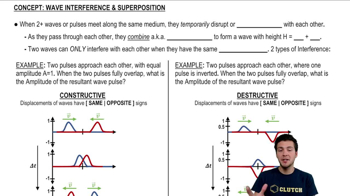
Interference occurs when two or more waves overlap, resulting in a new wave pattern. Constructive interference happens when waves are in phase, amplifying the signal, while destructive interference occurs when waves are out of phase by half a wavelength, canceling each other out. Understanding interference is key to analyzing the combined effect of waves from antennas at a point.
추천 영상:
가이드 코스
Wave Interference & Superposition
Path Difference and Phase Difference
The path difference is the difference in distance traveled by waves from two sources to a point. This difference determines the phase difference between the waves at that point. For destructive interference, the path difference must be an odd multiple of half wavelengths, causing the waves to arrive out of phase and cancel.
추천 영상:
가이드 코스
Mean Free Path
Relationship Between Wavelength, Frequency, and Speed
Wavelength (λ), frequency (f), and wave speed (v) are related by v = fλ. For electromagnetic waves like radio waves, the speed is constant (speed of light). Varying the frequency changes the wavelength, which affects interference patterns. Finding the longest wavelength for destructive interference involves using this relationship along with path difference conditions.
추천 영상:
가이드 코스
Relationships Between Force, Field, Energy, Potential
관련 실천
교과서 질문
4449
views
1
rank
교과서 질문
Coherent light with wavelength 450 nm falls on a pair of slits. On a screen 1.80 m away, the distance between dark fringes is 3.90 mm. What is the slit separation?
2223
views
교과서 질문
Two radio antennas A and B radiate in phase. Antenna B is 120 m to the right of antenna A. Consider point Q along the extension of the line connecting the antennas, a horizontal distance of 40 m to the right of antenna B. The frequency, and hence the wavelength, of the emitted waves can be varied. What is the longest wavelength for which there will be constructive interference at point Q?
1740
views
1
rank
