Ch 35: Interference
Young & Freedman Calc - University Physics 15th Edition
Young & Freedman Calc15th EditionUniversity PhysicsISBN: 9780135159552당신이 사용하는 게 아니라요?교과서 변경
34장, 문제 2b

Two radio antennas A and B radiate in phase. Antenna B is 120 m to the right of antenna A. Consider point Q along the extension of the line connecting the antennas, a horizontal distance of 40 m to the right of antenna B. The frequency, and hence the wavelength, of the emitted waves can be varied. What is the longest wavelength for which there will be constructive interference at point Q?

검증된 단계별 안내
1
Determine the condition for constructive interference: Constructive interference occurs when the path difference between the waves from the two antennas is an integer multiple of the wavelength, i.e., \( \Delta d = m \lambda \), where \( m \) is an integer (0, 1, 2, ...).
Calculate the path difference \( \Delta d \): The distance from antenna A to point Q is \( 120 + 40 = 160 \ \text{m} \), and the distance from antenna B to point Q is \( 40 \ \text{m} \). Thus, the path difference is \( \Delta d = 160 - 40 = 120 \ \text{m} \).
Set the path difference equal to an integer multiple of the wavelength: For constructive interference, \( \Delta d = m \lambda \). Substituting \( \Delta d = 120 \ \text{m} \), we get \( 120 = m \lambda \).
Find the longest wavelength: The longest wavelength corresponds to the smallest integer value of \( m \), which is \( m = 1 \). Substituting \( m = 1 \) into \( 120 = m \lambda \), we find \( \lambda = 120 \ \text{m} \).
Conclude the result: The longest wavelength for which there will be constructive interference at point Q is \( \lambda = 120 \ \text{m} \).

비슷한 문제에 대한 검증된 영상 답변:

이 영상 해법은 위 문제에 도움이 된다고 튜터들이 추천한 것입니다.
영상 길이:
8m
도움이 되었나요?

주요 개념

질문에 올바르게 답하기 위해 반드시 이해해야 하는 핵심 개념들은 다음과 같습니다.

Constructive Interference

Constructive interference occurs when two or more waves meet in phase, meaning their peaks and troughs align. This alignment results in a wave of greater amplitude, enhancing the overall signal. For constructive interference to happen, the path difference between the waves arriving at a point must be an integer multiple of the wavelength.
추천 영상:
가이드 코스
03:47
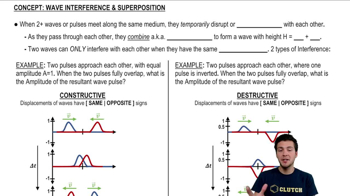
Wave Interference & Superposition

Path Difference

Path difference refers to the difference in distance traveled by two waves from their sources to a specific point. In the context of interference, it is crucial to determine whether this difference leads to constructive or destructive interference. For constructive interference, the path difference must equal nλ, where n is an integer and λ is the wavelength.
추천 영상:

Wavelength

Wavelength is the distance between successive peaks (or troughs) of a wave, typically denoted by the symbol λ. It is inversely related to frequency; as frequency increases, wavelength decreases. In the context of radio waves, varying the wavelength affects the conditions for interference, including the longest wavelength that allows for constructive interference at a given point.
추천 영상:
가이드 코스
05:42
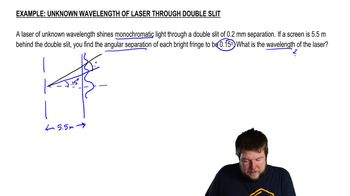
Unknown Wavelength of Laser through Double Slit