 뒤로
뒤로Chapter 6.1: Angles, Arc Length, and Circular Motion – Precalculus Study Notes
스터디 가이드 - 스마트 노트
 자료에 맞춘 맞춤형 노트, 핵심 정의, 예시, 맥락을 확장해 제공합니다.
Trigonometric Functions
Angles, Arc Length, and Circular Motion
This section introduces the foundational concepts of angles, their measurement, and their applications in circular motion. Understanding these concepts is essential for further study in trigonometry and its applications in science and engineering.
Angles and Their Measurement
Definition of an Angle
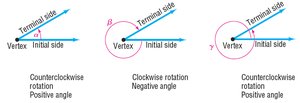
An angle is formed by two rays sharing a common endpoint called the vertex. The ray from which the angle begins is the initial side, and the ray where the angle ends is the terminal side. The direction of rotation determines the sign of the angle:
Counterclockwise rotation: Positive angle
Clockwise rotation: Negative angle
Standard Position of an Angle
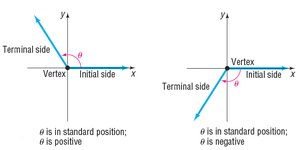
An angle is in standard position if its vertex is at the origin of a rectangular coordinate system and its initial side lies along the positive x-axis. The terminal side determines the quadrant or axis in which the angle lies.
Quadrantal Angles and Quadrants
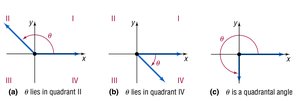
If the terminal side of an angle in standard position lies on the x-axis or y-axis, the angle is called a quadrantal angle. Otherwise, the angle lies in one of the four quadrants.
Degree Measure
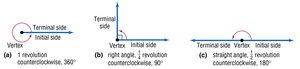
The degree is a common unit for measuring angles. Important reference angles include:
One full revolution: 360°
Right angle: 90° (one-quarter revolution)
Straight angle: 180° (half revolution)
Degree, Minute, Second Notation
Angles can also be measured in degrees, minutes, and seconds (DMS):
1 degree (°) = 60 minutes (')
1 minute (') = 60 seconds (")
To convert between decimal degrees and DMS:
Multiply the decimal part by 60 to get minutes.
Multiply the decimal part of the minutes by 60 to get seconds.
Example: Convert 32.479° to DMS.
32°
0.479 × 60 = 28.74 → 28'
0.74 × 60 ≈ 44"
Result: 32° 28' 44"
Radian Measure
Definition of a Radian
A radian is the measure of a central angle that subtends an arc equal in length to the radius of the circle. Radians are the standard unit of angular measure in mathematics.
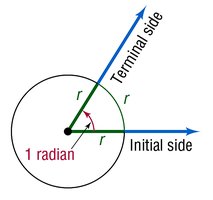
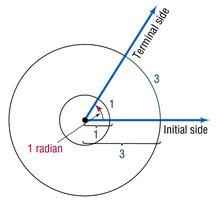
Relationship Between Degrees and Radians
The relationship between degrees and radians is given by:
To convert degrees to radians:
To convert radians to degrees:
Arc Length
Arc Length Formula
The length s of an arc of a circle of radius r subtended by a central angle (in radians) is:
Example: Find the length of the arc of a circle of radius 4 meters subtended by a central angle of 0.75 radians.
meters
Applications: Field Width and Circular Motion
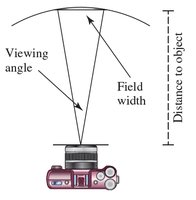
Field Width of a Camera Lens
For small angles, the arc length subtended by a central angle approximates the field width of a camera lens. If the viewing angle is (in radians) and the distance to the object is , then the field width is .
Area of a Sector
Sector Area Formula
The area A of a sector of a circle of radius r formed by a central angle (in radians) is:
Example: Find the area of a sector of a circle of radius 3 meters formed by an angle of 45°.
Convert 45° to radians: radians
square meters
Linear and Angular Speed
Linear Speed
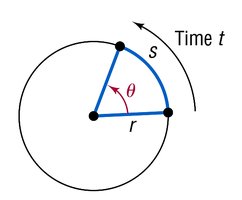
The linear speed of an object moving along a circle of radius is the distance traveled per unit time:
Angular Speed
The angular speed is the angle (in radians) swept out per unit time:
Linear and angular speed are related by:
Example: Finding Linear Speed
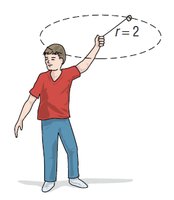
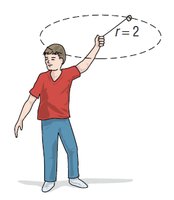
A child spins a rock at the end of a 2-foot rope at 180 revolutions per minute. The radius is 2 feet. To find the linear speed:
First, find the angular speed in radians per minute: radians/minute
Then, feet/minute
Additional info: These notes cover all main objectives of Section 6.1, including angle measurement, conversion between units, arc length, sector area, and applications to circular motion. All images included are directly relevant to the explanations provided.
