 뒤로
뒤로Complex Numbers: Operations and Properties
스터디 가이드 - 스마트 노트
 자료에 맞춘 맞춤형 노트, 핵심 정의, 예시, 맥락을 확장해 제공합니다.
Equations and Inequalities
Complex Numbers
Complex numbers extend the real number system by introducing the imaginary unit i, where is defined as . Every complex number can be written in the form a + bi, where a and b are real numbers. The set of all complex numbers is denoted as .
Standard Form:
Imaginary Unit: , where
Purely Real:
Purely Imaginary:
Operations on Complex Numbers
Complex numbers can be added, subtracted, and multiplied using rules similar to those for binomials. The results are always written in standard form.
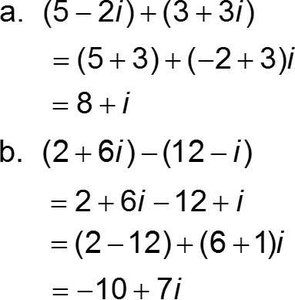
Addition/Subtraction: Combine like terms (real with real, imaginary with imaginary).
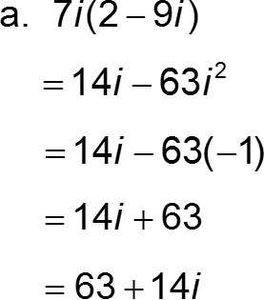
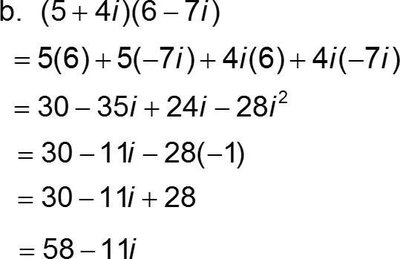
Multiplication: Use distributive property and the fact that .
Example: Adding and Subtracting Complex Numbers
Example: Multiplying Complex Numbers
Complex Conjugate
The complex conjugate of is . Multiplying a complex number by its conjugate results in a real number:
Formula:
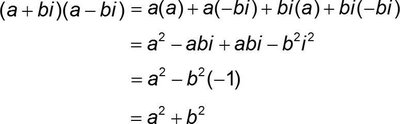
This property is especially useful for simplifying denominators in division.
Division of Complex Numbers
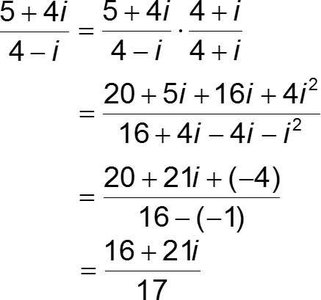
To divide complex numbers, multiply the numerator and denominator by the conjugate of the denominator to eliminate the imaginary part from the denominator.
Standard Form: Express the result as .
Principal Square Root of a Negative Number
The principal square root of a negative number (where ) is defined as . This allows us to extend the concept of square roots to negative numbers using the imaginary unit.
Operations Involving Square Roots of Negative Numbers
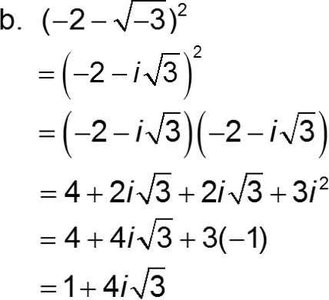
When performing operations with square roots of negative numbers, express each square root in terms of and simplify as with other complex numbers.
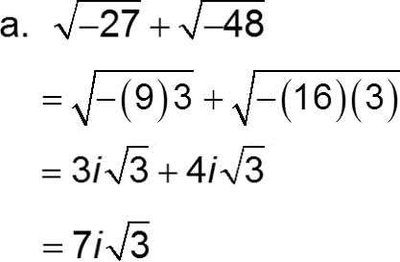
Example:
Example:
Summary Table: Key Operations with Complex Numbers
Operation | Formula | Example |
|---|---|---|
Addition | ||
Subtraction | ||
Multiplication | ||
Conjugate | Conjugate of is | |
Division | ||
Square Root |
