 뒤로
뒤로Expanding Binomials Using the Binomial Theorem
스터디 가이드 - 스마트 노트
 자료에 맞춘 맞춤형 노트, 핵심 정의, 예시, 맥락을 확장해 제공합니다.
The Binomial Theorem
Introduction to the Binomial Theorem
The Binomial Theorem provides a systematic method for expanding expressions of the form (a + b)^n without direct multiplication. This theorem is essential in algebra and precalculus for simplifying and evaluating binomial expressions raised to a power.
Key Concept: The theorem expresses the expansion as a sum involving binomial coefficients.
Formula: The general term in the expansion of is given by:
Binomial Coefficient: where denotes the factorial of .
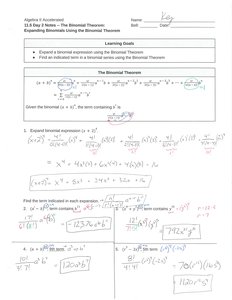
Expanding Binomial Expressions
To expand a binomial expression using the Binomial Theorem, follow these steps:
Identify the values of a, b, and n in the expression (a + b)^n.
Apply the Binomial Theorem formula to write the expansion as a sum.
Calculate each term using the binomial coefficient and the appropriate powers of a and b.
Example: Expand
Using the formula:
Simplifying coefficients:
Finding a Specific Term in a Binomial Expansion
To find a specific term in the expansion of , use the general term formula:
General Term (k-th term):
Identify the value of k for the term you need (e.g., the term containing ).
Substitute k into the formula to find the desired term.
Example: Find the term containing in the expansion of .
Set up the general term:
Set the exponent of equal to 3:
Substitute :
Properties of Binomial Coefficients
Symmetry:
Sum of coefficients: The sum of the coefficients in the expansion of is (set , ).
Applications
Expanding powers of binomials in algebraic expressions
Finding specific terms in polynomial expansions
Combinatorial problems involving selections and arrangements
Summary Table: Binomial Theorem Components
Component | Description | Formula |
|---|---|---|
Binomial Coefficient | Number of ways to choose k items from n | |
General Term | k-th term in expansion | |
Sum of Coefficients | Sum of all coefficients in expansion |
Additional info: The Binomial Theorem is foundational for later topics in probability, combinatorics, and calculus, where expansions and coefficients play a critical role in solving complex problems.
