뒤로
뒤로Foundations: The Distance and Midpoint Formulas in the Coordinate Plane
스터디 가이드 - 스마트 노트
 자료에 맞춘 맞춤형 노트, 핵심 정의, 예시, 맥락을 확장해 제공합니다.
Chapter F: Foundations – A Prelude to Functions
Section F.1: The Distance and Midpoint Formulas
This section introduces the foundational concepts of the rectangular (Cartesian) coordinate system and the essential formulas for calculating the distance and midpoint between two points in the plane. Mastery of these concepts is crucial for understanding functions, analytic geometry, and later topics in precalculus.
Rectangular Coordinates
Definition and Structure of the Coordinate Plane
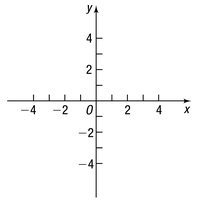
The rectangular coordinate system, also known as the Cartesian coordinate system, consists of two perpendicular number lines: the x-axis (horizontal) and the y-axis (vertical). Their intersection point is called the origin (O), which has coordinates (0, 0). The plane formed by these axes is called the xy-plane or coordinate plane.
Any point P in the plane is represented by an ordered pair (x, y), where x is the x-coordinate (abscissa) and y is the y-coordinate (ordinate).
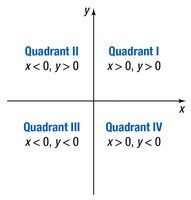
The coordinate axes divide the plane into four regions called quadrants.
Locating Points and Quadrants
Each point in the plane can be precisely located using its coordinates. The quadrants are numbered I through IV, starting from the upper right and moving counterclockwise:
Quadrant I: x > 0, y > 0
Quadrant II: x < 0, y > 0
Quadrant III: x < 0, y < 0
Quadrant IV: x > 0, y < 0
Examples of Plotting Points
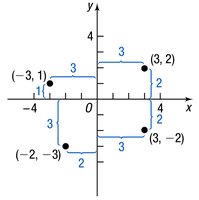
To plot a point such as (3, 2), move 3 units along the x-axis and 2 units up the y-axis. Negative values indicate movement in the opposite direction.
The Distance Formula
Definition and Derivation
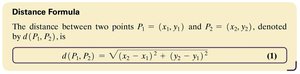
The distance formula calculates the straight-line distance between two points, P1 = (x1, y1) and P2 = (x2, y2), in the coordinate plane. It is derived from the Pythagorean Theorem.
Formula:
Example: Finding the Distance Between Two Points
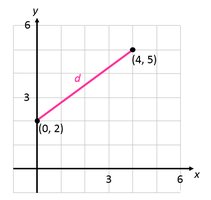
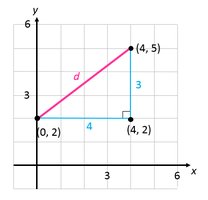
Find the distance between (0, 2) and (4, 5):
Plot the points and connect them with a straight line.
Draw a horizontal and a vertical line to form a right triangle.
Apply the distance formula:
Application: Using Algebra to Solve Geometry Problems
The distance formula can be used to determine the lengths of sides in geometric figures, such as triangles, and to verify properties like right angles using the converse of the Pythagorean Theorem.
Example: Given triangle ABC with vertices A = (–3, 1), B = (–3, 4), and C = (4, 1), calculate the lengths of the sides and determine if the triangle is a right triangle.
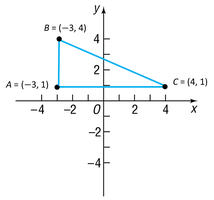
Additional info: If the sum of the squares of two sides equals the square of the third side, the triangle is right-angled at the vertex opposite the longest side.
The Midpoint Formula
Definition and Formula
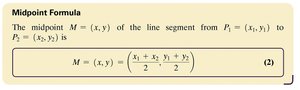
The midpoint formula finds the coordinates of the point exactly halfway between two points, P1 = (x1, y1) and P2 = (x2, y2).
Formula:
Example: Finding the Midpoint of a Line Segment
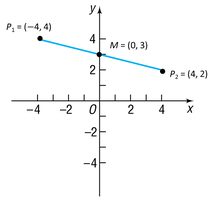
Find the midpoint of the segment joining P1 = (–4, 4) and P2 = (4, 2):
Apply the midpoint formula: