 뒤로
뒤로Key Trigonometric Formulas and the Unit Circle
스터디 가이드 - 스마트 노트
 자료에 맞춘 맞춤형 노트, 핵심 정의, 예시, 맥락을 확장해 제공합니다.
Trigonometric Identities and Formulas
Sum and Difference Formulas
These formulas allow us to compute the sine, cosine, and tangent of sums and differences of angles, which are essential for simplifying expressions and solving trigonometric equations.
Cosine of a Sum:
Cosine of a Difference:
Sine of a Sum:
Sine of a Difference:
Tangent of a Sum:
Tangent of a Difference:
Double Angle Formulas
Double angle formulas are used to express trigonometric functions of double angles in terms of single angles.
Sine Double Angle:
Tangent Double Angle:
Cosine Double Angle (three forms):
Half Angle Formulas
Half angle formulas are useful for finding the sine, cosine, or tangent of half an angle.
The sign ( or ) is determined by the quadrant of .
Product-to-Sum and Sum-to-Product Formulas
These identities convert products of sines and cosines into sums or differences, and vice versa.
Applications in Analytic Geometry and Complex Numbers
Law of Cosines
The Law of Cosines relates the lengths of the sides of a triangle to the cosine of one of its angles.
Example: Used to solve triangles when two sides and the included angle are known.
De Moivre's Theorem and Roots of Complex Numbers
These formulas are used for raising complex numbers to powers and extracting roots in polar form.
De Moivre's Theorem:
n-th Roots of a Complex Number:
Vectors and Dot Product
Cosine of the Angle Between Vectors
The cosine of the angle between two vectors can be found using the dot product.
Vector Projection
Vector projection formulas allow us to decompose a vector into components parallel and perpendicular to another vector.
Projection of onto :
Component of orthogonal to :
The Unit Circle
Definition and Importance
The unit circle is a circle of radius 1 centered at the origin of the coordinate plane. It is fundamental in trigonometry for defining the sine and cosine of any angle, and for understanding the periodicity and symmetry of trigonometric functions.
Each point on the unit circle corresponds to and for some angle measured from the positive x-axis.
The unit circle is divided into quadrants, and common angles (in degrees and radians) are marked to facilitate quick reference for trigonometric values.
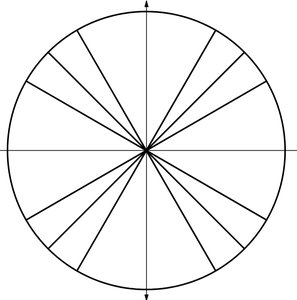
Example: The coordinates at are , at are , at are , and at are .
