 뒤로
뒤로Limits and Infinite Limits: Precalculus Study Notes
스터디 가이드 - 스마트 노트
 자료에 맞춘 맞춤형 노트, 핵심 정의, 예시, 맥락을 확장해 제공합니다.
Limits & Continuity
Infinite Limits
Infinite limits occur when the value of a function increases or decreases without bound as the input approaches a certain point. This concept is fundamental in understanding the behavior of functions near points where they are not defined or where they exhibit vertical asymptotes.
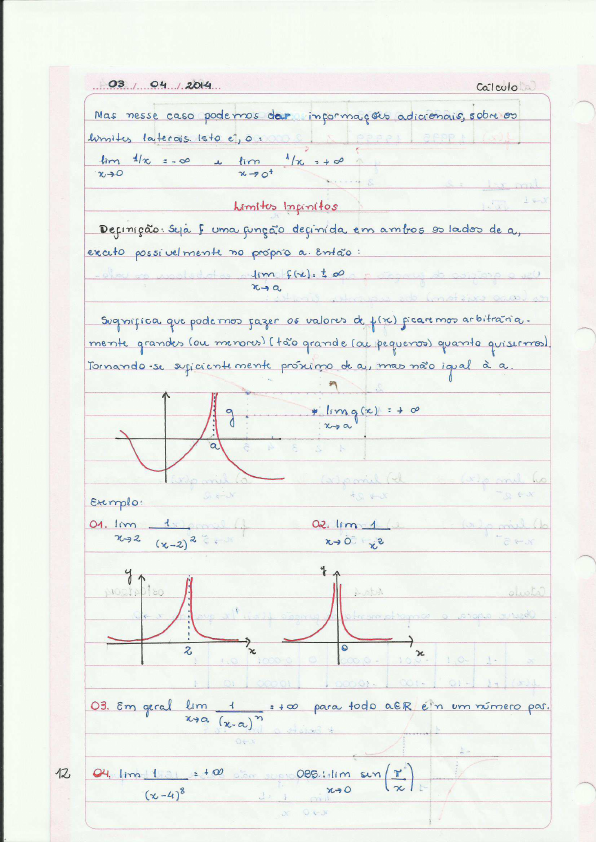
Definition: Let f be a function defined on both sides of a, except possibly at a itself. We say that the limit of f(x) as x approaches a is infinite if the values of f(x) become arbitrarily large (positive or negative) as x gets closer to a but not equal to a.
Notation: or
Interpretation: This means that as x approaches a, f(x) increases (or decreases) without bound.
One-Sided Infinite Limits
Sometimes, the behavior of a function as x approaches a point from the left or right can be different. One-sided limits help describe this behavior.
Left-hand limit:
Right-hand limit:
Example: ,
Examples of Infinite Limits
Infinite limits often occur in rational functions where the denominator approaches zero.
Example 1: As x approaches 2, the denominator approaches zero, causing the function to grow without bound.
Example 2: As x approaches 0, the denominator approaches zero, and the function increases without bound.
General Case: for any positive integer n.
Special Cases and Other Limits
Example:
Oscillating Limit: This limit does not tend to infinity but is a classic example of a limit that exists and is finite.
Summary Table: Infinite Limits
Expression | Limit as x → a | Behavior |
|---|---|---|
or | Depends on direction (left/right) | |
Vertical asymptote at x = a | ||
1 | Finite limit as x → 0 |
Additional info: These notes cover the concept of infinite limits, one-sided limits, and provide graphical and algebraic examples relevant to Precalculus. The included image directly illustrates the behavior of functions near vertical asymptotes, reinforcing the explanation of infinite limits.
