 뒤로
뒤로Precalculus Study Notes: Trigonometric Functions, Unit Circle, and Graph Transformations
스터디 가이드 - 스마트 노트
 자료에 맞춘 맞춤형 노트, 핵심 정의, 예시, 맥락을 확장해 제공합니다.
Trigonometric Functions on Right Triangles
Definition and Basic Properties
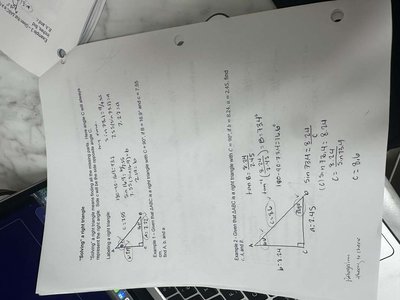
Trigonometric functions relate the angles of a right triangle to the ratios of its sides. These functions are foundational in precalculus and are used to solve for unknown sides or angles in right triangles.
Sine (sin): Ratio of the length of the opposite side to the hypotenuse.
Cosine (cos): Ratio of the length of the adjacent side to the hypotenuse.
Tangent (tan): Ratio of the length of the opposite side to the adjacent side.
Other trigonometric functions include cosecant (csc), secant (sec), and cotangent (cot), which are the reciprocals of sine, cosine, and tangent, respectively.
csc(θ) = 1/sin(θ)
sec(θ) = 1/cos(θ)
cot(θ) = 1/tan(θ)
Example: Given a right triangle with sides 3, 4, and 5, and angle θ opposite the side of length 3:
sin(θ) = 3/5
cos(θ) = 4/5
tan(θ) = 3/4
Unit Circle and Trigonometric Functions
Angles and the Unit Circle
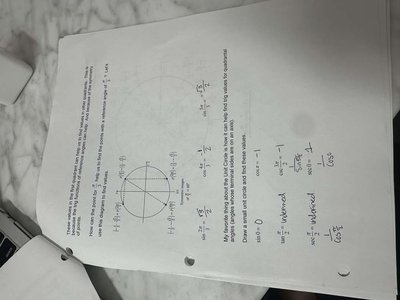
The unit circle is a circle of radius 1 centered at the origin of the coordinate plane. It is used to define trigonometric functions for all real numbers, not just angles in right triangles.
Each point (x, y) on the unit circle corresponds to an angle θ, where x = cos(θ) and y = sin(θ).
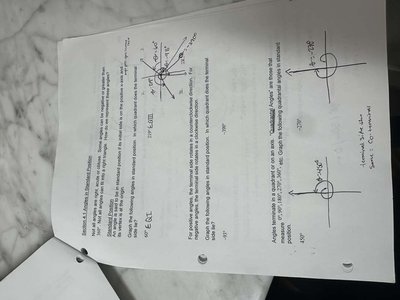
Angles can be measured in degrees or radians. One full revolution is 360° or 2π radians.
Example: The point (√2/2, √2/2) on the unit circle corresponds to θ = 45° or π/4 radians.
Reference Angles and Quadrants
Reference angles are the acute angles formed by the terminal side of an angle and the x-axis. The sign of trigonometric functions depends on the quadrant in which the terminal side lies:
Quadrant I: All functions positive
Quadrant II: Sine positive
Quadrant III: Tangent positive
Quadrant IV: Cosine positive
Graphing Trigonometric Functions
Basic Graphs and Transformations
Trigonometric functions such as sine and cosine have characteristic wave-like graphs. Their basic forms are:
y = sin(x)
y = cos(x)
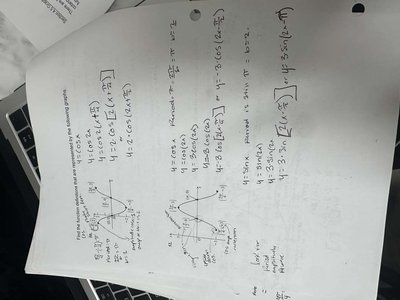
Key properties include amplitude, period, phase shift, and vertical shift.
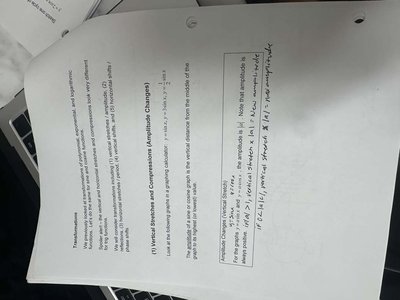
Amplitude: The maximum value from the midline (for y = a sin(x), amplitude is |a|).
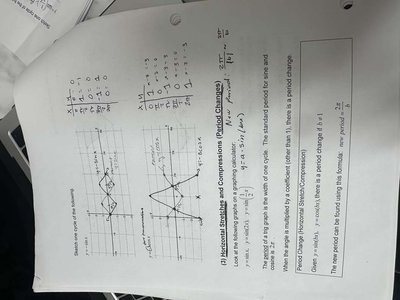
Period: The length of one complete cycle (for y = sin(bx), period is ).
Phase Shift: Horizontal shift left or right (for y = sin(x - c), phase shift is c).
Vertical Shift: Up or down movement (for y = sin(x) + d, vertical shift is d).
Graphing Secant, Cosecant, Tangent, and Cotangent
Secant, cosecant, tangent, and cotangent functions are also graphed using their definitions and properties. Asymptotes are present where the functions are undefined.
y = sec(x) and y = csc(x) have vertical asymptotes where cos(x) = 0 and sin(x) = 0, respectively.
y = tan(x) and y = cot(x) have periods of π and vertical asymptotes where their denominators are zero.
Transformations of Trigonometric Graphs
Vertical and Horizontal Shifts
Transformations allow us to shift, stretch, or reflect trigonometric graphs. The general form is:
y = a sin(b(x - c)) + d
Where:
a: Amplitude (vertical stretch/shrink)
b: Affects period
c: Phase shift (horizontal shift)
d: Vertical shift
Reflections and Stretches
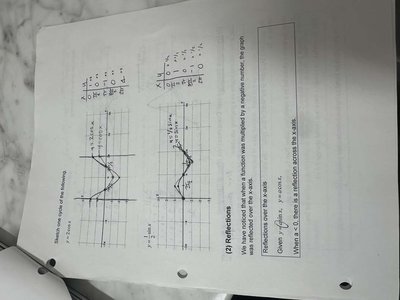
Reflections occur when the function is multiplied by -1, flipping the graph over the x-axis. Vertical and horizontal stretches/compressions change the amplitude and period, respectively.
y = -sin(x): Reflection over the x-axis
y = sin(2x): Horizontal compression (period is halved)
Inverse Trigonometric Functions and Basic Equations
Solving Trigonometric Equations
Inverse trigonometric functions are used to find angles when given a trigonometric value. For example, if sin(θ) = 1/2, then θ = arcsin(1/2).
arcsin(x), arccos(x), arctan(x) are the principal value branches of the inverse functions.
Solutions may require considering all possible angles within a given interval.
Example: Solve sin(θ) = 1/2 for θ in [0, 2π]: θ = π/6, 5π/6.
Summary Table: Trigonometric Function Properties
Function | Domain | Range | Period | Asymptotes |
|---|---|---|---|---|
sin(x) | All real x | [-1, 1] | None | |
cos(x) | All real x | [-1, 1] | None | |
tan(x) | All real y | |||
cot(x) | All real y | |||
sec(x) | ||||
csc(x) |
Additional info: The notes also include worked examples, step-by-step solutions, and sketches of graphs for each transformation and trigonometric equation, reinforcing the concepts above.
