 뒤로
뒤로Radian Measure and the Unit Circle: Precalculus Study Notes
스터디 가이드 - 스마트 노트
 자료에 맞춘 맞춤형 노트, 핵심 정의, 예시, 맥락을 확장해 제공합니다.
Chapter 3: Radian Measure and the Unit Circle
3.1 Radian Measure
Understanding radian measure is fundamental to trigonometry and calculus. Radians provide a natural way to measure angles based on the properties of circles.
Radian: An angle with its vertex at the center of a circle that intercepts an arc equal in length to the radius of the circle has a measure of 1 radian.
General Formula: If a central angle θ (in radians) intercepts an arc of length s on a circle of radius r, then the radian measure is given by:
Unit: Radians are dimensionless; they are a ratio of two lengths.
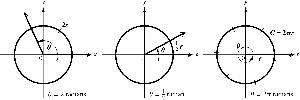
Conversions between Degrees and Radians
To convert degrees to radians: Multiply the degree measure by .
To convert radians to degrees: Multiply the radian measure by .
Example: Convert 45° to radians: radians.
Example: Convert radians to degrees: .
Agreement on Angle Measurement Units
If no unit is specified, angles are assumed to be in radians.
Be careful: 30° and 30 radians are very different angles.
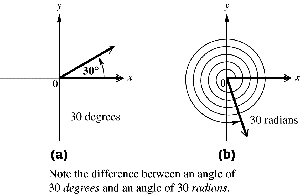
Equivalent Angle Measures
Common angles and their equivalents in degrees and radians:
Degrees | Radians (exact) | Radians (approximate) |
|---|---|---|
0° | 0 | 0 |
30° | 0.52 | |
45° | 0.79 | |
60° | 1.05 | |
90° | 1.57 | |
180° | 3.14 | |
270° | 4.71 | |
360° | 6.28 |
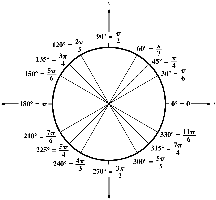
Trigonometric Function Values of Angles in Radians
Trigonometric functions can be evaluated for angles in radians using the unit circle.
Calculator must be in radian mode when working with radian measures.
3.2 Applications of Radian Measure
Radians are essential for solving real-world problems involving circles, such as arc length and area of a sector.
Arc Length on a Circle
The length s of an arc intercepted by a central angle θ (in radians) on a circle of radius r is:
θ must be in radians for this formula to be valid.
Example: Find the arc length for a circle of radius 18.20 cm and central angle 2 radians: cm.
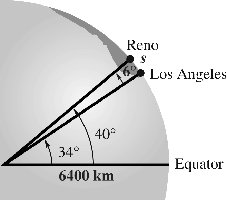
Example: Find the north-south distance between Reno (40° N) and Los Angeles (34° N) on Earth (radius 6400 km): Difference in latitude = 6° = radians. Distance = km.
Area of a Sector of a Circle
The area A of a sector with radius r and central angle θ (in radians):
θ must be in radians.
Example: Find the area of a sector with radius 324 m and angle 15°: Convert 15° to radians: radians. m².
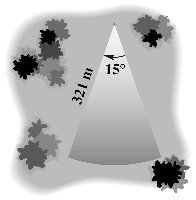
Applications: Rope and Gears
Arc length can be used to determine how much rope is wound around a drum or how far gears rotate.
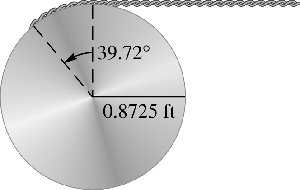
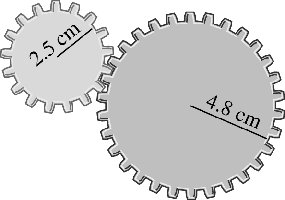
3.3 The Unit Circle and Circular Functions
The unit circle is a circle of radius 1 centered at the origin. It is fundamental for defining the trigonometric (circular) functions for all real numbers.
Circular Functions
For a point (x, y) on the unit circle corresponding to an arc length s (or angle θ):
The equation of the unit circle:
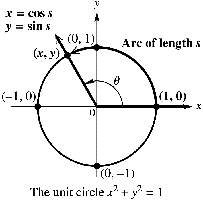
Symmetry and Reference Arcs
The unit circle is symmetric about the x-axis, y-axis, and the origin.
Reference arcs help find function values for any angle using known values from the first quadrant.
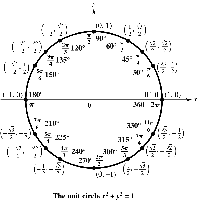
Function Values as Lengths of Line Segments
Trigonometric functions can be interpreted as lengths of specific line segments in the unit circle diagram.
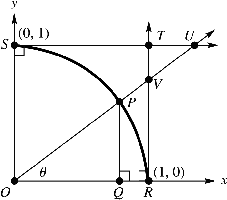
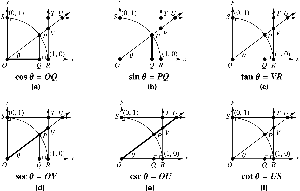
3.4 Linear and Angular Speed
Linear and angular speed describe how fast a point moves along a circle and how fast the angle changes, respectively.
Linear Speed
Linear speed v is the rate at which the arc length s is traversed:
Alternatively, using angular speed :
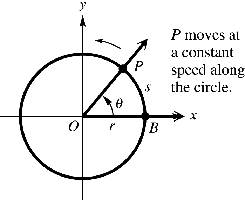
Angular Speed
Angular speed is the rate at which the angle θ changes:
θ must be in radians, t in units of time.
Applications: Pulley and Satellite
For a pulley of radius 6 cm rotating at 80 revolutions per minute:
Angular speed: radians/minute
Linear speed: cm/minute
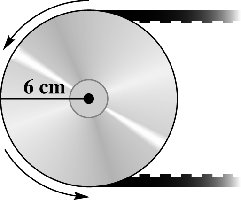
For a satellite orbiting Earth at a radius of 8000 km (6400 km + 1600 km):
Distance in one orbit:
Linear speed: , where T is the period
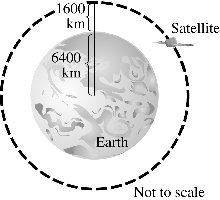
Reflect: Linear speed measures how fast a point moves along the circumference, while angular speed measures how fast the angle changes at the center.
