 뒤로
뒤로Section 1.2: Introduction to Relations and Functions
스터디 가이드 - 스마트 노트
 자료에 맞춘 맞춤형 노트, 핵심 정의, 예시, 맥락을 확장해 제공합니다.
Section 1.2: Introduction to Relations and Functions
Set-Builder Notation and Interval Notation
In mathematics, we often describe sets of numbers using specific notations. Two common forms are set-builder notation and interval notation.
Set-Builder Notation: Describes a set by stating the properties its members must satisfy. For example, {x | x > -2} is read as "the set of all x such that x is greater than -2."
Interval Notation: Uses intervals to describe sets of numbers. For example, (-2, \infty) represents all real numbers greater than -2. Parentheses indicate endpoints are not included, while brackets indicate inclusion.
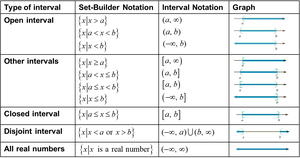
Example: The inequality 3 < x is written in interval notation as (3, \infty).
Relations, Domain, and Range
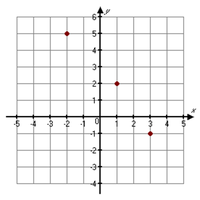
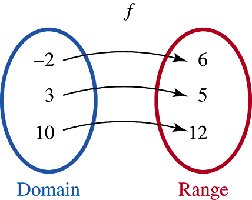
A relation is any set of ordered pairs (x, y). The domain is the set of all possible x-values, and the range is the set of all possible y-values. Relations can be represented as sets of ordered pairs, graphs, or mapping diagrams.
Domain: All input values (x-values) of the relation.
Range: All output values (y-values) of the relation.
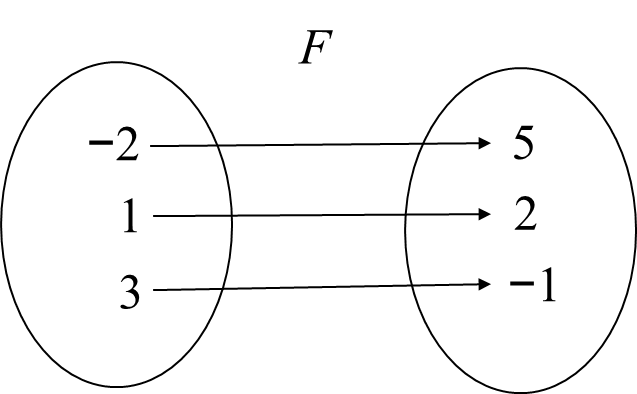
Relations can also be illustrated using mapping diagrams, which visually show how each element of the domain is paired with elements in the range.
Determining Domains and Ranges from Graphs
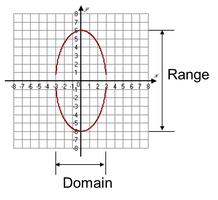
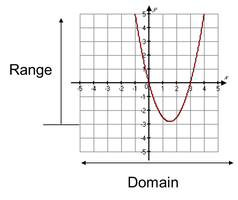
To find the domain and range from a graph, identify all possible x-values (domain) and y-values (range) that the graph covers.
Example a: The domain and range are determined by the horizontal and vertical extent of the plotted points or curve.
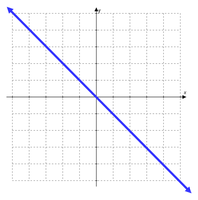
Example b: For a straight line extending infinitely in both directions, both the domain and range are all real numbers: .
Example c: For a parabola opening upwards, the domain is all real numbers, and the range is all y-values greater than or equal to the vertex's y-coordinate.
Functions
A function is a special type of relation in which each element of the domain is paired with exactly one element of the range. In a function, x is called the independent variable and y is the dependent variable.
Definition: A function f from set A to set B is a rule that assigns to each element x in A exactly one element y in B.
Notation:
Examples:
If every x-value is paired with only one y-value, the relation is a function.
If any x-value is paired with more than one y-value, the relation is not a function.
Vertical Line Test
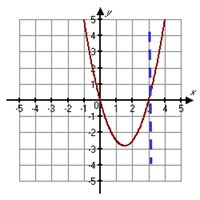
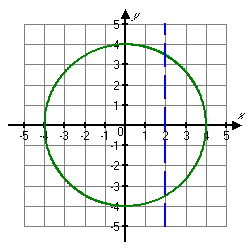
The vertical line test is a graphical method to determine if a relation is a function. If every vertical line intersects the graph at most once, the graph represents a function.
Function: A vertical line crosses the graph at most once.
Not a Function: A vertical line crosses the graph more than once.
Function Notation
Function notation is used to emphasize the dependence of one variable on another. If y is a function of x, we write , read as "f of x." This notation is used to evaluate the function at specific values of x.
Example: If , then when x = 3, the output is 5.
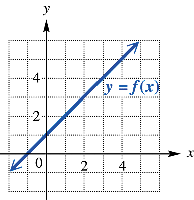
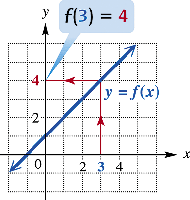
Evaluating Functions: To find , locate a on the x-axis, move vertically to the graph, then horizontally to the y-axis to find the corresponding y-value.
Summary Table: Key Concepts
Concept | Definition | Example |
|---|---|---|
Relation | Set of ordered pairs (x, y) | {(1, 2), (3, 4)} |
Domain | Set of all x-values | {1, 3} |
Range | Set of all y-values | {2, 4} |
Function | Each x has exactly one y | y = x + 2 |
Interval Notation | Describes intervals of numbers | (-2, \infty) |
Additional info: These foundational concepts are essential for understanding more advanced topics in functions, graphing, and algebraic analysis in Precalculus.
