 뒤로
뒤로Study Guide: Asymptotes and Domains of Rational Functions
스터디 가이드 - 스마트 노트
 자료에 맞춘 맞춤형 노트, 핵심 정의, 예시, 맥락을 확장해 제공합니다.
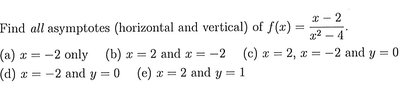
Q1. Find all asymptotes (horizontal and vertical) of .
Background
Topic: Properties of Rational Functions
This question tests your understanding of how to find vertical and horizontal asymptotes for rational functions. Asymptotes are lines that the graph of the function approaches but never touches.
Key Terms and Formulas:
Vertical Asymptote (VA): Values of that make the denominator zero (after simplification).
Horizontal Asymptote (HA): Determined by comparing the degrees of the numerator and denominator.
where and are polynomials.
Step-by-Step Guidance
Factor the denominator: .
Check for common factors in numerator and denominator. If any, simplify and note where holes occur.
Find vertical asymptotes by setting the denominator equal to zero and solving for .
Determine the horizontal asymptote by comparing the degrees of the numerator and denominator.
Set up the equations for the asymptotes, but do not solve for the final values yet.
Try solving on your own before revealing the answer!
Final Answer:
Vertical asymptotes: and
Horizontal asymptote:
After factoring and simplifying, the denominator gives two vertical asymptotes. The degrees of numerator and denominator are equal, so the horizontal asymptote is .
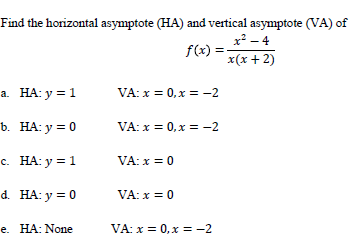
Q2. Find the horizontal asymptote (HA) and vertical asymptote (VA) of .
Background
Topic: Properties of Rational Functions
This question asks you to identify both horizontal and vertical asymptotes for a rational function. You need to factor and analyze the function carefully.
Key Terms and Formulas:
Vertical Asymptote (VA): Set denominator equal to zero.
Horizontal Asymptote (HA): Compare degrees of numerator and denominator.
Factoring:
Step-by-Step Guidance
Factor numerator and denominator: , denominator is .
Identify any common factors and simplify if possible.
Find vertical asymptotes by setting denominator equal to zero: and .
Determine the horizontal asymptote by comparing degrees: numerator degree is 2, denominator degree is 2.
Set up the equations for the asymptotes, but do not solve for the final values yet.
Try solving on your own before revealing the answer!
Final Answer:
Horizontal asymptote:
Vertical asymptotes: and
The degrees are equal, so the horizontal asymptote is . The denominator gives two vertical asymptotes.
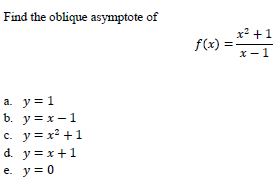
Q3. Find the oblique asymptote of .
Background
Topic: Oblique Asymptotes of Rational Functions
This question tests your ability to find an oblique (slant) asymptote, which occurs when the degree of the numerator is exactly one higher than the denominator.
Key Terms and Formulas:
Oblique Asymptote: Occurs when degree of numerator = degree of denominator + 1.
Find by dividing numerator by denominator using polynomial long division.
Step-by-Step Guidance
Check degrees: numerator is degree 2, denominator is degree 1.
Set up polynomial long division: divide by .
Perform the division to find the quotient (ignore the remainder).
Write the equation for the oblique asymptote based on the quotient.
Try solving on your own before revealing the answer!
Final Answer:
Oblique asymptote:
When you divide by , the quotient is . The remainder is ignored for the asymptote.
