 뒤로
뒤로The Twelve Basic Functions in Precalculus: Properties and Graphical Analysis
스터디 가이드 - 스마트 노트
 자료에 맞춘 맞춤형 노트, 핵심 정의, 예시, 맥락을 확장해 제공합니다.
Chapter 1: Functions and Graphs
Section 1.3: Twelve Basic Functions
The study of functions is central to precalculus and higher mathematics. There are twelve basic functions that serve as foundational models for a wide variety of mathematical phenomena. Understanding their properties and graphs is essential for recognizing and analyzing more complex functions.
Twelve Basic Functions
Identity Function:
Squaring Function:
Cubing Function:
Reciprocal Function:
Square Root Function:
Exponential Function:
Natural Logarithm Function:
Sine Function:
Cosine Function:
Absolute Value Function:
Greatest Integer Function:
Logistic Function:
Analyzing the Twelve Basic Functions
Each basic function has unique properties, domains, ranges, and graphical features. Below is a summary of each function, including its definition, key properties, and a representative graph.
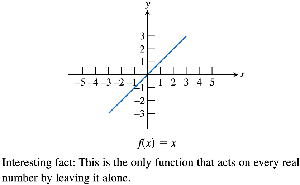
Identity Function
Definition:
Domain: All real numbers
Range: All real numbers
Key Property: The only function that leaves every real number unchanged.
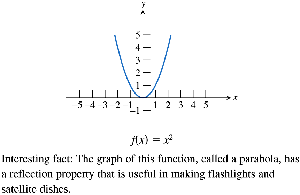
Squaring Function
Definition:
Domain: All real numbers
Range:
Key Property: The graph is a parabola with a reflection property useful in engineering.
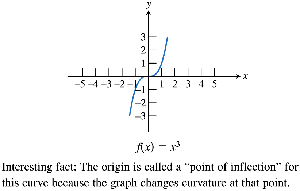
Cubing Function
Definition:
Domain: All real numbers
Range: All real numbers
Key Property: The origin is a point of inflection where the graph changes curvature.
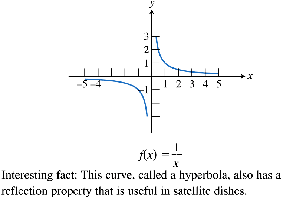
Reciprocal Function
Definition:
Domain: All real numbers except
Range: All real numbers except
Key Property: The graph is a hyperbola with a vertical asymptote at and a horizontal asymptote at .
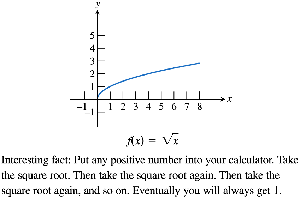
Square Root Function
Definition:
Domain:
Range:
Key Property: Repeatedly taking the square root of a positive number approaches 1.
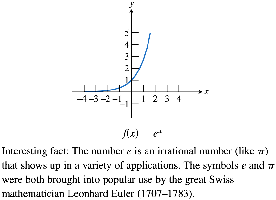
Exponential Function
Definition:
Domain: All real numbers
Range:
Key Property: The base is an irrational number important in mathematics and science.
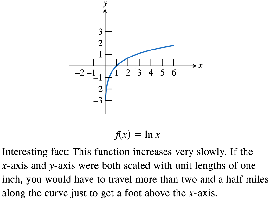
Natural Logarithm Function
Definition:
Domain:
Range:
Key Property: The function increases very slowly for large .
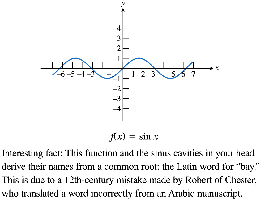
Sine Function
Definition:
Domain: All real numbers
Range:
Key Property: The function is periodic with period .
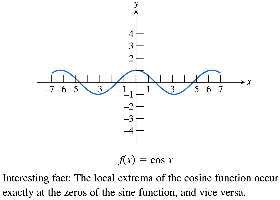
Cosine Function
Definition:
Domain: All real numbers
Range:
Key Property: The local extrema of the cosine function occur at the zeros of the sine function, and vice versa.
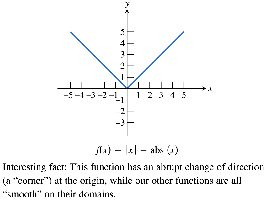
Absolute Value Function
Definition:
Domain: All real numbers
Range:
Key Property: The graph has a sharp corner at the origin, unlike the other basic functions.
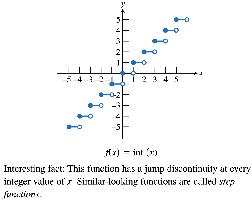
Greatest Integer Function
Definition: (also known as the floor function)
Domain: All real numbers
Range: All integers
Key Property: The function has a jump discontinuity at every integer value of .
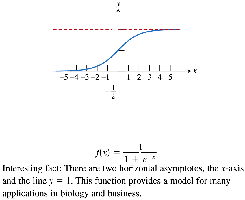
Logistic Function
Definition:
Domain: All real numbers
Range:
Key Property: The function has two horizontal asymptotes: and . It is used in modeling population growth and other applications in biology and business.
Example: Looking for Domains
One of the basic functions, , has domain all real numbers except because division by zero is undefined. The graph of this function has a vertical asymptote at .
Example: Analyzing a Function Graphically
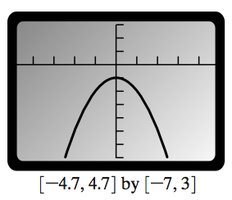
Consider the function . To analyze its graph:
Increasing Interval: The function is increasing on .
Decreasing Interval: The function is decreasing on .
Symmetry: The function is even, as it is symmetric with respect to the y-axis.
Extrema: The function has a maximum value of at .
Graph Transformation: The graph is the reflection of over the x-axis, translated down by 1 unit.
Additional info: Recognizing transformations and symmetries in basic functions is a key skill in precalculus, as it allows for quick analysis of more complex functions built from these basic forms.
