 뒤로
뒤로Operant Conditioning: Principles, Applications, and Critical Evaluation
스터디 가이드 - 스마트 노트
 자료에 맞춘 맞춤형 노트, 핵심 정의, 예시, 맥락을 확장해 제공합니다.
Operant Conditioning
Introduction to Operant Conditioning
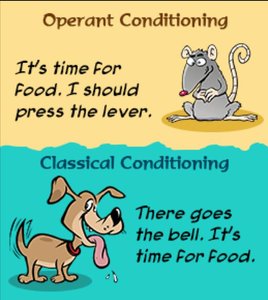
Operant conditioning is a fundamental theory in behavioral psychology that explains how behaviors are acquired and maintained through the consequences that follow them. Developed by B.F. Skinner, this theory emphasizes the role of reinforcement and punishment in shaping voluntary behavior. Operant conditioning is distinct from classical conditioning, as it focuses on the association between a behavior and its consequence rather than the association between two stimuli.
Historical Background
B.F. Skinner is recognized as the father of operant conditioning, building on Edward Thorndike’s Law of Effect (1898), which stated that behaviors followed by satisfying consequences are more likely to recur.
Skinner introduced the concept of reinforcement to describe how consequences influence the likelihood of behavior repetition.
Behaviorism, the theoretical framework underlying operant conditioning, views learners as passive recipients shaped by environmental stimuli.
Types of Behaviors
Skinner distinguished between two main types of behaviors:
Respondent Behaviors: Automatic, reflexive actions (e.g., pulling a hand from a hot surface). These are unlearned and involuntary.
Operant Behaviors: Actions under conscious control, influenced by their consequences. These behaviors can be spontaneous or purposeful.
Types of Responses
Neutral Operants: Environmental responses that neither increase nor decrease the likelihood of a behavior being repeated.
Reinforcers: Environmental responses that increase the probability of a behavior being repeated. Reinforcers can be positive or negative.
Punishers: Environmental responses that decrease the likelihood of a behavior being repeated. Punishment weakens behavior.
Types of Conditioning
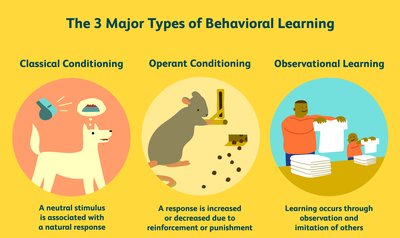
Operant conditioning is one of the three major types of behavioral learning, alongside classical conditioning and observational learning.
Principles of Operant Conditioning
Positive Reinforcement
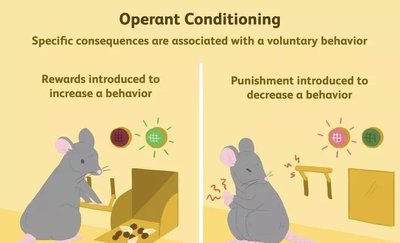
Positive reinforcement strengthens a behavior by providing a rewarding consequence. This increases the likelihood that the behavior will be repeated.
Example: Receiving money from parents for completing chores increases the likelihood of doing chores in the future.
Negative Reinforcement
Negative reinforcement involves the removal of an unpleasant stimulus to strengthen a behavior. The behavior is reinforced because it allows the individual to avoid or escape something undesirable.
Example: Completing an assignment on time to avoid having to do extra work in the future.
Punishment
Punishment is used to weaken or eliminate a behavior. It can be applied in two forms:
Positive Punishment (Punishment by Application): Introducing an unfavorable outcome to decrease a behavior (e.g., spanking for misbehavior).
Negative Punishment (Punishment by Removal): Taking away a desirable stimulus to decrease a behavior (e.g., removing a child’s video game for misbehavior).
Examples of Operant Conditioning
Telling a funny story and receiving laughter increases the likelihood of telling stories in the future (positive reinforcement).
Being scolded for shouting in class decreases the likelihood of interrupting again (punishment).
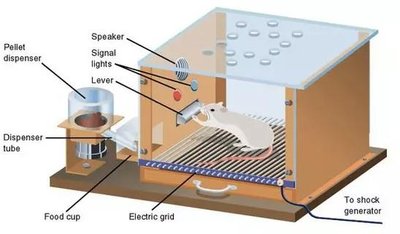
Skinner’s experiments with rats in the Skinner Box demonstrated how animals learn to press a lever for food or avoid a lever that delivers a shock.
Reinforcement Schedules
Types of Reinforcement Schedules
The timing and frequency of reinforcement significantly affect how quickly and robustly behaviors are learned and maintained. Skinner identified several reinforcement schedules:
Continuous Reinforcement: Every response is reinforced. Leads to rapid learning but also rapid extinction when reinforcement stops.
Fixed-Ratio Schedule: Reinforcement is given after a set number of responses. Produces a steady response rate.
Fixed-Interval Schedule: Reinforcement is given after a fixed time interval. Response rates increase as the time for reinforcement approaches.
Variable-Ratio Schedule: Reinforcement is given after a variable number of responses. Produces high response rates and resistance to extinction (e.g., gambling).
Variable-Interval Schedule: Reinforcement is given after varying time intervals. Also leads to steady, persistent responding.
Critical Evaluation of Operant Conditioning
Operant conditioning explains a wide range of behaviors, including learning, addiction, and language acquisition.
It has practical applications in education, therapy (e.g., token economies), and behavior modification in various settings.
Limitations: Operant conditioning does not account for inherited or cognitive factors in learning, making it an incomplete explanation for all learning processes.
Summary Table: Reinforcement and Punishment
Type | Definition | Example |
|---|---|---|
Positive Reinforcement | Adding a desirable stimulus to increase behavior | Giving praise for good work |
Negative Reinforcement | Removing an unpleasant stimulus to increase behavior | Turning off a loud alarm when seatbelt is fastened |
Positive Punishment | Adding an unpleasant stimulus to decrease behavior | Scolding for misbehavior |
Negative Punishment | Removing a desirable stimulus to decrease behavior | Taking away privileges for rule-breaking |
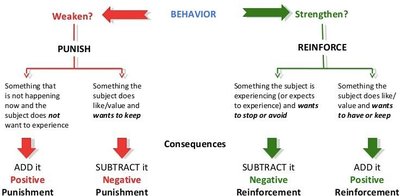
Practice: Identifying Types of Conditioning
Praising a pet for obeying: Positive Reinforcement
Employee suffers wage cut for missing work: Negative Punishment
Worker receives bonus for high sales: Positive Reinforcement
Child receives praise for chores: Positive Reinforcement
Employee receives a day off (removal of something undesirable): Negative Reinforcement
Employee must work overtime for missing work: Positive Punishment
Teen loses phone for not cleaning room: Negative Punishment
Boy must do community service for smoking: Positive Punishment
Conclusion
Operant conditioning is a cornerstone of behavioral psychology, providing a systematic framework for understanding how consequences shape voluntary behavior. Its principles are widely applied in education, therapy, and behavior management, though it is important to recognize its limitations regarding cognitive and biological influences on learning.
