 뒤로
뒤로Postoperative Nursing Management: Study Notes for Introduction to Psychology Students
스터디 가이드 - 스마트 노트
 자료에 맞춘 맞춤형 노트, 핵심 정의, 예시, 맥락을 확장해 제공합니다.
Chapter 16: Postoperative Nursing Management
Postoperative nursing management focuses on the care of patients recovering from anesthesia and surgery. This process involves monitoring, assessment, and interventions to ensure patient safety, comfort, and optimal recovery. Although primarily a nursing topic, understanding postoperative care is relevant for psychology students interested in health psychology, stress, and recovery processes.
Care of the Patient in the Postanesthesia Care Unit (PACU)
Purpose and Structure of the PACU
Location: Adjacent to the operating room for immediate access to medical staff and equipment.
Goal: Ensure patient safety and recovery from anesthesia by providing advanced monitoring and support.
Phases:
Phase I: Intensive care immediately after surgery.
Phase II: Less intensive care, preparing for discharge or transfer.
Admitting the Patient to the PACU
Responsibility for safe transfer lies with the anesthesia provider and surgical team.
Special considerations include preventing strain on incisions and avoiding orthostatic hypotension.
Immediate assessment and documentation are essential upon arrival.
Nursing Management in the PACU
Objectives and Recovery Criteria
Care continues until the patient recovers from anesthesia effects.
Recovery criteria include: return to baseline cognitive function, clear airway, controlled nausea/vomiting, and stable vital signs.
Assessing the Patient
Frequent assessments: airway, consciousness, cardiac and respiratory status, wound, pain, and additional factors based on comorbidities.
Vital signs are checked at arrival and repeated per protocol.
Maintaining a Patent Airway
Importance and Techniques
Primary objective: Maintain ventilation to prevent hypoxemia (low oxygen) and hypercapnia (high carbon dioxide).
Assess respiratory rate, depth, ease, oxygen saturation, and breath sounds.
Hypopharyngeal obstruction: Occurs when the tongue and jaw fall backward, blocking the airway.
Signs: Choking, noisy/irregular respirations, decreased oxygen saturation, cyanosis.
Nurse checks for exhaled breath at the nose and mouth.
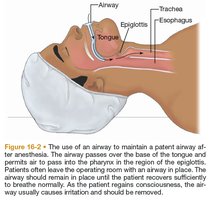
Additional info: The airway device is removed once the patient regains consciousness and can breathe independently.
Maintaining Cardiovascular Stability
Monitoring and Complications
Monitor consciousness, vital signs, cardiac rhythm, skin, and urine output.
Common complications: hypotension, shock, hemorrhage, hypertension, arrhythmias.
Critically ill patients may require advanced hemodynamic monitoring.
Relieving Pain and Anxiety
Pain Management Strategies
Opioid analgesics are commonly administered intravenously in the PACU.
Multimodal analgesia (combining different pain relief methods) is more effective than opioids alone.
Psychological support and family visits can reduce anxiety.
Nonpharmacologic methods: massage, heat/cold packs, relaxation, guided imagery, music.
Controlling Nausea and Vomiting
Prevention and Management
Postoperative nausea and vomiting (PONV) occurs in about 30% of patients.
Nurses intervene at the first sign of nausea and may use medications or aromatherapy.
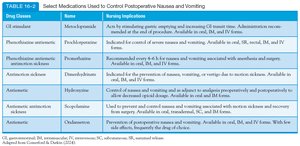
Additional info: The table lists drug classes, examples, and nursing implications for PONV management.
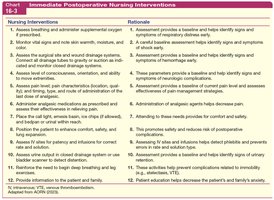
Immediate Postoperative Nursing Interventions
Assess breathing, vital signs, wound, drains, and pain.
Monitor IV fluids, medications, and output.
Promote safety, comfort, and patient education.
Gerontologic Considerations
Special Needs of Older Patients
Monitor for blood pressure changes, hypothermia, and confusion.
Frequent position changes and support for impaired organ function are important.
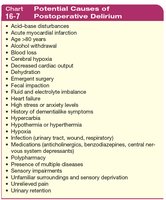
Differentiate between postoperative cognitive dysfunction (POCD) and delirium.
Provide hydration, reorientation, and medication reassessment.
Determining Readiness for PACU Discharge
Indicators and Scoring
Stable blood pressure, adequate respiratory function, and oxygen saturation are required.
The Aldrete score (7–10) is used to determine readiness for transfer.
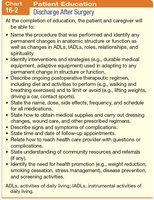
Discharge Preparation and Patient Education
Key Elements
Provide verbal and written instructions for follow-up care.
Ensure understanding by both patient and caregiver.
List possible complications and management strategies.
Arrange for continuing or transitional care if needed.
Collaborative Problems and Potential Complications
Major Risks
Pulmonary infection/hypoxia, venous thromboembolism (VTE), hematoma, hemorrhage, infection, wound dehiscence, and evisceration.
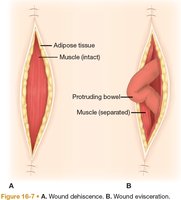
Additional info: Dehiscence is the separation of wound edges; evisceration is the protrusion of internal organs through the wound.
Planning and Goals
Optimal respiratory and cardiovascular function
Pain relief and increased activity tolerance
Unimpaired wound healing and maintenance of body temperature
Resumption of normal bowel and bladder patterns
Acquisition of self-care knowledge and absence of complications
Preventing Respiratory Complications
Risk factors: opioid use, decreased lung expansion, immobility
Prevention: deep breathing, coughing, incentive spirometry, early ambulation
Signs: decreased breath sounds, crackles, cough, fever, tachycardia, tachypnea
Relieving Pain
Assess pain location, intensity, and quality
Use validated pain scales and adjust medications as needed
Consider stress response and its physiological effects
Opioid Analgesic Medications and Patient-Controlled Analgesia (PCA)
Opioids are commonly prescribed; IV route is preferred initially
PCA allows patients to self-administer pain medication, improving outcomes
Assessment tools: Pasero Opioid-Induced Sedation Scale (POSS), Aldrete Scale, RASS, PADSS, Glasgow Coma Scale
Multimodal Analgesia and Other Pain Relief Measures
Combines opioid and nonopioid analgesics for better pain control
Nonpharmacologic methods: music therapy, guided imagery, position changes, massage
Promoting Cardiac Output and Preventing VTE
Monitor for shock, hemorrhage, and fluid balance
Prevent VTE with leg exercises, position changes, stockings, and early ambulation
Encouraging Activity and Early Ambulation
Prevents complications, reduces pain, and shortens hospital stay
Gradual position changes and physical support are essential
Bed exercises promote circulation and muscle strength
Wound Healing and Care
Phases: inflammatory, proliferative, remodeling
Monitor for redness, swelling, drainage, and suture integrity
Risk factors: poor nutrition, smoking, diabetes, age
Caring for Surgical Drains and Dressings
Types: Penrose, Jackson-Pratt, Hemovac
Purpose: remove fluids, prevent infection
Patient education on wound care is crucial for recovery
Maintaining Normal Body Temperature
Prevent hypothermia and monitor for malignant hyperthermia
Interventions: blankets, room temperature, hydration, nutrition
Managing Gastrointestinal and Urinary Function
Prevent constipation with early ambulation and dietary measures
Monitor for urinary retention and encourage voiding
Use bladder ultrasound and catheterization if necessary
Maintaining a Safe Environment
Ensure safety with bed rails, low bed position, and accessible call light
Assess neurovascular integrity and prevent injury
Providing Emotional Support
Address anxiety, pain, and unfamiliarity with the environment
Engage patient and family in care planning and provide reassurance
Managing Potential Complications
Monitor for VTE, hematoma, infection, wound dehiscence, and evisceration
Implement preventive and management strategies as needed
Educating Patients About Self-Care
Begin discharge teaching before surgery
Include wound care, complication prevention, and resource identification
Assess learning preferences and resources for safe recovery
Continuing and Transitional Care
Arrange for home or community-based care for patients with special needs
Home visits assess complications, reinforce education, and identify additional services
Evaluation and Expected Outcomes
Effective airway clearance, pain management, cardiac output, and activity tolerance
Intact skin, normal thermoregulation, nutritional intake, bowel and urinary function
No perioperative injury, reduced anxiety, and adequate self-care knowledge
