뒤로
뒤로Sensation and Perception: Foundations of Psychological Science
스터디 가이드 - 스마트 노트
 자료에 맞춘 맞춤형 노트, 핵심 정의, 예시, 맥락을 확장해 제공합니다.
Sensation and Perception
Introduction to Sensation and Perception
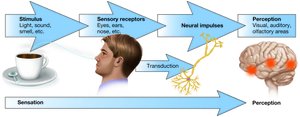
Sensation and perception are foundational processes in psychology that allow us to experience and interpret the world around us. Sensation refers to the detection of external stimuli by sensory organs, while perception involves the organization and interpretation of these sensory signals by the brain.
Sensation: The process of detecting external events with sense organs and converting them into neural signals.
Perception: The process of attending to, organizing, and interpreting sensory information.
Transduction: The transformation of physical energy from the environment into neural impulses by specialized receptors.
Stimulus Thresholds
Psychophysics is the study of the relationship between physical stimuli and psychological experience. Two important thresholds are:
Absolute Threshold: The minimum amount of energy required for a stimulus to be detected at least 50% of the time.
Difference Threshold (Just Noticeable Difference): The smallest detectable difference between two stimuli.
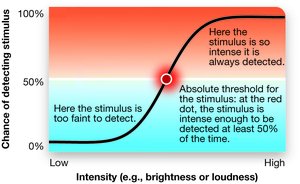
Thresholds can vary between individuals, ages, and species. For example, cats can detect subtle changes in shadows that humans cannot perceive.
Subliminal Perception and Placebo Effects
Subliminal perception refers to the detection of stimuli below the threshold of conscious awareness. Research indicates that the effects of subliminal messages are limited and often influenced by expectations (placebo effects) or the Hawthorne effect (changes in behavior due to awareness of being observed).
Gestalt Principles of Perception
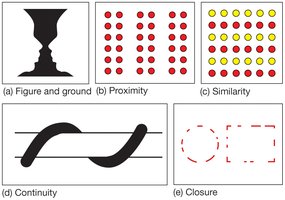
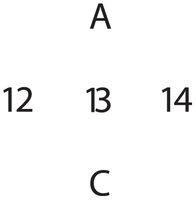
Gestalt psychology emphasizes that the whole is greater than the sum of its parts. We tend to organize sensory information into meaningful wholes using several principles:
Figure and Ground: Differentiating an object (figure) from its background (ground).
Proximity: Grouping objects that are close together.
Similarity: Grouping objects that are similar in appearance.
Continuity: Perceiving continuous patterns rather than discontinuous ones.
Closure: Filling in gaps to perceive complete objects.
Top-Down and Bottom-Up Processing
Perception involves both bottom-up and top-down processing:
Bottom-Up Processing: Building a perception from individual sensory inputs.
Top-Down Processing: Using prior knowledge and expectations to interpret sensory information.
For example, recognizing a friend's face in a crowd uses top-down processing, while identifying a new object relies on bottom-up processing.

Attention and Perception
Attention determines what information we process:
Selective Attention: Focusing on one specific stimulus or task.
Divided Attention: Splitting attention between multiple tasks or stimuli.
Inattentional Blindness: Failing to notice visible objects or events because attention is directed elsewhere.
The Visual System
Properties of Light and Colour
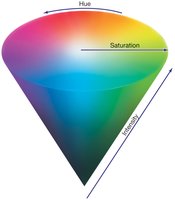
Light is characterized by three main properties:
Hue: The colour of light, determined by wavelength.
Intensity: The brightness of light, determined by amplitude.
Saturation: The purity or vividness of colour.
Structure of the Eye
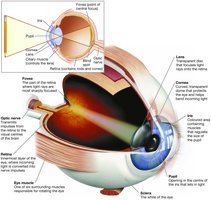
The eye gathers and focuses light onto the retina, where photoreceptors convert it into neural signals. Key structures include the cornea, lens, retina, and fovea.
Photoreceptors: Rods and Cones
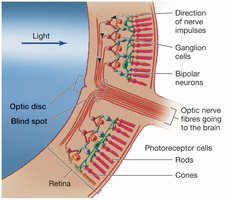
The retina contains two main types of photoreceptors:
Rods: Sensitive to low light, located in the periphery, do not detect colour.
Cones: Sensitive to colour and fine detail, concentrated in the fovea.
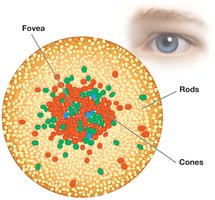
Dark adaptation is the process by which rods and cones become more sensitive to low levels of illumination.
Theories of Colour Vision
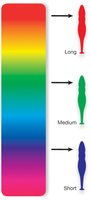
Trichromatic Theory: Humans have three types of cones, each sensitive to short (blue), medium (green), or long (red) wavelengths. Colour perception arises from the combined activity of these cones.
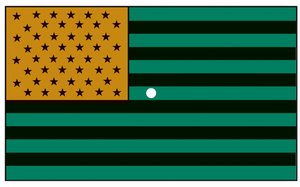
Opponent-Process Theory: Colour perception is controlled by opposing neural processes (e.g., red-green, blue-yellow). Explains phenomena such as afterimages.
Common Vision Disorders
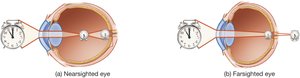
Vision disorders such as nearsightedness (myopia) and farsightedness (hyperopia) result from the shape of the eye, causing images to be focused incorrectly on the retina.
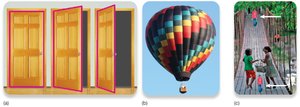
Perceptual Constancy
Perceptual constancy allows us to perceive objects as unchanging despite variations in sensory input:
Shape Constancy: Recognizing objects as having a constant shape.
Colour Constancy: Perceiving colours as stable under different lighting conditions.
Size Constancy: Perceiving objects as having a constant size regardless of distance.
Depth Perception
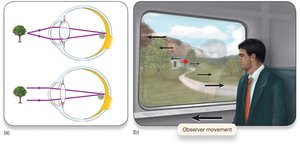
We perceive depth using both binocular and monocular cues:
Binocular Cues: Require both eyes (e.g., convergence, retinal disparity).
Monocular Cues: Require one eye (e.g., accommodation, motion parallax, pictorial cues such as linear perspective and texture gradient).

The Auditory and Vestibular Systems
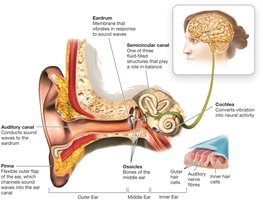
Structure and Function of the Ear
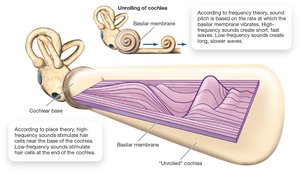
The ear detects sound waves and converts them into neural signals. The cochlea is the site of transduction, where hair cells on the basilar membrane respond to vibrations.
Properties of Sound
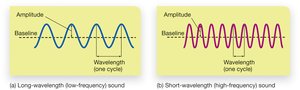
Frequency: Number of cycles per second (Hz), determines pitch.
Amplitude: Height of the sound wave, determines loudness.
Theories of Pitch Perception
Pitch perception is explained by place theory (different frequencies stimulate different places on the basilar membrane) and frequency theory (pitch is based on the rate of nerve impulses).
Hearing Ranges in Species
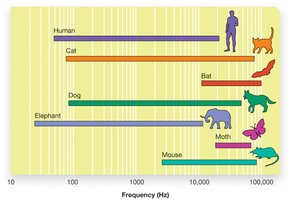
Different species have different hearing ranges. Humans can hear from about 20 Hz to 20,000 Hz, while other animals may detect higher or lower frequencies.
The Vestibular System
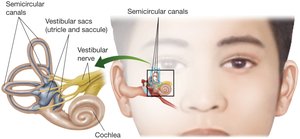
The vestibular system, located in the inner ear, helps maintain balance and spatial orientation. It consists of the vestibular sacs and semicircular canals, which detect head position and movement.
Touch and the Chemical Senses
The Olfactory System (Smell)
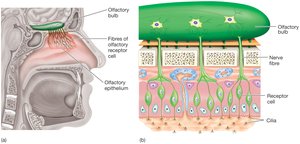
The olfactory system detects airborne chemicals through receptors in the olfactory epithelium. Signals are sent to the olfactory bulb and then to brain regions involved in emotion and memory.
Touch and Kinesthesis
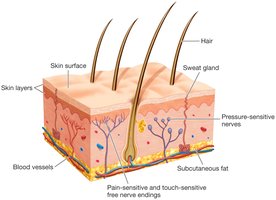
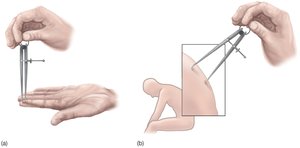
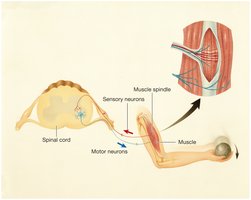
Touch (haptics) involves detecting pressure, temperature, and pain. Kinesthesis is the sense of body position and movement, with receptors in muscles, joints, and tendons.
Pain Perception
Pain is detected by nociceptors and transmitted to the brain via fast and slow nerve fibers. The hypothalamus and somatosensory cortex process pain signals, influencing both sensation and emotional response.