 뒤로
뒤로Modeling with Geometry: Quantitative Reasoning Study Notes
스터디 가이드 - 스마트 노트
 자료에 맞춘 맞춤형 노트, 핵심 정의, 예시, 맥락을 확장해 제공합니다.
Modeling with Geometry
Introduction to Geometry
Geometry is the mathematical study of shapes, sizes, and properties of space. It is fundamental to understanding the three-dimensional world we live in and is widely used in fields such as surveying, navigation, architecture, and art. The word 'geometry' means 'earth measure,' reflecting its origins in practical measurement and land division.
Measuring Perimeter: Natural vs. Geometric Objects
While the perimeter of regular geometric shapes (like circles or squares) can be found using simple formulas, measuring the perimeter of natural objects with irregular, jagged edges (such as a fern leaf) depends on the resolution of the measuring tool. Finer rulers capture more detail, resulting in a larger measured perimeter. This concept is related to the idea of fractals in mathematics.
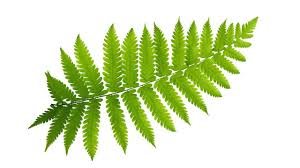
10-1 Fundamentals of Geometry
Key Terms and Definitions
Point: An exact location in space with no size or dimension.
Line: An infinite set of points extending in both directions with length but no thickness.
Plane: A flat, two-dimensional surface extending infinitely in all directions.
Dimension: A measure of spatial extent (e.g., length, area, volume).
Coordinates: Numbers that specify the position of a point in space.
Angle: The figure formed by two rays sharing a common endpoint (vertex).
Types of Angles
Right angle: Measures 90°.
Straight angle: Measures 180°.
Acute angle: Measures between 0° and 90°.
Obtuse angle: Measures between 90° and 180°.
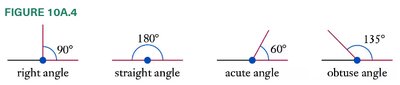
Polygons and Regular Polygons
A polygon is a closed shape in a plane made from straight line segments. A regular polygon has all sides and angles equal. Common regular polygons include triangles, squares, pentagons, hexagons, octagons, and decagons.
Sides | Name | Picture |
|---|---|---|
3 | Equilateral triangle | △ |
4 | Square | □ |
5 | Regular pentagon | ⬟ |
6 | Regular hexagon | ⬢ |
8 | Regular octagon | ⯃ |
10 | Regular decagon | ⯈ |
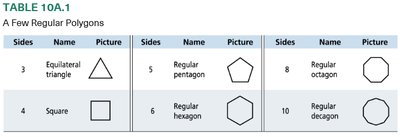
Triangles: Types and Properties
Equilateral triangle: All sides and angles are equal.
Isosceles triangle: Two sides are equal in length.
Right triangle: Contains one right (90°) angle.
In all triangles, the sum of the interior angles is always 180°.
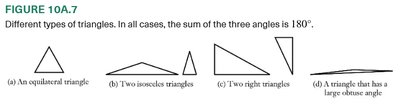
Perimeter and Circumference
The perimeter of a polygon is the sum of the lengths of its sides. The circumference is the perimeter of a circle, given by:
where is the radius and is the diameter.
Area of Common Shapes
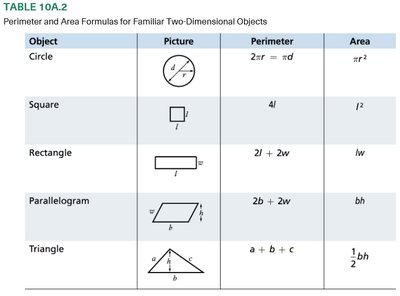
The area of a shape is the measure of the region it covers. Common area formulas include:
Object | Perimeter | Area |
|---|---|---|
Circle | ||
Square | ||
Rectangle | ||
Parallelogram | ||
Triangle |
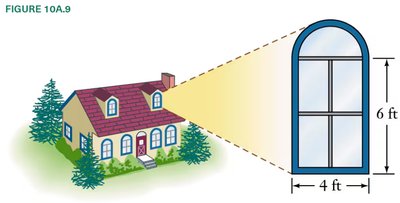
Example: Perimeter of a Window
To find the perimeter of a window consisting of a rectangle capped by a semicircle, add the perimeter of the rectangle and the circumference of the semicircle (excluding the base shared with the rectangle).
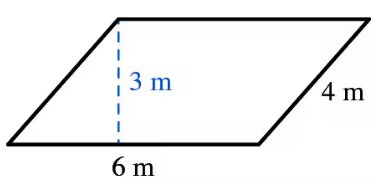
Example: Area of a Parallelogram
Given a parallelogram with base m and height m, the area is:
m2
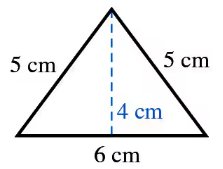
Example: Area of a Triangle
For a triangle with base cm and height cm, the area is:
cm2
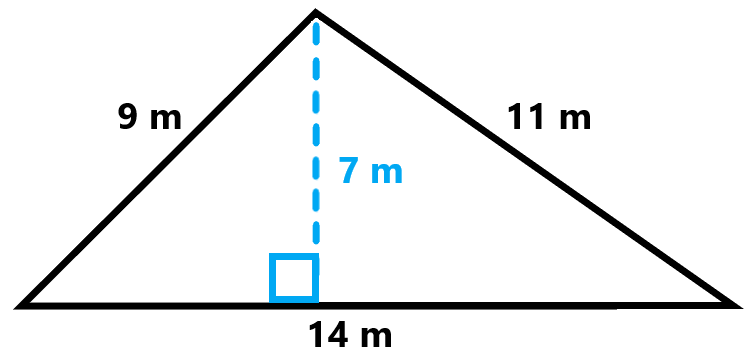
Example: Area of a Larger Triangle
For a triangle with base m and height m, the area is:
m2
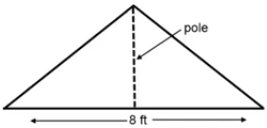
Example: Finding Height from Area
If the area of a triangle is 22 ft2 and the base is 8 ft, the height can be found by solving:
ft
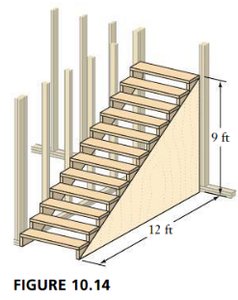
Example: Area Under Stairs
To find the area under a stairway (a right triangle with base 12 ft and height 9 ft):
ft2
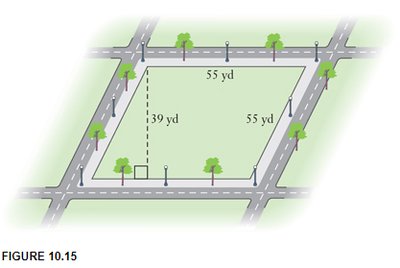
Example: Area of a Parallelogram (City Park)
For a city park shaped as a parallelogram with base 55 yd and height 39 yd:
yd2
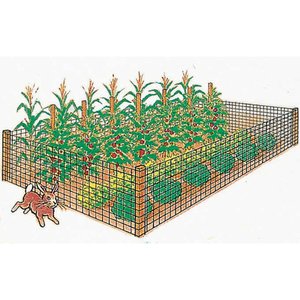
Example: Area of a Garden
For a rectangular garden with base 20 yd and height 40 yd:
yd2
Three-Dimensional Geometry
Volume and Surface Area
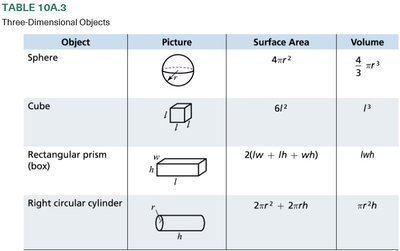
Three-dimensional objects have volume (the amount of space they occupy) and surface area (the total area of their surfaces). Common formulas include:
Object | Surface Area | Volume |
|---|---|---|
Sphere | ||
Cube | ||
Rectangular prism | ||
Right circular cylinder |
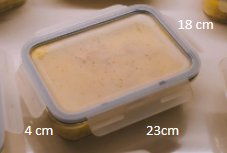
Example: Volume of a Box
For a box with length 23 cm, width 18 cm, and height 4 cm:
cm3
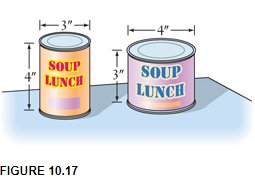
Example: Comparing Volumes of Cans
To compare two soup cans:
Can 1: Diameter = 3 in, Height = 4 in. in3
Can 2: Diameter = 4 in, Height = 3 in. in3
Can 2 holds more soup.
Scaling Laws
Lengths scale with the scale factor .
Areas scale with .
Volumes scale with .
For example, if an object's dimensions double (), its area increases by a factor of 4 and its volume by a factor of 8.
Surface Area to Volume Ratio
Larger objects have smaller surface-area-to-volume ratios than similarly proportioned small objects.
This ratio is important in biology, chemistry, and engineering (e.g., heat loss, diffusion rates).
10-2 Problem Solving with Geometry
Measuring Angles: Degrees, Minutes, and Seconds
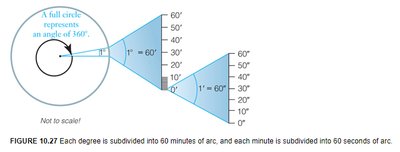
Angles are measured in degrees (°), minutes ('), and seconds ('').
1 degree = 60 minutes
1 minute = 60 seconds
Latitude and Longitude
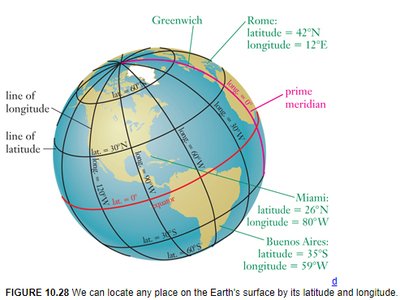
Latitude and longitude are angular measurements used to specify locations on Earth. Latitude measures north-south position from the equator (0°), while longitude measures east-west position from the prime meridian (0° in Greenwich, England).
Angular Size and Distance: The Small-Angle Formula
The angular size of an object depends on its physical size and distance from the observer. For small angles, the relationship is:
For degrees:
Pitch, Grade, and Slope
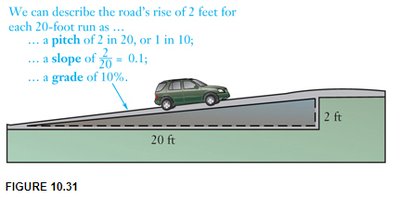
Pitch: The ratio of vertical rise to horizontal run (e.g., 2 in 20).
Slope: The rise over run, expressed as a decimal (e.g., 0.1).
Grade: The slope expressed as a percentage (e.g., 10%).
The Pythagorean Theorem
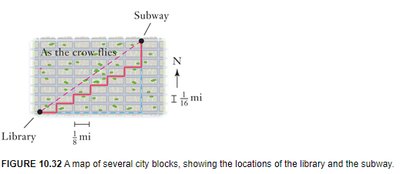
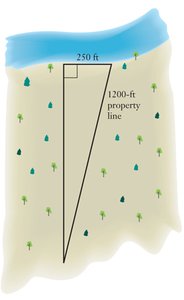
For a right triangle with legs and , and hypotenuse :
This theorem is fundamental for finding distances and solving problems involving right triangles.
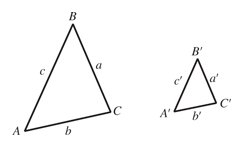
Similar Triangles
Two triangles are similar if their corresponding angles are equal and the ratios of their corresponding sides are equal. If triangles and are similar:
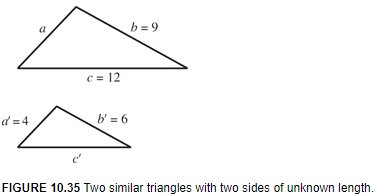
Example: Finding Unknown Sides in Similar Triangles
Given two similar triangles with sides , , , , and unknowns and , set up proportions to solve for the unknowns.
Optimization Problems in Geometry
Optimization involves finding the maximum or minimum value of a quantity, such as area or cost, given certain constraints. For example, to enclose the largest possible area with a fixed perimeter, a circle provides the optimal shape.
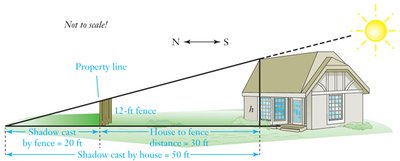
Example: Solar Access Policy
Using similar triangles, you can determine the maximum allowable height of a house addition so that its shadow does not exceed a specified length, ensuring solar access for neighbors.
Example: Finding the Height of a Flagpole
Set up a proportion using similar triangles to solve for the unknown height.
Example: Optimizing Area with Fixed Perimeter
To maximize the area enclosed by a fixed length of fencing, a circle is optimal. For rectangles, a square gives the largest area.
Example: Optimal Container Design
To minimize the cost of materials for a box of fixed volume, use calculus or geometric reasoning to find the dimensions that minimize surface area.
Additional info: These notes cover the core concepts of geometry as applied in quantitative reasoning, including definitions, formulas, and real-world applications. All images included are directly relevant to the explanations provided.
