 뒤로
뒤로6.1 : Diamond Global Supply Chain
스터디 가이드 - 스마트 노트
 자료에 맞춘 맞춤형 노트, 핵심 정의, 예시, 맥락을 확장해 제공합니다.
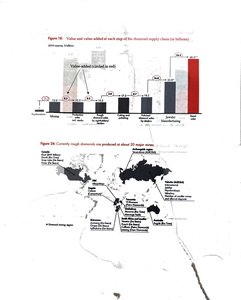
Q1. Complete the steps and their value added contained in Figure 18 according to sector (Consumer demand is not a step in the supply chain). Consult Figure 15 for the description of each step. One primary sector step has already been included.
Background
Topic: Economic Sectors & Global Commodity Chains
This question is testing your understanding of the diamond supply chain and how different economic sectors (primary, secondary, tertiary) contribute value at each stage. It also asks you to classify activities and calculate total value added by sector.
Key Terms and Concepts:
Primary sector: Activities that involve extraction of raw materials (e.g., mining).
Secondary sector: Activities that involve processing or manufacturing (e.g., cutting, polishing).
Tertiary sector: Activities that provide services (e.g., retail, marketing).
Value added: The increase in value that each step of production or service adds to the product.
Step-by-Step Guidance
Review Figure 15 to identify the eight steps in the diamond value chain, from exploration to retail.
Classify each step as belonging to the primary, secondary, or tertiary sector. For example, mining is primary, cutting/polishing is secondary, and retail is tertiary.
For each sector, list the relevant steps and record the value added at each stage using the data from Figure 18.
Add up the value added for each sector to find the total value added by the primary, secondary, and tertiary sectors.
Leave the final calculation of total value added for each sector for the next step.
Try solving on your own before revealing the answer!
Final Answer:
The primary sector includes exploration and mining, the secondary sector includes sorting, cutting, and polishing, and the tertiary sector includes jewelry manufacturing, retail, and marketing. The total value added for each sector can be calculated by summing the values from Figure 18 for the relevant steps. For example, the tertiary sector (retail and marketing) adds the greatest value, as shown by the highest bar in Figure 18.
Q2. Which sector generates the most value? The least? Which step added the greatest value to the supply chain?
Background
Topic: Economic Value Distribution in Global Supply Chains
This question asks you to analyze which sector (primary, secondary, tertiary) contributes the most and least value to the diamond supply chain, and to identify the specific step with the highest value addition.
Key Terms:
Value added: The economic value contributed at each stage of production or service.
Supply chain step: A specific activity or process in the production and distribution of diamonds.
Step-by-Step Guidance
Examine Figure 18 to compare the value added by each sector (primary, secondary, tertiary).
Identify which sector's steps (e.g., retail, marketing) have the highest value added bars.
Note which sector has the lowest value added by looking for the smallest bars.
Find the single step with the highest value added and record its name.
Do not write the final values or names yet; prepare to summarize your findings.
Try solving on your own before revealing the answer!
Final Answer:
The tertiary sector (retail and marketing) generates the most value, while the primary sector (exploration and mining) generates the least. The retail step adds the greatest value to the supply chain, as indicated by the highest value bar in Figure 18.
Q3. Consult Figures 24, 40, 41, and 47. In which region of the world are the primary sector activities of the diamond supply chain concentrated? In which region are the secondary sector activities concentrated? In which region are the tertiary sector activities concentrated?
Background
Topic: Globalization and Spatial Distribution of Economic Activities
This question is about identifying the global regions where different stages of the diamond supply chain are concentrated, using maps and data from the figures provided.
Key Terms:
Primary sector: Extraction (mining) locations.
Secondary sector: Processing (cutting, polishing) locations.
Tertiary sector: Retail and marketing locations.
Step-by-Step Guidance
Use Figure 24 to identify major diamond-producing countries (primary sector).
Refer to Figures 40 and 41 to see where cutting, polishing, and jewelry manufacturing (secondary sector) are concentrated.
Look at Figure 47 to determine where retail and marketing (tertiary sector) are most prominent.
Match each sector to its dominant region(s) based on the figures.
Prepare to summarize your findings for each sector and region.
Try solving on your own before revealing the answer!
Final Answer:
The primary sector is concentrated in Africa (e.g., Botswana, South Africa, Russia), the secondary sector is concentrated in India (especially for cutting and polishing), and the tertiary sector is concentrated in high-income regions such as the United States and Western Europe, where most retail and marketing occur.
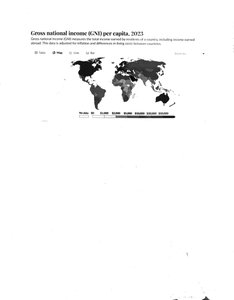
Q4. Compare the location of the sectoral activities of the diamond supply chain to the World Bank income group map. Which income groups (by country) are associated with primary, secondary, and tertiary sector activities in the diamond global supply chain? How does this diamond supply chain illustrate the logic of the theory of economic restructuring?
Background
Topic: Global Inequality, Economic Restructuring, and World Systems Theory
This question asks you to connect the locations of supply chain activities to global income levels and to explain how this pattern fits sociological theories about global economic organization and restructuring.
Key Terms and Concepts:
World Bank income groups: Classification of countries by income (low, lower-middle, upper-middle, high).
Economic restructuring: The shift of economic activities (especially manufacturing and services) to different regions based on cost, labor, and market access.
World Systems Theory: Sociological theory that explains global inequality through core, semi-periphery, and periphery relationships.
Step-by-Step Guidance
Compare the map of diamond supply chain activities to the World Bank income group map (Figure 47).
Identify which income groups are most associated with primary sector activities (e.g., mining in low- and middle-income countries).
Determine which income groups are linked to secondary sector activities (e.g., manufacturing in middle-income countries).
Note which income groups dominate tertiary sector activities (e.g., retail in high-income countries).
Think about how this pattern reflects the logic of economic restructuring and world systems theory, where lower-value activities are located in lower-income regions and higher-value activities in higher-income regions.
Try solving on your own before revealing the answer!
Final Answer:
Primary sector activities are concentrated in low- and lower-middle-income countries (Africa, Russia), secondary sector activities in middle-income countries (India, China), and tertiary sector activities in high-income countries (U.S., Western Europe). This pattern illustrates economic restructuring and world systems theory, as high-value activities are concentrated in core (wealthy) regions, while lower-value extraction occurs in the periphery.
