 뒤로
뒤로Theories of Space: Henri Lefebvre and the Production of Social Space
스터디 가이드 - 스마트 노트
 자료에 맞춘 맞춤형 노트, 핵심 정의, 예시, 맥락을 확장해 제공합니다.
Theories of Space in Sociology
Introduction to Spatial Approaches in Sociology
Spatial approaches in sociology examine how space and society interact, focusing on the ways humans organize, produce, and make sense of their environments. This perspective is foundational in human geography and is crucial for understanding social structures, institutions, and everyday life.
Geography: The scientific and systematic study of both physical and cultural features of the earth’s surface, emphasizing spatial patterns and distributions.
Human Geography: The study of spatial differentiation and organization of human activity, including how people make places and interact across space.
Key Sociological Relevance: Human geography provides insight into how society is structured spatially, influencing social interaction, stratification, and institutions.
Physical vs. Human Geography
Geography is divided into two main branches: physical geography and human (or cultural) geography.
Physical Geography: Focuses on the four spheres—Lithosphere (land), Atmosphere (air), Hydrosphere (water), and Biosphere (living things).
Human Geography: Examines spatial organization of human activity, including social, economic, and cultural processes.
Henri Lefebvre: Overview and Contributions
Henri Lefebvre’s Background
Henri Lefebvre was a French Marxist theorist whose work spans philosophy, sociology, urban studies, and political science. His most influential book, The Production of Space, critiques structuralism and existentialism, and introduces a Marxist analysis of space.
Key Areas: Social space, dialectical materialism, modernity, urban politics, state theory, globalization.
Academic Influence: Lefebvre’s radical transdisciplinarity led to limited reception in English-speaking academia, but his ideas are foundational for spatial sociology.

The Production of Social Space
Lefebvre’s Theory of Social Space
Lefebvre argues that humans produce social space through their social relations, practices, and institutions. Space is not merely a container or object, but a product and means of production, shaped by social, political, and economic forces.
Key Concept: Humans produce their own life, consciousness, and world, mobilizing spatial elements rationally.
Dialectic of Space: Social relations exist only in and through space; space is both the result and cause of social action.
Space as Social Reality: Space is a set of relations and forms, interrelating everything produced by nature or society.
Boundaries and Communication of Social Space
Social spaces have physical borders and conceptual boundaries, which are produced, marked, and communicated through symbols, discourse, and practices.
Physical Boundaries: Natural features (mountains, valleys) and political borders (nation states).
Symbolic Boundaries: Passports, maps, and signs communicate closure and access.
Political Production: Borders are historical results of wars and political struggles, defined by conventions and power.
Lefebvre’s Triad: Perceived, Conceived, and Lived Space
Lefebvre distinguishes three levels of social space, forming a dialectical relationship:
Perceived Space: Social practices and everyday routines.
Conceived Space: Representations and plans by experts (architects, planners).
Lived Space: Spaces of representation, collective meanings, and lived experience.
Level | Description |
|---|---|
Perceived | Everyday spatial practices |
Conceived | Representations and plans |
Lived | Spaces of representation and meaning |
Dominated vs. Appropriated Space
Lefebvre distinguishes between dominated spaces (controlled by state and capital) and appropriated spaces (lived and used by individuals).
Dominated Space: Political and economic spaces shaped by state power and capitalism.
Appropriated Space: Spaces of everyday life, subjective and concrete.
Abstract Space: Organized for calculation, quantification, and exchange; often fragments and obscures social relations.
Social Systems, Institutions, and Structures
Social systems are regularized relations in space and time, forming the basis for institutions such as the parliamentary system, legal system, education, and health care.
Structures: Enable and constrain practices, making social systems durable.
Institutions: Large-scale social systems with key societal roles.
Space as Bounded Collection: Social spaces are bounded combinations of relations, structures, systems, and institutions.
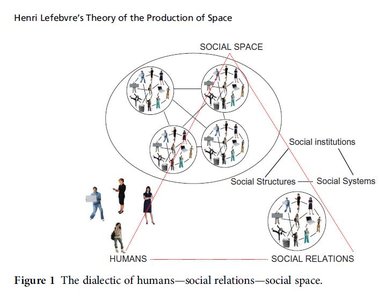
Communication and the Reproduction of Social Space
Communication is central to the production and reproduction of social relations, structures, systems, and spaces. It involves both verbal and non-verbal codes, technologies, and practices.
Role of Communication: Enables the living and reproduction of social space in everyday life.
Continuity: Social systems and spaces persist beyond individual members, maintained through communicative practices.
Modernity, Globalization, and Space
Modernization and Globalization
Globalization is rooted in modernization, representing an enlargement of modernity. It involves the production and management of space on a global scale, often leading to homogenization and increased inequality.
Modernization: Inherently globalizing, reshaping social, economic, and political spaces.
Globalization: Enlarges modernity, rescaling and reterritorializing governance and citizenship.
Critique: Lefebvre critiques modern modalities of thinking, abstract space, and the privileged position of time.
Rescaling, Reterritorialization, and Reorientation
Globalization leads to changes in the scale of citizenship, policy delivery, and spatial organization. The state reasserts itself through new regional blocs, while cities and production clusters gain prominence.
Rescaling: Nested spatialization from micro- to macro-level.
Reterritorialization: New arrangements of territories, increased geographic inequality.
Reorientation: Changing expectations of state power, importance of cities and global coalitions.
Counterspaces and Contradictory Spaces
Social space can resist bureaucratic management, giving rise to counterspaces—alternative spatial systems and practices. Leisure spaces, such as beaches, exemplify contradictory spaces where social relations and labor are reproduced.
Counterspaces: Sites of resistance and alternative social arrangements.
Contradictory Spaces: Zones of rupture in abstract space, unifying body-subject and body-object.
Postmodernism and Spatial Theory
Postmodernism: Respatialization
Postmodernism disrupts traditional cognitive mapping, eroding modernist categories such as the individual, city, and nation-state. It emphasizes the dualism of presence and absence, material and abstract, proximate and remote.
Presence and Absence: Cultural oppositions shape spatial understanding.
Impact: Unravels guiding metaphors and categories, leading to new forms of spatialization.
World Systems Theory and Global Space
Immanuel Wallerstein’s World Systems Theory
Wallerstein’s theory parallels Lefebvre’s analysis, describing the capitalist world-economy as a global division of labor with core, semiperiphery, and periphery zones. This division leads to fetishistic forms of labor and limits political organization among workers.
Global Space: International division of labor, spatial separation of production.
Social Implications: Workers are disconnected, unable to communicate or organize politically.
Definitions and Changing Space
Different Definitions of Space
Space has been defined variously as a container, a mental construct, and a social product. Lefebvre’s approach emphasizes space as socially produced, shaped by power relations and historical context.
Container: Space as a natural setting for events.
Mental Construct: Space shaped by cognitive processes (mental maps).
Social Product: Space gains meaning through social production and relations.
Changing Space: Space is situated in history and changes through time, influenced by power relations and social practices.
Summary and Further Study
Lefebvre’s theory of the production of space provides a critical framework for understanding how social relations, structures, systems, and institutions are produced and reproduced in space. It is essential for analyzing modernity, globalization, state power, and postmodern spatialization in sociology.
Next Steps: Tutorial discussion on space and society; practical research on spatial problems and questions; upcoming lecture on nationalism and exclusion.
