 뒤로
뒤로Chapter 3: Probability – Conditional Probability and the Multiplication Rule
스터디 가이드 - 스마트 노트
 자료에 맞춘 맞춤형 노트, 핵심 정의, 예시, 맥락을 확장해 제공합니다.
Probability
Basic Concepts of Probability and Counting
Probability is a fundamental concept in statistics that quantifies the likelihood of events occurring. It is used to make predictions and informed decisions based on data.
Probability is the measure of how likely an event is to occur, expressed as a number between 0 and 1.
Sample space refers to the set of all possible outcomes of an experiment.
Event is any subset of the sample space.
Counting techniques, such as permutations and combinations, are used to determine the number of possible outcomes.
Conditional Probability
Conditional probability is the probability of an event occurring given that another event has already occurred. It is denoted as , which reads as "the probability of B, given A."
Conditional Probability Formula:
Used when the occurrence of one event affects the probability of another event.
Example: If two cards are drawn from a deck without replacement, the probability that the second card is a queen given the first card is a king is calculated using conditional probability.
Example: In a survey, the probability that an adult is 18 to 64 years old given that they have ridden as a passenger in a self-driving vehicle is .
Independent and Dependent Events
Events can be classified as independent or dependent based on whether the occurrence of one affects the probability of the other.
Independent Events: The occurrence of one event does not affect the probability of the other event.
Dependent Events: The occurrence of one event affects the probability of the other event.
Example of dependent events: Drawing a king from a deck, not replacing it, then drawing a queen.
Example: Driving over 85 miles per hour and getting in a car accident are dependent events because the first increases the probability of the second.
The Multiplication Rule
The multiplication rule is used to find the probability that two events occur in sequence. For independent events, the rule simplifies.
General Multiplication Rule:
For Independent Events:
Can be extended to more than two events.
Example: Drawing a king and then a queen from a deck without replacement (dependent events).
Example: Tossing a head and then rolling a 6 (independent events).
"At Least" vs "At Most" Probabilities
These terms are used to describe the number of occurrences in probability problems.
At least one: One or more occurrences (1, 2, 3, ...).
At most one: One or fewer occurrences (0 or 1).
Probability of at least one:
Example: Probability with Defective Tires
Suppose you purchase a set of four tires, and the manufacturer states that 3% of all tires produced are defective. The company provides full replacement for any defective tire.
Probability that none are defective:
Probability that all four are defective:
Probability that at least one is defective:
Probability that at least one is not defective:

Example: Medical Residency Matching
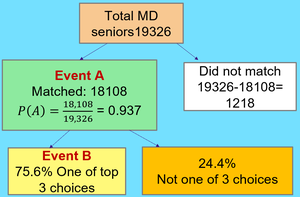
In a recent year, 19,326 U.S. MD medical school seniors applied to residency programs. Of these, 18,108 were matched with residency positions, and 75.6% got one of their top three choices.
Total seniors: 19,326
Matched: 18,108 ()
Did not match: 1,218
Matched to one of top 3 choices: 75.6%
Not matched to one of top 3 choices: 24.4%
Probability of being matched and getting one of top 3 choices:
Since , this event is likely to happen.
Summary Table: Multiplication Rule for Probability
The following table summarizes the multiplication rule for independent and dependent events:
Type of Events | Formula | Example |
|---|---|---|
Independent | Tossing a coin and rolling a die | |
Dependent | Drawing two cards without replacement |
Additional info:
These notes expand on the brief points in the original materials, providing definitions, formulas, and examples for clarity and completeness. The images included directly reinforce the probability concepts discussed in the relevant paragraphs.
