 뒤로
뒤로Chapter 4: Probability – Foundations and Applications in Statistics CHAP 4
스터디 가이드 - 스마트 노트
 자료에 맞춘 맞춤형 노트, 핵심 정의, 예시, 맥락을 확장해 제공합니다.
Probability: Basic Concepts and Rules
Introduction to Probability
Probability is a fundamental concept in statistics that quantifies the likelihood of events occurring in a random experiment. Understanding probability is essential for making informed decisions based on data and uncertainty.
Event: Any collection of results or outcomes of a procedure.
Simple Event: An outcome that cannot be broken down into simpler components.
Sample Space: The set of all possible simple events for a procedure.
Example: For a single birth, the sample space is {boy, girl}. For three births, the sample space is {bbb, bbg, bgb, bgg, gbb, gbg, ggb, ggg}.
Probability Notation and Values
P(A): Probability of event A occurring.
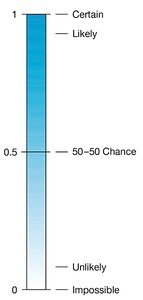
Probabilities are always between 0 and 1:
Three Approaches to Probability
Relative Frequency Approximation: Probability is estimated by the proportion of times an event occurs in a large number of trials.
Classical Approach: If all outcomes are equally likely, , where s is the number of ways A can occur, and n is the total number of simple events.
Subjective Probability: Probability is estimated based on knowledge or intuition about the situation.
Simulations: When direct calculation is not possible, simulations can be used to estimate probabilities by mimicking the process.
Law of Large Numbers
As the number of trials increases, the relative frequency probability of an event approaches the actual probability. This law applies only to large numbers of trials, not individual outcomes.
Rules and Properties of Probability
Complementary Events
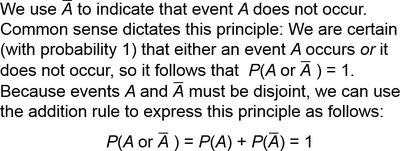
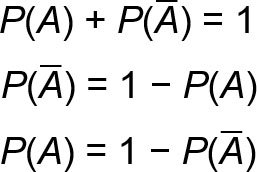
The complement of event A (denoted as ) is the event that A does not occur. The sum of the probabilities of an event and its complement is 1:
Addition Rule for Probability
The addition rule is used to find the probability that at least one of two events occurs.
Formal Addition Rule:
If events A and B are disjoint (mutually exclusive), .
Example: Selecting a person who is either a male or a female (disjoint events).
Multiplication Rule for Probability
The multiplication rule is used to find the probability that two events both occur.
Formal Multiplication Rule:
If A and B are independent, , so
Conditional Probability
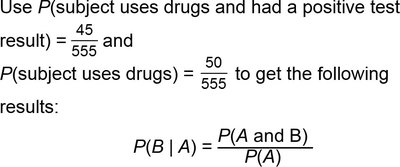
The probability of event B occurring given that event A has already occurred is called conditional probability and is denoted .
Confusion of the Inverse
In general, . Confusing these two probabilities is a common error in interpreting statistical results.
Bayes’ Theorem
Bayes’ theorem allows us to update the probability of an event based on new information. It is especially useful in medical testing and diagnostic problems.
Counting Rules in Probability
Multiplication Counting Rule
If a sequence of events occurs in ways respectively, the total number of outcomes is .
Example: The number of 4-digit passcodes using digits 0-9 is .
Factorial Rule
The number of ways to arrange n different items is (n factorial).
By definition,
Permutations and Combinations
Permutations: Arrangements where order matters. The number of permutations of n items taken r at a time is
Combinations: Arrangements where order does not matter. The number of combinations of n items taken r at a time is
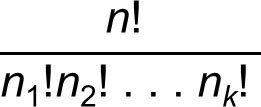
Permutations with Identical Items: If there are n items, with alike, alike, ..., alike, the number of distinct arrangements is:
Examples and Applications
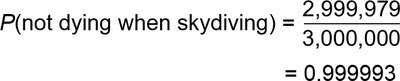
Skydiving Probability Example
Given 3,000,000 skydiving jumps and 21 deaths, the probability of dying in a jump is:

The probability of surviving is:
Complementary Probability Example
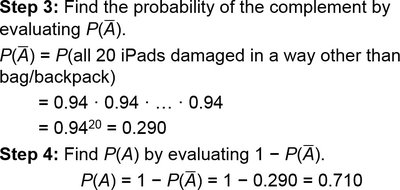
To find the probability of getting at least one iPad damaged in a bag/backpack among 20, use the complement rule:
Let A = at least one iPad damaged in a bag/backpack
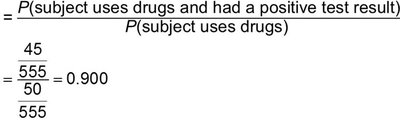
Conditional Probability Example: Drug Testing
Positive Test | Negative Test | |
|---|---|---|
Uses Drugs | 45 | 5 |
Does Not Use Drugs | 25 | 480 |
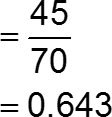
Counting Example: Passcodes
For a 4-digit passcode, the probability of guessing correctly on the first try is:
Counting Example: Lottery
In a lottery where you must select 5 numbers from 39, the probability of winning with one ticket is:
Summary Table: Key Probability Rules
Rule | Formula | When to Use |
|---|---|---|
Addition Rule | Finding probability of A or B | |
Multiplication Rule | Finding probability of A and B | |
Complement Rule | Finding probability of event not occurring | |
Conditional Probability | Probability of B given A | |
Permutations | Arrangements where order matters | |
Combinations | Arrangements where order does not matter |
