 뒤로
뒤로Chapter 4: Probability – Fundamental Concepts and Applications
스터디 가이드 - 스마트 노트
 자료에 맞춘 맞춤형 노트, 핵심 정의, 예시, 맥락을 확장해 제공합니다.
Probability: Basic Concepts
Introduction to Probability
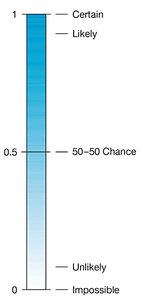
Probability is a foundational concept in statistics, quantifying the likelihood of events occurring in a random experiment. Probability values range from 0 (impossible event) to 1 (certain event), and are used to interpret and predict outcomes in various contexts, such as games of chance, scientific studies, and everyday decision-making.
Event: Any collection of results or outcomes of a procedure.
Simple Event: An outcome that cannot be further broken down into simpler components.
Sample Space: The set of all possible simple events for a procedure.
Examples of Simple Events and Sample Spaces
Single Birth: Sample space = {b, g} (b = boy, g = girl).
Three Births: Sample space = {bbb, bbg, bgb, bgg, gbb, gbg, ggb, ggg}.
Rolling a Die: The outcome of rolling a 5 is a simple event; the outcome of rolling an even number is not a simple event, as it can be broken down further.
Three Common Approaches to Finding Probability
Probability Notation and Range
P(A): Probability of event A occurring.
Probability values satisfy .
1. Relative Frequency Approximation
This approach estimates probability based on the outcomes of repeated trials of an experiment.
Formula:
Example: If 16 out of 39,000,000 airline flights crashed,
2. Classical Approach (Equally Likely Outcomes)
Used when all simple events are equally likely.
Formula:
Caution: Only use when outcomes are equally likely.
3. Subjective Probability
Probability is estimated based on knowledge, experience, or intuition about the situation.
Example: Estimating the chance of rain based on weather patterns.
Simulations
When none of the above approaches are feasible, simulations can be used to model a procedure and estimate probabilities by mimicking real-life processes.
Rounding Probabilities
Express probabilities as exact fractions or decimals, or round to three significant digits for clarity.
Example: or
Worked Examples
Example: Probability from Survey Data
366 adults answered "yes" to seeing a ghost; 1637 answered "no"; total responses = 2003.
Probability:
Interpretation: There is an 18.3% chance a randomly selected adult reports seeing a ghost.
Significance in Probability
Identifying Significant Results
Significantly High: x successes among n trials is significantly high if .
Significantly Low: x successes among n trials is significantly low if .
The threshold 0.05 is commonly used but not absolute.
Complementary Events
Definition and Notation
Complement of A (denoted ): All outcomes where event A does not occur.
Probability of Complement:
Probability Review
Probability is always between 0 and 1 (inclusive).
Impossible event:
Certain event:
Notation: for event A, for the complement of A.
Odds
Actual Odds Against and In Favor
Actual Odds Against A: , usually expressed as a:b.
Actual Odds In Favor of A: , the reciprocal of odds against.
If odds against are a:b, odds in favor are b:a.
Example: Roulette Odds
Probability of winning on 13:
Probability of not 13:
Actual odds against 13:
Casino payoff odds: 35:1 (less than actual odds, favoring the casino)
If payoff odds matched actual odds (37:1), a $5 bet would yield $185 profit.
Summary Table: Probability Approaches
Approach | Formula | When to Use |
|---|---|---|
Relative Frequency | When historical data or repeated trials are available | |
Classical | When all outcomes are equally likely | |
Subjective | Based on expert judgment or knowledge | When neither data nor equally likely outcomes are available |
