
Ch. 10 - Chi-Square Tests and the F-Distribution
Larson - Elementary Statistics: Picturing the World 8th Edition
Larson8th EditionElementary Statistics: Picturing the WorldISBN: 9780137493470당신이 사용하는 게 아니라요?교과서 변경
10장, 문제 11.1.6

List the two conditions that must be met in order to use the paired-sample sign test.

검증된 단계별 안내
1
The first condition for using the paired-sample sign test is that the data must consist of paired observations. This means that each observation in one sample is uniquely matched to an observation in the other sample, often representing measurements taken on the same subject under two different conditions or at two different times.
The second condition is that the paired observations must be ordinal or at least capable of being ranked. The sign test does not require interval or ratio-level data, but it does require that the differences between paired observations can be classified as positive, negative, or zero.

비슷한 문제에 대한 검증된 영상 답변:

이 영상 해법은 위 문제에 도움이 된다고 튜터들이 추천한 것입니다.
영상 길이:
3m

주요 개념

질문에 올바르게 답하기 위해 반드시 이해해야 하는 핵심 개념들은 다음과 같습니다.

Paired Samples

Paired samples refer to two sets of related observations, where each observation in one sample is uniquely matched with an observation in the other sample. This relationship is crucial for the paired-sample sign test, as it assesses the differences between these matched pairs rather than treating the samples as independent. Examples include measurements taken before and after a treatment on the same subjects.
추천 영상:
가이드 코스
08:33
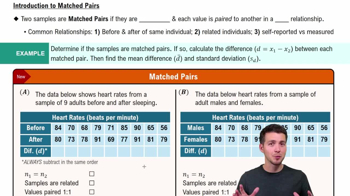
Introduction to Matched Pairs

Non-Normality of Differences

The paired-sample sign test is a non-parametric method used when the differences between paired observations do not follow a normal distribution. This condition is essential because the test relies on the ranks of the differences rather than their actual values, making it suitable for data that may be skewed or ordinal in nature. It allows for valid statistical inference without the assumption of normality.
추천 영상:
가이드 코스
03:17
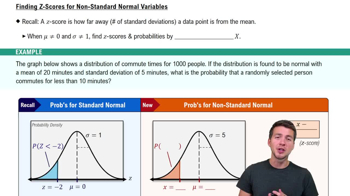
Finding Z-Scores for Non-Standard Normal Variables

Symmetry of Differences

For the paired-sample sign test to be valid, the distribution of the differences between paired observations should be symmetric around the median. This condition ensures that the test accurately reflects the central tendency of the differences, allowing for reliable conclusions about the population from which the samples are drawn. If the differences are highly skewed, alternative methods may be more appropriate.
추천 영상:
가이드 코스
08:21
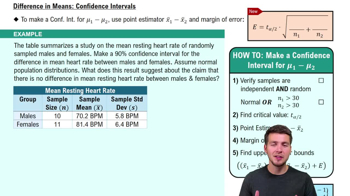
Difference in Means: Confidence Intervals
관련 실천
교과서 질문

Performing a Chi-Square Goodness-of-Fit Test

In Exercises 7–16, (b) find the critical value and identify the rejection region.


Ways to Pay A financial analyst claims that the distribution of people’s preferences on how to pay for goods is different from the distribution shown in the figure. You randomly select 600 people and record their preferences on how to pay for goods. The table shows the results. At α=0.01, test the financial analyst’s claim. (Adapted from Travis Credit Union)


49
views
교과서 질문

Performing a Chi-Square Goodness-of-Fit Test

In Exercises 7–16, (c) find the chi-square test statistic.


Ways to Pay A financial analyst claims that the distribution of people’s preferences on how to pay for goods is different from the distribution shown in the figure. You randomly select 600 people and record their preferences on how to pay for goods. The table shows the results. At α=0.01, test the financial analyst’s claim. (Adapted from Travis Credit Union)


67
views
교과서 질문

Performing a Chi-Square Goodness-of-Fit Test

In Exercises 7–16, (d) decide whether to reject or fail to reject the null hypothesis.


Ways to Pay A financial analyst claims that the distribution of people’s preferences on how to pay for goods is different from the distribution shown in the figure. You randomly select 600 people and record their preferences on how to pay for goods. The table shows the results. At α=0.01, test the financial analyst’s claim. (Adapted from Travis Credit Union)


79
views