
Ch. 3 - Probability
Larson - Elementary Statistics: Picturing the World 8th Edition
Larson8th EditionElementary Statistics: Picturing the WorldISBN: 9780137493470당신이 사용하는 게 아니라요?교과서 변경
3장, 문제 3.3.1

1. When two events are mutually exclusive, why is P(A and B) = 0?

검증된 단계별 안내
1
Understand the concept of mutually exclusive events: Two events are mutually exclusive if they cannot occur at the same time. For example, flipping a coin and getting both heads and tails simultaneously is impossible, making these events mutually exclusive.
Recall the definition of the intersection of events: The intersection of two events, denoted as P(A and B), represents the probability that both events A and B occur simultaneously.
Apply the property of mutually exclusive events: Since mutually exclusive events cannot happen at the same time, the intersection of these events is empty. Mathematically, this means P(A and B) = 0.
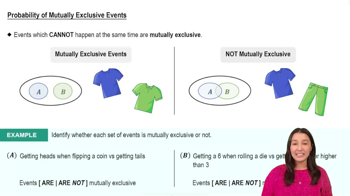
Visualize the concept using a Venn diagram: In a Venn diagram, mutually exclusive events do not overlap. The absence of overlap visually confirms that P(A and B) = 0.
Conclude with the reasoning: The probability of two mutually exclusive events occurring together is zero because their definitions inherently prevent simultaneous occurrence.

비슷한 문제에 대한 검증된 영상 답변:

이 영상 해법은 위 문제에 도움이 된다고 튜터들이 추천한 것입니다.
영상 길이:
1m
도움이 되었나요?

주요 개념

질문에 올바르게 답하기 위해 반드시 이해해야 하는 핵심 개념들은 다음과 같습니다.

Mutually Exclusive Events

Mutually exclusive events are those that cannot occur simultaneously. If one event happens, the other cannot. For example, when flipping a coin, getting heads and tails at the same time is impossible. This concept is crucial for understanding why the probability of both events occurring together is zero.
추천 영상:
5:14
Probability of Mutually Exclusive Events

Probability of Events

Probability is a measure of the likelihood that an event will occur, expressed as a number between 0 and 1. The probability of two events occurring together, denoted as P(A and B), is calculated based on their individual probabilities. For mutually exclusive events, since they cannot happen at the same time, the probability of both occurring is always zero.
추천 영상:
05:54
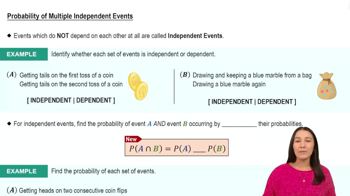
Probability of Multiple Independent Events

Addition Rule of Probability

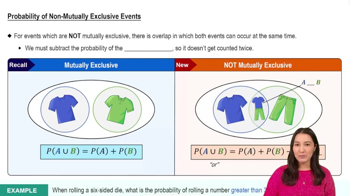
The addition rule of probability states that for any two events A and B, the probability of either A or B occurring is the sum of their individual probabilities, minus the probability of both occurring together. For mutually exclusive events, since P(A and B) = 0, the rule simplifies to P(A or B) = P(A) + P(B), reinforcing that they cannot happen at the same time.
추천 영상:
5:14
Probability of Non-Mutually Exclusive Events
관련 실천
교과서 질문

"According to Bayes’ Theorem, the probability of event A , given that event B has occurred, is

P(A|B) = P(A) * P(B|A)P(A) * P(B|A) + P(A') * P(B|A').

In Exercises 33–38, use Bayes’ Theorem to find P(A|B).

35. P(A) = 0.25, P(A') = 0.75, P(B|A) = 0.3 , and P(B|A') = 0.5 "

104
views
교과서 질문

True or False? In Exercises 3-6, determine whether the statement is true or false. If it is false, rewrite it as a true statement.

3. A combination is an ordered arrangement of objects.

101
views
교과서 질문

Cards In Exercises 59-62, you are dealt a hand of five cards from a standard deck of 52 playing cards.

62. Find the probability of being dealt three of a kind (the other two cards are different from each other).

146
views
교과서 질문

Matching Probabilities In Exercises 11-16, match the event with its probability.

a. 0.95

b. 0.005

c. 0.25

d. 0

e. 0.375

f. 0.5

11. A random number generator is used to select a number from 1 to 100. What is the probability of selecting the number 153?

111
views
교과서 질문

Classifying Events Based on Studies In Exercises 15-18, identify the two events described in the study. Do the results indicate that the events are independent or dependent? Explain your reasoning.

17. A study found that there is no relationship between playing violent video games and aggressive or bullying behavior in teenagers. (Source: The Royal Society Publishing)

75
views
교과서 질문

Boy or Girl? In Exercises 71-74, a couple plans to have three children. Each child is equally likely to be a boy or a girl.

74. What is the probability that at least one child is a boy?

111
views