
교과서 질문
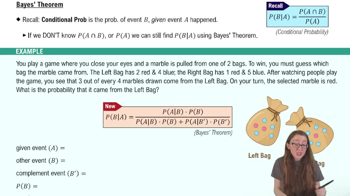
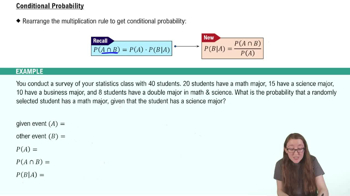
1. When two events are mutually exclusive, why is P(A and B) = 0?
264
views

 검증된 단계별 안내
 05:10
05:10
 03:53
03:53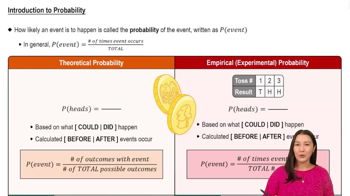 5:37
5:371. When two events are mutually exclusive, why is P(A and B) = 0?
True or False? In Exercises 3-6, determine whether the statement is true or false. If it is false, rewrite it as a true statement.
3. A combination is an ordered arrangement of objects.
Cards In Exercises 59-62, you are dealt a hand of five cards from a standard deck of 52 playing cards.
62. Find the probability of being dealt three of a kind (the other two cards are different from each other).
Matching Probabilities In Exercises 11-16, match the event with its probability.
a. 0.95
b. 0.005
c. 0.25
d. 0
e. 0.375
f. 0.5
11. A random number generator is used to select a number from 1 to 100. What is the probability of selecting the number 153?
Classifying Events Based on Studies In Exercises 15-18, identify the two events described in the study. Do the results indicate that the events are independent or dependent? Explain your reasoning.
17. A study found that there is no relationship between playing violent video games and aggressive or bullying behavior in teenagers. (Source: The Royal Society Publishing)
Cards In Exercises 59-62, you are dealt a hand of five cards from a standard deck of 52 playing cards.
59. Find the probability of being dealt two clubs and one of each of the other three suits.