Ch. 3 - Probability
Larson - Elementary Statistics: Picturing the World 8th Edition
Larson8th EditionElementary Statistics: Picturing the WorldISBN: 9780137493470당신이 사용하는 게 아니라요?교과서 변경
3장, 문제 3.4.1

1. When you calculate the number of permutations of n distinct objects taken r at a time, what are you counting? Give an example.

검증된 단계별 안내
1
Understand the concept of permutations: Permutations refer to the arrangement of objects in a specific order. When calculating the number of permutations of n distinct objects taken r at a time, you are counting the number of possible ordered arrangements of r objects selected from a total of n objects.
Recall the formula for permutations: The number of permutations of n distinct objects taken r at a time is given by the formula P(n, r) = n! / (n - r)!, where '!' denotes factorial (the product of all positive integers up to that number).
Break down the formula: The numerator, n!, represents the total number of ways to arrange all n objects. The denominator, (n - r)!, removes the arrangements of the remaining (n - r) objects that are not selected, leaving only the arrangements of the r selected objects.
Provide an example: Suppose you have 5 distinct objects (A, B, C, D, E) and want to calculate the number of permutations when selecting 3 objects at a time. Using the formula, P(5, 3) = 5! / (5 - 3)!. This simplifies to 5! / 2!.
Explain the result conceptually: The result represents the total number of ways to arrange 3 objects (in a specific order) chosen from the 5 distinct objects. For example, one possible arrangement is (A, B, C), and another is (C, A, B).

비슷한 문제에 대한 검증된 영상 답변:

이 영상 해법은 위 문제에 도움이 된다고 튜터들이 추천한 것입니다.
영상 길이:
3m
도움이 되었나요?

주요 개념

질문에 올바르게 답하기 위해 반드시 이해해야 하는 핵심 개념들은 다음과 같습니다.

Permutations

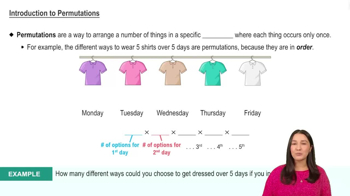
Permutations refer to the different arrangements of a set of objects where the order matters. When calculating permutations of n distinct objects taken r at a time, you are counting the number of ways to arrange r objects selected from a total of n. For example, if you have three distinct letters A, B, and C, the permutations of 2 letters taken from these would include AB, AC, BA, BC, CA, and CB, totaling six arrangements.
추천 영상:
가이드 코스
07:11
Introduction to Permutations

Factorial

The factorial of a non-negative integer n, denoted as n!, is the product of all positive integers up to n. It is a fundamental concept in combinatorics used to calculate permutations and combinations. For instance, 4! equals 4 × 3 × 2 × 1 = 24, which represents the total arrangements of four distinct objects.
추천 영상:

Combination vs. Permutation

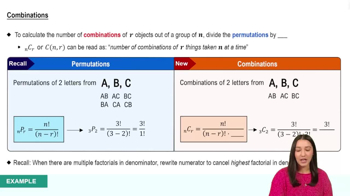
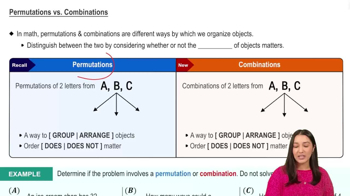
While both permutations and combinations deal with selecting items from a set, the key difference lies in the importance of order. Permutations consider the arrangement of selected items as significant, whereas combinations focus solely on the selection itself, disregarding order. For example, selecting the letters A and B is the same in combinations (AB) but different in permutations (AB vs. BA).
추천 영상:
가이드 코스
03:18
Permutations vs. Combinations