Ch. 3 - Probability
Larson - Elementary Statistics: Picturing the World 8th Edition
Larson8th EditionElementary Statistics: Picturing the WorldISBN: 9780137493470당신이 사용하는 게 아니라요?교과서 변경
3장, 문제 3.2.2

"2. Give an example of
a. two events that are independent.
b. two events that are dependent."

검증된 단계별 안내
1
Understand the concept of independent events: Two events are independent if the occurrence of one event does not affect the probability of the other event. Mathematically, events A and B are independent if P(A ∩ B) = P(A) * P(B).
Understand the concept of dependent events: Two events are dependent if the occurrence of one event affects the probability of the other event. For example, if event A occurs, it changes the likelihood of event B occurring.
For part (a), think of two events that do not influence each other. For example, flipping a coin and rolling a die are independent events because the outcome of the coin flip does not affect the outcome of the die roll.
For part (b), think of two events where one affects the other. For example, drawing two cards from a deck without replacement is a dependent event because the outcome of the first draw changes the probabilities for the second draw.
Summarize your examples and verify that they align with the definitions of independence and dependence. Ensure that for independent events, P(A ∩ B) = P(A) * P(B), and for dependent events, the probabilities are influenced by the occurrence of one event.

비슷한 문제에 대한 검증된 영상 답변:

이 영상 해법은 위 문제에 도움이 된다고 튜터들이 추천한 것입니다.
영상 길이:
4m
도움이 되었나요?

주요 개념

질문에 올바르게 답하기 위해 반드시 이해해야 하는 핵심 개념들은 다음과 같습니다.

Independent Events

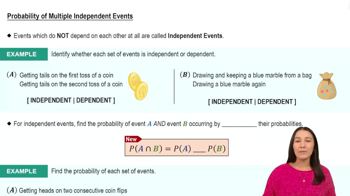
Independent events are two or more events where the occurrence of one event does not affect the probability of the other event occurring. For example, flipping a coin and rolling a die are independent events; the outcome of the coin flip has no impact on the result of the die roll.
추천 영상:
05:54
Probability of Multiple Independent Events

Dependent Events

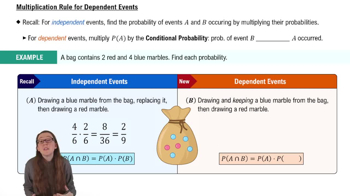
Dependent events are events where the occurrence of one event influences the probability of the other event occurring. For instance, drawing two cards from a deck without replacement is a dependent event; the outcome of the first draw affects the composition of the deck for the second draw.
추천 영상:
05:17
Multiplication Rule: Dependent Events

Probability

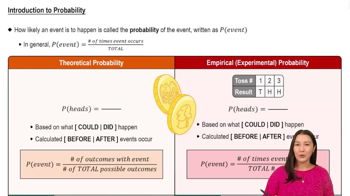
Probability is a measure of the likelihood that a particular event will occur, expressed as a number between 0 and 1. Understanding probability is essential for distinguishing between independent and dependent events, as it helps quantify how the occurrence of one event impacts the likelihood of another.
추천 영상:
5:37
Introduction to Probability
관련 실천
교과서 질문

1. When you calculate the number of permutations of n distinct objects taken r at a time, what are you counting? Give an example.

221
views

교과서 질문

"Classifying Events as Independent or Dependent In Exercises 9-14, determine whether the events are independent or dependent. Explain your reasoning.

12. Not putting money in a parking meter and getting a parking ticket"

74
views
교과서 질문

13. Students A physics class has 40 students. Of these, 12 students are physics majors and 16 students are minoring in math. Of the physics majors, three are minoring in math. Find the probability that a randomly selected student is minoring in math or a physics major.

131
views
교과서 질문

"Classifying Events Based on Studies In Exercises 15-18, identify the two events described in the study. Do the results indicate that the events are independent or dependent? Explain your reasoning.

15. A study was conducted to debunk the idea that abilities in music and math are related. Instead, the study showed a strong relationship between achievements in music and math.

(Source: University of Kansas)"

59
views
교과서 질문

Classifying Events as Independent or Dependent In Exercises 9-14, determine whether the events are independent or dependent. Explain your reasoning.

11. Returning a rented movie after the due date and receiving a late fee

109
views
교과서 질문

16. Can Defects Of the cans produced by a company, 96% do not have a puncture, 93% do not have a smashed edge, and 89.3% have neither a puncture nor a smashed edge. Find

the probability that a randomly selected can does not have a puncture or a smashed edge.

88
views