
Ch. 3 - Probability
Larson - Elementary Statistics: Picturing the World 8th Edition
Larson8th EditionElementary Statistics: Picturing the WorldISBN: 9780137493470당신이 사용하는 게 아니라요?교과서 변경
3장, 문제 3.4.31

31. Experiment A researcher is randomly selecting a treatment group of 10 human subjects from a group of 20 people taking part in an experiment. In how many different ways can the treatment group be selected?

검증된 단계별 안내
1
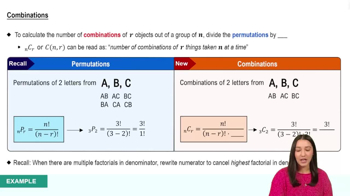
Step 1: Recognize that this is a combination problem because the order in which the subjects are selected does not matter. The formula for combinations is given by: C=n!r!(n-r)!, where n is the total number of items, and r is the number of items to choose.
Step 2: Identify the values of n and r. Here, n=20 (total number of people) and r=10 (number of people to select).
Step 3: Substitute the values of n and r into the combination formula: C=20!10!(20-10)!.
Step 4: Simplify the denominator by calculating (20-10)!, which equals 10!. The formula now becomes: C=20!10!10!.
Step 5: Cancel out the common terms in the numerator and denominator, and compute the remaining terms to find the number of ways the treatment group can be selected. This involves dividing the factorial of 20 by the product of two factorials of 10.

비슷한 문제에 대한 검증된 영상 답변:

이 영상 해법은 위 문제에 도움이 된다고 튜터들이 추천한 것입니다.
영상 길이:
1m
도움이 되었나요?

주요 개념

질문에 올바르게 답하기 위해 반드시 이해해야 하는 핵심 개념들은 다음과 같습니다.

Combinatorics

Combinatorics is a branch of mathematics dealing with combinations and permutations of objects. It provides the tools to count the number of ways to select items from a larger set without regard to the order of selection. In this context, it helps determine how many different groups of 10 can be formed from a total of 20 subjects.

Binomial Coefficient

The binomial coefficient, often denoted as 'n choose k' or C(n, k), represents the number of ways to choose k elements from a set of n elements without considering the order. It is calculated using the formula C(n, k) = n! / (k!(n-k)!), where '!' denotes factorial. This concept is essential for solving the problem of selecting the treatment group.
추천 영상:
가이드 코스
06:14
Coefficient of Determination

Factorial

A factorial, denoted as n!, is the product of all positive integers up to n. It is a fundamental concept in combinatorics used to calculate permutations and combinations. In the context of this question, factorials are used in the binomial coefficient formula to compute the total number of ways to select the treatment group from the available subjects.
추천 영상:
05:22
Combinations
관련 실천
교과서 질문

Identifying the Sample Space of a Probability Experiment In Exercises 25-32, identify the sample space of the probability experiment and determine the number of outcomes in the sample space. Draw a tree diagram when appropriate.

28. Identifying a person's eye color (brown, blue, green, hazel, gray, other) and hair color (black, brown, blonde, red, other).

113
views
교과서 질문

The table shows the results of a survey in which 3,545,286 public and 509,168 private school teachers were asked about their full-time teaching experience.

Are the events “being a public school teacher” and “having more than 20 years of full-time teaching experience” independent? Explain.

87
views
교과서 질문

In Exercises 7-14, perform the indicated calculation.

9.8C3

136
views
교과서 질문

In Exercises 15-18, determine whether the situation involves permutations, combinations, or neither. Explain your reasoning.

15. The number of ways 16 floats can line up in a row for a parade

89
views
교과서 질문

Using a Frequency Distribution to Find Probabilities In Exercises 49-52, use the frequency distribution at the left, which shows the population of the United States by age group, to find the probability that a U.S. resident chosen at random is in the age range. (Source: U.S. Census Bureau)

49. 18 to 24 years old

134
views
교과서 질문

The table shows the numbers (in thousands) of earned degrees by level in two different fields, conferred in the United States in a recent year. (Source: U.S. National Center for Education Statistics)

A person who earned a degree in the year is randomly selected. Find the probability that the degree earned by the person is a

a. bachelor's degree.

84
views