
Ch. 3 - Probability
Larson - Elementary Statistics: Picturing the World 8th Edition
Larson8th EditionElementary Statistics: Picturing the WorldISBN: 9780137493470당신이 사용하는 게 아니라요?교과서 변경
3장, 문제 3.Q.4

4. Determine whether the events are mutually exclusive. Then determine whether the events are independent or dependent. Explain your reasoning.
Event A: A bowler having the highest game in a 40-game tournament
Event B: Losing the bowling tournament

검증된 단계별 안내
1
Step 1: Define mutually exclusive events. Mutually exclusive events are events that cannot occur at the same time. For example, if one event happens, the other cannot happen. Analyze whether Event A (having the highest game) and Event B (losing the tournament) can occur simultaneously.
Step 2: Evaluate whether Event A and Event B are mutually exclusive. Consider if it is possible for a bowler to have the highest game in a tournament but still lose the tournament. If this is possible, the events are not mutually exclusive. If it is not possible, the events are mutually exclusive.
Step 3: Define independent and dependent events. Independent events are events where the occurrence of one event does not affect the probability of the other event occurring. Dependent events are events where the occurrence of one event affects the probability of the other event.
Step 4: Assess whether Event A and Event B are independent or dependent. Consider whether having the highest game (Event A) affects the likelihood of losing the tournament (Event B). If the outcome of one event influences the other, the events are dependent. If not, they are independent.
Step 5: Summarize your reasoning. Based on the analysis of mutual exclusivity and independence, explain your conclusions about the relationship between Event A and Event B. Provide logical justification for your determination.

비슷한 문제에 대한 검증된 영상 답변:

이 영상 해법은 위 문제에 도움이 된다고 튜터들이 추천한 것입니다.
영상 길이:
3m
도움이 되었나요?

주요 개념

질문에 올바르게 답하기 위해 반드시 이해해야 하는 핵심 개념들은 다음과 같습니다.

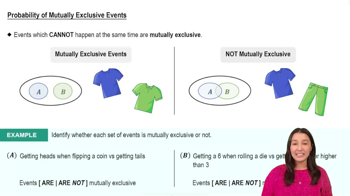
Mutually Exclusive Events

Mutually exclusive events are those that cannot occur at the same time. In the context of the question, if Event A (a bowler having the highest game) occurs, it implies that the bowler cannot simultaneously lose the tournament (Event B). Therefore, these two events are mutually exclusive.
추천 영상:
5:14
Probability of Mutually Exclusive Events

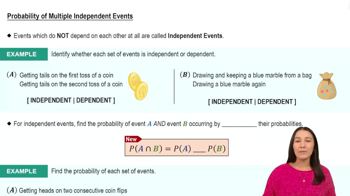
Independent Events

Independent events are those where the occurrence of one event does not affect the probability of the other event occurring. In this case, if a bowler has the highest game, it does not influence the outcome of losing the tournament, as the highest score does not guarantee winning. Thus, these events are dependent on each other.
추천 영상:
05:54
Probability of Multiple Independent Events

Dependent Events

Dependent events are those where the outcome of one event affects the outcome of another. In this scenario, if a bowler has the highest game, it is likely that they would not lose the tournament, indicating a relationship between the two events. This dependency suggests that the events are not independent.
추천 영상:
05:54
Probability of Multiple Independent Events
관련 실천
교과서 질문

The table shows the results of a survey in which 3,545,286 public and 509,168 private school teachers were asked about their full-time teaching experience.

Are the events “being a public school teacher” and “having more than 20 years of full-time teaching experience” independent? Explain.

87
views
교과서 질문

6. A shipment of 250 netbooks contains 3 defective units. Determine how many ways a vending company can buy three of these units and receive

c. at least one good unit.

92
views
교과서 질문

Using a Frequency Distribution to Find Probabilities In Exercises 49-52, use the frequency distribution at the left, which shows the population of the United States by age group, to find the probability that a U.S. resident chosen at random is in the age range. (Source: U.S. Census Bureau)

49. 18 to 24 years old

134
views
교과서 질문

The table shows the numbers (in thousands) of earned degrees by level in two different fields, conferred in the United States in a recent year. (Source: U.S. National Center for Education Statistics)

A person who earned a degree in the year is randomly selected. Find the probability that the degree earned by the person is a

a. bachelor's degree.

84
views
교과서 질문

The table shows the numbers (in thousands) of earned degrees by level in two different fields, conferred in the United States in a recent year. (Source: U.S. National Center for Education Statistics)

A person who earned a degree in the year is randomly selected. Find the probability that the degree earned by the person is a

g. bachelor's degree and the degree is in natural sciences/mathematics.

103
views
교과서 질문

The table shows the numbers (in thousands) of earned degrees by level in two different fields, conferred in the United States in a recent year. (Source: U.S. National Center for Education Statistics)

A person who earned a degree in the year is randomly selected. Find the probability that the degree earned by the person is a

g. bachelor's degree and the degree is in natural sciences/mathematics.

68
views