
Ch. 3 - Probability
Larson - Elementary Statistics: Picturing the World 8th Edition
Larson8th EditionElementary Statistics: Picturing the WorldISBN: 9780137493470당신이 사용하는 게 아니라요?교과서 변경
3장, 문제 3.2.34

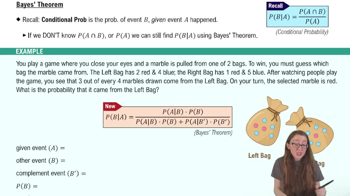
"According to Bayes’ Theorem, the probability of event A , given that event B has occurred, is
P(A|B) = P(A) * P(B|A)P(A) * P(B|A) + P(A') * P(B|A').
In Exercises 33–38, use Bayes’ Theorem to find P(A|B).
34. P(A) = 3/8, P(A') = 5/8, P(B|A) = 2/3 , and P(B|A') = 3/5 "

검증된 단계별 안내
1
Step 1: Recall Bayes' Theorem formula: P(A|B) = (P(A) * P(B|A)) / (P(A) * P(B|A) + P(A') * P(B|A')). This formula helps calculate the conditional probability of event A given that event B has occurred.
Step 2: Substitute the given values into the formula. From the problem, P(A) = 3/8, P(A') = 5/8, P(B|A) = 2/3, and P(B|A') = 3/5. Replace these values in the formula.
Step 3: Calculate the numerator of the formula, which is P(A) * P(B|A). Multiply 3/8 by 2/3.
Step 4: Calculate the denominator of the formula, which is P(A) * P(B|A) + P(A') * P(B|A'). First, calculate P(A') * P(B|A') by multiplying 5/8 by 3/5. Then, add this result to the numerator calculated in Step 3.
Step 5: Divide the numerator (from Step 3) by the denominator (from Step 4) to find P(A|B). This will give you the conditional probability of event A given that event B has occurred.

비슷한 문제에 대한 검증된 영상 답변:

이 영상 해법은 위 문제에 도움이 된다고 튜터들이 추천한 것입니다.
영상 길이:
4m
도움이 되었나요?

주요 개념

질문에 올바르게 답하기 위해 반드시 이해해야 하는 핵심 개념들은 다음과 같습니다.

Bayes' Theorem

Bayes' Theorem is a fundamental principle in probability theory that describes how to update the probability of a hypothesis based on new evidence. It states that the probability of event A given event B, denoted as P(A|B), can be calculated using the formula P(A|B) = P(A) * P(B|A) / P(B). This theorem is particularly useful in scenarios where we want to revise our beliefs in light of new data.
추천 영상:
05:10
Bayes' Theorem

Conditional Probability

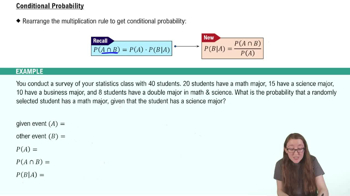
Conditional probability is the probability of an event occurring given that another event has already occurred. It is denoted as P(A|B), which represents the probability of A occurring under the condition that B is true. Understanding conditional probability is crucial for applying Bayes' Theorem, as it allows us to assess how the occurrence of one event influences the likelihood of another.
추천 영상:
03:53
Conditional Probability Rule

Prior and Posterior Probabilities

In the context of Bayes' Theorem, prior probability refers to the initial assessment of the likelihood of an event before considering new evidence, denoted as P(A). Posterior probability, on the other hand, is the updated probability after taking into account the new evidence, represented as P(A|B). Distinguishing between these two types of probabilities is essential for understanding how new information can alter our beliefs about uncertain events.
추천 영상:
5:37
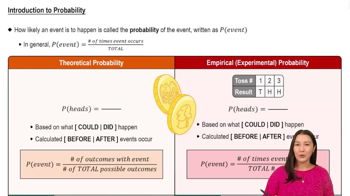
Introduction to Probability
관련 실천
교과서 질문

97. Rolling a Pair of Dice You roll a pair of six-sided dice and record the sum.

a. List all of the possible sums and determine the probability of rolling each sum.

b. Use technology to simulate rolling a pair of dice and record the sum 100 times. Make a tally of the 100 sums and use these results to list the probability of rolling

each sum.

c. Compare the probabilities in part (a) with the probabilities in part (b). Explain any similarities or differences.

143
views
교과서 질문

Finding New Music In Exercises 45–48, use the pie chart, which shows the results of a survey of 513 music listeners who were asked about their primary source for new music. (Source: The Sound of AI)

<IMAGE>

47. You choose nine music listeners at random. What is the probability that none of them say their primary source for new music is friends or social media?

71
views
교과서 질문

Using the Fundamental Counting Principle In Exercises 37-40, use the Fundamental Counting Principle.

40. True or False Quiz Assuming that no questions are left unanswered, in how many ways can a six-question true or false quiz be answered?

165
views
교과서 질문

True or False? In Exercises 3-6, determine whether the statement is true or false. If it is false, rewrite it as a true statement.

6. 7C5=7C2

119
views
교과서 질문

True or False? In Exercises 5 and 6, determine whether the statement is true or false. If it is false, rewrite it as a true statement.

6. If events A and B are dependent, then P(A and B) = P(A) · P(B).

73
views
교과서 질문

16. Can Defects Of the cans produced by a company, 96% do not have a puncture, 93% do not have a smashed edge, and 89.3% have neither a puncture nor a smashed edge. Find

the probability that a randomly selected can does not have a puncture or a smashed edge.

88
views