
Ch. 3 - Probability
Larson - Elementary Statistics: Picturing the World 8th Edition
Larson8th EditionElementary Statistics: Picturing the WorldISBN: 9780137493470당신이 사용하는 게 아니라요?교과서 변경
3장, 문제 3.4.47

Finding New Music In Exercises 45–48, use the pie chart, which shows the results of a survey of 513 music listeners who were asked about their primary source for new music. (Source: The Sound of AI)
<IMAGE>
47. You choose nine music listeners at random. What is the probability that none of them say their primary source for new music is friends or social media?

검증된 단계별 안내
1
Step 1: Identify the relevant data from the problem. The pie chart provided does not pertain to the problem about music listeners, so we will focus on the textual information given in the problem. The survey involves 513 music listeners, and we are tasked with finding the probability that none of the nine randomly chosen listeners say their primary source for new music is friends or social media.
Step 2: Determine the probability that a single listener does not choose friends or social media as their primary source for new music. This requires knowing the proportion of listeners who chose friends or social media from the survey data. If this proportion is not explicitly provided, it must be calculated or assumed based on the problem context.
Step 3: Calculate the probability that a single listener does not choose friends or social media. If the proportion of listeners who chose friends or social media is p, then the probability of not choosing friends or social media is (1 - p).
Step 4: Use the binomial probability formula to calculate the probability that none of the nine listeners choose friends or social media. The formula for the probability of k successes in n trials is P(X = k) = (n choose k) * (p^k) * ((1-p)^(n-k)). Here, k = 0 (no successes), n = 9, and the probability of success (choosing friends or social media) is p.
Step 5: Simplify the formula for k = 0. The term (n choose k) becomes 1 when k = 0, and the formula simplifies to P(X = 0) = ((1-p)^n). Substitute the values of p and n into this formula to find the probability.

비슷한 문제에 대한 검증된 영상 답변:

이 영상 해법은 위 문제에 도움이 된다고 튜터들이 추천한 것입니다.
영상 길이:
2m
도움이 되었나요?

주요 개념

질문에 올바르게 답하기 위해 반드시 이해해야 하는 핵심 개념들은 다음과 같습니다.

Probability

Probability is a measure of the likelihood that a particular event will occur, expressed as a number between 0 and 1. In this context, it involves calculating the chance that none of the selected music listeners cite friends or social media as their primary source for new music. Understanding how to compute probabilities, especially in scenarios involving multiple independent events, is crucial for solving the question.
추천 영상:
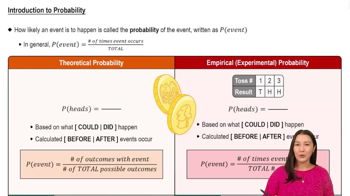
5:37
Introduction to Probability

Independent Events

Independent events are those whose outcomes do not affect each other. In this scenario, the selection of each music listener is independent, meaning the choice of one listener does not influence the choices of others. This concept is essential for calculating the overall probability of multiple listeners not selecting a specific source, as it allows for the multiplication of individual probabilities.
추천 영상:
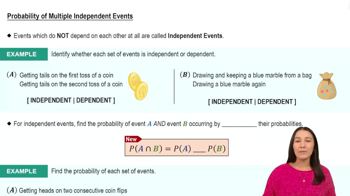
05:54
Probability of Multiple Independent Events

Complement Rule

The complement rule in probability states that the probability of an event not occurring is equal to one minus the probability of the event occurring. In this case, to find the probability that none of the nine listeners cite friends or social media, one can first determine the probability that at least one does and then subtract that from one. This approach simplifies the calculation and enhances understanding of the overall probability distribution.
추천 영상:
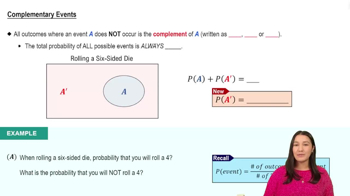
4:23
Complementary Events
관련 실천
교과서 질문

According to Bayes’ Theorem, the probability of event A , given that event B has occurred, is

P(A|B) = P(A) * P(B|A)P(A) * P(B|A) + P(A') * P(B|A').

In Exercises 33–38, use Bayes’ Theorem to find P(A|B).

37. P(A) = 73%, P(A') = 17%, P(B|A) = 46% , and P(B|A') = 52%

109
views
교과서 질문

20. Skating Eight people compete in a short track speed skating race. Assuming that there are no ties, in how many different orders can the skaters finish?

107
views
교과서 질문

97. Rolling a Pair of Dice You roll a pair of six-sided dice and record the sum.

a. List all of the possible sums and determine the probability of rolling each sum.

b. Use technology to simulate rolling a pair of dice and record the sum 100 times. Make a tally of the 100 sums and use these results to list the probability of rolling

each sum.

c. Compare the probabilities in part (a) with the probabilities in part (b). Explain any similarities or differences.

143
views
교과서 질문

Using the Fundamental Counting Principle In Exercises 37-40, use the Fundamental Counting Principle.

40. True or False Quiz Assuming that no questions are left unanswered, in how many ways can a six-question true or false quiz be answered?

165
views
교과서 질문

"According to Bayes’ Theorem, the probability of event A , given that event B has occurred, is

P(A|B) = P(A) * P(B|A)P(A) * P(B|A) + P(A') * P(B|A').

In Exercises 33–38, use Bayes’ Theorem to find P(A|B).

34. P(A) = 3/8, P(A') = 5/8, P(B|A) = 2/3 , and P(B|A') = 3/5 "

108
views
교과서 질문

True or False? In Exercises 3-6, determine whether the statement is true or false. If it is false, rewrite it as a true statement.

6. 7C5=7C2

119
views