
Ch. 3 - Probability
Larson - Elementary Statistics: Picturing the World 8th Edition
Larson8th EditionElementary Statistics: Picturing the WorldISBN: 9780137493470당신이 사용하는 게 아니라요?교과서 변경
3장, 문제 3.2.5

"True or False? In Exercises 5 and 6, determine whether the statement is true or false. If it is false, rewrite it as a true statement.
5. If two events are independent, then P(A|B) = P(B)."

검증된 단계별 안내
1
Step 1: Begin by recalling the definition of independent events. Two events A and B are independent if the occurrence of one does not affect the probability of the other. Mathematically, this is expressed as P(A ∩ B) = P(A) * P(B).
Step 2: Understand the conditional probability formula. Conditional probability P(A|B) is defined as P(A|B) = P(A ∩ B) / P(B), provided P(B) > 0.
Step 3: Substitute the independence condition into the conditional probability formula. Since P(A ∩ B) = P(A) * P(B) for independent events, the formula becomes P(A|B) = (P(A) * P(B)) / P(B).
Step 4: Simplify the expression. Cancel out P(B) in the numerator and denominator, which results in P(A|B) = P(A). This shows that for independent events, P(A|B) equals P(A), not P(B).
Step 5: Conclude that the given statement is false. Rewrite the true statement: 'If two events are independent, then P(A|B) = P(A).'

비슷한 문제에 대한 검증된 영상 답변:

이 영상 해법은 위 문제에 도움이 된다고 튜터들이 추천한 것입니다.
영상 길이:
1m
도움이 되었나요?

주요 개념

질문에 올바르게 답하기 위해 반드시 이해해야 하는 핵심 개념들은 다음과 같습니다.

Independent Events

Independent events are those whose occurrence does not affect the probability of the other event occurring. In probability theory, two events A and B are independent if the probability of A occurring given that B has occurred is equal to the probability of A occurring alone, expressed as P(A|B) = P(A). This concept is crucial for understanding how probabilities interact in different scenarios.
추천 영상:
05:54
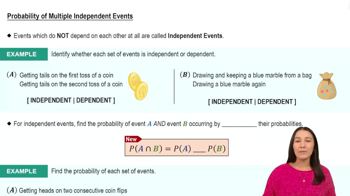
Probability of Multiple Independent Events

Conditional Probability

Conditional probability refers to the probability of an event occurring given that another event has already occurred. It is denoted as P(A|B), which reads as 'the probability of A given B.' Understanding this concept is essential for analyzing relationships between events and determining how the occurrence of one event influences the likelihood of another.
추천 영상:
03:53
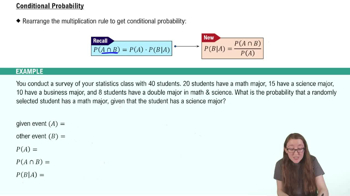
Conditional Probability Rule

Probability Notation

Probability notation is a standardized way of expressing probabilities and relationships between events. For example, P(A) represents the probability of event A occurring, while P(A|B) indicates the probability of A occurring under the condition that B has occurred. Familiarity with this notation is important for interpreting statements and solving problems in probability.
추천 영상:
5:37
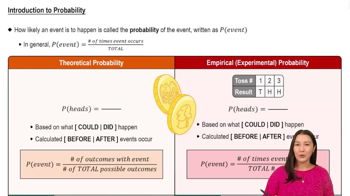
Introduction to Probability
관련 실천
교과서 질문

According to Bayes’ Theorem, the probability of event A , given that event B has occurred, is

P(A|B) = P(A) * P(B|A)P(A) * P(B|A) + P(A') * P(B|A').

In Exercises 33–38, use Bayes’ Theorem to find P(A|B).

33. P(A) = 2/3, P(A') = 1/3, P(B|A) = 1/5 , and P(B|A') = 1/2

238
views
교과서 질문

Identifying Simple Events In Exercises 33-36, determine the number of outcomes in the event. Then decide whether the event is a simple event or not. Explain your reasoning.

34. A spreadsheet is used to randomly generate a number from 1 to 4000. Event B is generating a number less than 500.

112
views
교과서 질문

Using a Tree Diagram In Exercises 67-70, a probability experiment consists of rolling a six-sided die and spinning the spinner shown at the left. The spinner is equally likely to land on each color. Use a tree diagram to find the probability of the event. Then explain whether the event can be considered unusual.

68. Event B: rolling an odd number and the spinner landing on green

87
views
교과서 질문

Finding Classical Probabilities In Exercises 41-46, a probability experiment consists of rolling a 12-sided die numbered 1 to 12. Find the probability of the event.

43. Event C: rolling a number greater than 4

164
views
교과서 질문

Finding the Probability of an Event In Exercises 21-24, the probability that an event will not happen is given. Find the probability that the event will happen. 

23. P(E')=3/4

256
views
교과서 질문

"According to Bayes’ Theorem, the probability of event A , given that event B has occurred, is

P(A|B) = P(A) * P(B|A)P(A) * P(B|A) + P(A') * P(B|A').

In Exercises 33–38, use Bayes’ Theorem to find P(A|B).

36. P(A) = 0.62, P(A') = 0.38, P(B|A) = 0.41 , and P(B|A') = 0.17 "

104
views