
Ch. 3 - Probability
Larson - Elementary Statistics: Picturing the World 8th Edition
Larson8th EditionElementary Statistics: Picturing the WorldISBN: 9780137493470당신이 사용하는 게 아니라요?교과서 변경
3장, 문제 3.2.23c

"Using the Multiplication Rule In Exercises 19-32, use the Multiplication Rule.
23. Celebrities as Role Models In a sample of 1103 probable voters, three out of four say they would like entertainers to address social and political issues. Two probable voters are selected at random. (Source: The Hollywood Reporter)
c. Find the probability that at least one of the two probable voters would like entertainers to address social and political issues."

검증된 단계별 안내
1
Step 1: Understand the problem. We are tasked with finding the probability that at least one of the two probable voters selected at random would like entertainers to address social and political issues. This involves using the complement rule and the multiplication rule.
Step 2: Define the probabilities. From the problem, we know that three out of four voters (or 75%) would like entertainers to address social and political issues. Thus, the probability of a voter liking this is P(A) = 0.75, and the probability of a voter not liking this is P(A') = 1 - 0.75 = 0.25.
Step 3: Use the complement rule. The probability of 'at least one' liking the issue is the complement of the probability that 'none' of the two voters like the issue. Mathematically, P(at least one) = 1 - P(none).
Step 4: Calculate P(none). To find P(none), use the multiplication rule. Since the two voters are selected independently, the probability that both do not like the issue is P(A') * P(A'). Substituting the values, P(none) = 0.25 * 0.25.
Step 5: Substitute into the complement formula. Finally, substitute P(none) into the complement formula: P(at least one) = 1 - P(none). This gives the probability that at least one of the two voters would like entertainers to address social and political issues.

비슷한 문제에 대한 검증된 영상 답변:

이 영상 해법은 위 문제에 도움이 된다고 튜터들이 추천한 것입니다.
영상 길이:
1m
도움이 되었나요?

주요 개념

질문에 올바르게 답하기 위해 반드시 이해해야 하는 핵심 개념들은 다음과 같습니다.

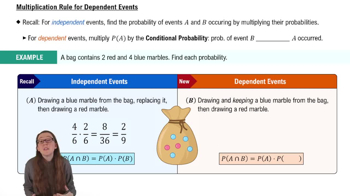
Multiplication Rule

The Multiplication Rule in probability states that the probability of two independent events both occurring is the product of their individual probabilities. This rule is essential for calculating the likelihood of multiple outcomes happening together, especially when events do not influence each other.
추천 영상:
가이드 코스
05:17
Multiplication Rule: Dependent Events

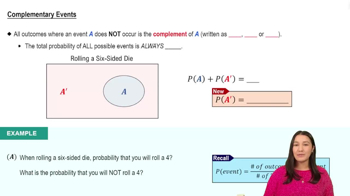
Complementary Events

Complementary events are pairs of outcomes in a probability scenario where one event occurs if and only if the other does not. In this context, finding the probability that at least one of the two voters supports entertainers addressing social issues can be simplified by calculating the probability that neither does and subtracting it from one.
추천 영상:
4:23
Complementary Events

Probability Calculation

Probability calculation involves determining the likelihood of an event occurring, expressed as a number between 0 and 1. In this problem, the probability of a voter wanting entertainers to address issues is 0.75, and the probability of not wanting this is 0.25, which are crucial for applying the Multiplication Rule and finding the desired probability.
추천 영상:
07:09
Probability From Given Z-Scores - TI-84 (CE) Calculator
관련 실천
교과서 질문

"Using the Multiplication Rule In Exercises 19-32, use the Multiplication Rule.

25. Best President In a sample of 1500 adult U.S. citizens, 270 said that Barack Obama was the best president in U.S. history. Two adult U.S. citizens are selected at random.

(Adapted from YouGov)

c. Find the probability that at least one of the two adult U.S. citizens says that Barack Obama was the best president in U.S. history."

42
views
교과서 질문

"Using the Multiplication Rule In Exercises 19-32, use the Multiplication Rule.

24. Knowing a Person Who Was Murdered In a sample of 11,771 children ages 2 to 17, 8% have lost a friend or relative to murder. Four children are selected at random. (Adapted from University of New Hampshire)

c. Find the probability that at least one of the four has lost a friend or relative to murder."

55
views
교과서 질문

19. U.S. Age Distribution The projected percent distribution of the U.S. population for 2025 is shown in the pie chart. Find the probability of each event. (Source: U.S. Census

Bureau)

c. Randomly selecting someone who is not 60 years or over

186
views
교과서 질문

88. Individual Stock Price An individual stock is selected at random from the portfolio represented by the box-and-whisker plot shown. Find the probability that the stock price is between \$21 and \$50.

82
views
교과서 질문

17. Selecting a Card A card is selected at random from a standard deck of 52 playing cards. Find the probability of each event.

c. Randomly selecting a 9 or a face card

388
views
교과서 질문

23. Engineering Degrees The table shows the numbers of male and female students in the U.S. who received B.S. degrees in engineering in a recent year. A student earning a B.S. degree in engineering during that year is selected at random. Find the probability of each event.

(Source: National Center for Educational Statistics)

c. The student is not female or did not receive a mechanical engineering degree.

82
views