
Ch. 4 - Discrete Probability Distributions
Larson - Elementary Statistics: Picturing the World 8th Edition
Larson8th EditionElementary Statistics: Picturing the WorldISBN: 9780137493470당신이 사용하는 게 아니라요?교과서 변경
4장, 문제 4.1.21d

Finding Probabilities Use the probability distribution you made in Exercise 19 to find the probability of randomly selecting a household that has (d) at most two HD televisions.

검증된 단계별 안내
1
Step 1: Recall the probability distribution created in Exercise 19. A probability distribution lists all possible outcomes (e.g., the number of HD televisions in a household) and their corresponding probabilities. Ensure that the probabilities sum to 1, as this is a requirement for a valid probability distribution.
Step 2: Identify the outcomes that correspond to 'at most two HD televisions.' This means you are interested in the probabilities for households with 0, 1, or 2 HD televisions.
Step 3: Write the mathematical expression for the probability of 'at most two HD televisions' as the sum of the probabilities for these outcomes: \( P(X \leq 2) = P(X = 0) + P(X = 1) + P(X = 2) \).
Step 4: Substitute the probabilities for \( P(X = 0) \), \( P(X = 1) \), and \( P(X = 2) \) from the probability distribution into the equation. Ensure that you use the correct values from the distribution.
Step 5: Add the probabilities together to compute the total probability of selecting a household with at most two HD televisions. Verify that the result is a valid probability (i.e., it lies between 0 and 1).

비슷한 문제에 대한 검증된 영상 답변:

이 영상 해법은 위 문제에 도움이 된다고 튜터들이 추천한 것입니다.
영상 길이:
1m
도움이 되었나요?

주요 개념

질문에 올바르게 답하기 위해 반드시 이해해야 하는 핵심 개념들은 다음과 같습니다.

Probability Distribution

A probability distribution is a mathematical function that provides the probabilities of occurrence of different possible outcomes in an experiment. It can be discrete, where outcomes are distinct and countable, or continuous, where outcomes can take any value within a range. Understanding how to construct and interpret a probability distribution is essential for calculating probabilities related to specific events.
추천 영상:
가이드 코스
06:39
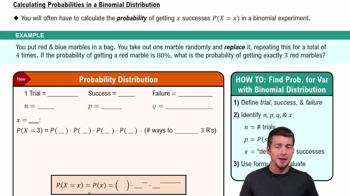
Calculating Probabilities in a Binomial Distribution

Cumulative Probability

Cumulative probability refers to the probability that a random variable takes on a value less than or equal to a specific value. In the context of the question, finding the probability of selecting a household with at most two HD televisions involves calculating the cumulative probability for the values 0, 1, and 2. This concept is crucial for determining the likelihood of outcomes within a defined range.
추천 영상:
5:37
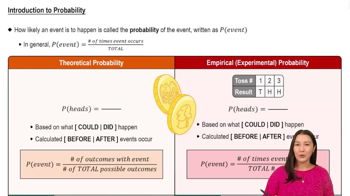
Introduction to Probability

Random Selection

Random selection is a fundamental principle in statistics that ensures each member of a population has an equal chance of being chosen. This concept is vital for ensuring that the results of probability calculations are valid and representative of the entire population. In the context of the question, it implies that the households are selected without bias, allowing for accurate probability assessments.
추천 영상:
가이드 코스
07:09
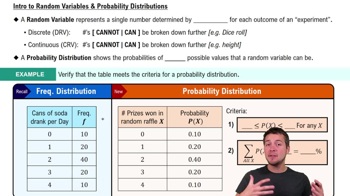
Intro to Random Variables & Probability Distributions
관련 실천
교과서 질문

Using a Distribution to Find Probabilities In Exercises 11–26, find the indicated probabilities using the geometric distribution, the Poisson distribution, or the binomial distribution. Then determine whether the events are unusual. If convenient, use a table or technology to find the probabilities.


Oil Tankers In the month of June 2021, 240 oil tankers stop at a port city. No oil tanker visits more than once. Find the probability that the number of oil tankers that stop on any given day in June is (c) more than eight.

104
views
교과서 질문

Unusual Events In Exercises 37 and 38, find the indicated probabilities. Then determine if the event is unusual. Explain your reasoning.


Rock-Paper-Scissors The probability of winning a game of rock-paper-scissors is 1/3. You play nine games of rock-paper-scissors. Find the probability that the number of games you win is (c) less than two.

85
views
교과서 질문

Hypergeometric Distribution Binomial experiments require that any sampling be done with replacement because each trial must be independent of the others. The hypergeometric distribution also has two outcomes: success and failure. The sampling, however, is done without replacement. For a population of N items having k successes and failures, the probability of selecting a sample of size that has successes and failures is given by

" style="max-width: 100%; white-space-collapse: preserve;" width="245">


In a shipment of 15 microchips, 2 are defective and 13 are not defective. A sample of three microchips is chosen at random. Use the above formula to find the probability that (c) two microchips are defective and one is not defective.

178
views