Ch. 4 - Discrete Probability Distributions
Larson - Elementary Statistics: Picturing the World 8th Edition
Larson8th EditionElementary Statistics: Picturing the WorldISBN: 9780137493470당신이 사용하는 게 아니라요?교과서 변경
4장, 문제 4.2.24

Finding Binomial Probabilities In Exercises 19–26, find the indicated probabilities. If convenient, use technology or Table 2 in Appendix B.


Responsible Consumption Forty-five percent of consumers say it is important that the clothing they buy is made without child labor. You randomly select 16 consumers. Find the probability that the number of of consumers who say it is important that the clothing they buy is made without child labor is (a) e

검증된 단계별 안내
1
Step 1: Identify the problem type. This is a binomial probability problem because we are dealing with a fixed number of trials (16 consumers), two possible outcomes (say it is important or not), and a constant probability of success (45% or 0.45).
Step 2: Define the binomial random variable. Let X represent the number of consumers who say it is important that the clothing they buy is made without child labor. X follows a binomial distribution with parameters n = 16 (number of trials) and p = 0.45 (probability of success).
Step 3: Write the formula for the binomial probability. The probability mass function for a binomial random variable is given by: P(X=k)=(n!k!(n-k)!)×pk×(1-p)n-k, where k is the number of successes, n is the number of trials, and p is the probability of success.
Step 4: Plug in the values for n and p into the formula. For this problem, n = 16 and p = 0.45. To find the probability for a specific value of k (the number of successes), substitute k into the formula and calculate the result.
Step 5: Use technology or a binomial probability table to compute the probability for the desired value of k. If using technology, such as a calculator or statistical software, input the values for n, p, and k to obtain the probability. Alternatively, refer to Table 2 in Appendix B for the binomial probabilities.

비슷한 문제에 대한 검증된 영상 답변:

이 영상 해법은 위 문제에 도움이 된다고 튜터들이 추천한 것입니다.
영상 길이:
3m
도움이 되었나요?

주요 개념

질문에 올바르게 답하기 위해 반드시 이해해야 하는 핵심 개념들은 다음과 같습니다.

Binomial Distribution

The binomial distribution models the number of successes in a fixed number of independent Bernoulli trials, each with the same probability of success. In this context, it applies to the scenario of selecting consumers who value child labor-free clothing, where each consumer's response can be seen as a success or failure.
추천 영상:
가이드 코스
03:28
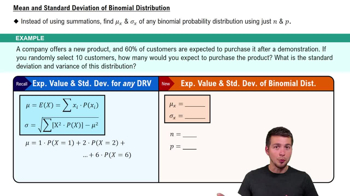
Mean & Standard Deviation of Binomial Distribution

Probability Mass Function (PMF)

The probability mass function gives the probability of obtaining exactly k successes in n trials for a binomial distribution. It is calculated using the formula P(X = k) = (n choose k) * p^k * (1-p)^(n-k), where p is the probability of success. This function is essential for determining the likelihood of a specific number of consumers expressing the importance of child labor-free clothing.
추천 영상:
5:37
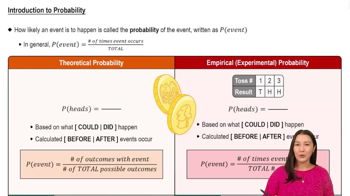
Introduction to Probability

Cumulative Probability

Cumulative probability refers to the probability that a random variable takes on a value less than or equal to a certain threshold. In the context of this question, it may be necessary to calculate cumulative probabilities to find the likelihood of a certain number of consumers valuing child labor-free clothing, which can be done using binomial tables or technology.
추천 영상:
5:37
Introduction to Probability