

Ch. 4 - Discrete Probability Distributions
Larson - Elementary Statistics: Picturing the World 8th Edition
Larson8th EditionElementary Statistics: Picturing the WorldISBN: 9780137493470당신이 사용하는 게 아니라요?교과서 변경
4장, 문제 4.RE.13c

In Exercises 13–16, find the indicated binomial probabilities. If convenient, use technology or Table 2 in Appendix B.
Fifty-three percent of U.S. adults support attempting to land an astronaut on Mars. You randomly select eight U.S. adults. Find the probability that the number who support attempting to land an astronaut on Mars is (c) more than three.

검증된 단계별 안내
1
Step 1: Identify the problem as a binomial probability problem. The binomial distribution is used when there are a fixed number of independent trials, each with two possible outcomes (success or failure). Here, the number of trials is n = 8, the probability of success (supporting the Mars mission) is p = 0.53, and the probability of failure is q = 1 - p = 0.47.
Step 2: Define the random variable X as the number of U.S. adults (out of 8) who support attempting to land an astronaut on Mars. The problem asks for the probability that X > 3. This can be expressed as P(X > 3).
Step 3: Use the complement rule to simplify the calculation. Since P(X > 3) = 1 - P(X ≤ 3), calculate P(X ≤ 3) first. This involves summing the probabilities for X = 0, X = 1, X = 2, and X = 3 using the binomial probability formula: P(X = k) = (n choose k) * p^k * q^(n-k), where (n choose k) = n! / [k! * (n-k)!].
Step 4: Compute each term for P(X = 0), P(X = 1), P(X = 2), and P(X = 3) using the binomial formula. For example, for P(X = 0), substitute k = 0, n = 8, p = 0.53, and q = 0.47 into the formula. Repeat this for k = 1, k = 2, and k = 3.
Step 5: Add the probabilities from Step 4 to find P(X ≤ 3). Finally, subtract this value from 1 to find P(X > 3). If convenient, use technology (e.g., a calculator or statistical software) to compute these probabilities more efficiently.

비슷한 문제에 대한 검증된 영상 답변:

이 영상 해법은 위 문제에 도움이 된다고 튜터들이 추천한 것입니다.
영상 길이:
3m
도움이 되었나요?

주요 개념

질문에 올바르게 답하기 위해 반드시 이해해야 하는 핵심 개념들은 다음과 같습니다.

Binomial Distribution

The binomial distribution models the number of successes in a fixed number of independent Bernoulli trials, each with the same probability of success. In this context, the trials are the responses of the eight randomly selected U.S. adults regarding their support for landing an astronaut on Mars, with a success defined as a 'yes' response.
추천 영상:
가이드 코스
03:28
Mean & Standard Deviation of Binomial Distribution

Probability Calculation

To find the probability of a specific outcome in a binomial distribution, we use the binomial probability formula: P(X = k) = (n choose k) * p^k * (1-p)^(n-k), where n is the number of trials, k is the number of successes, and p is the probability of success. For this question, we need to calculate the probability of more than three supporters, which involves summing the probabilities of four to eight supporters.
추천 영상:
가이드 코스
07:09
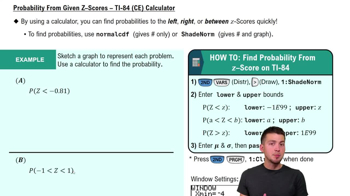
Probability From Given Z-Scores - TI-84 (CE) Calculator

Cumulative Probability

Cumulative probability refers to the probability that a random variable takes on a value less than or equal to a certain number. In this case, to find the probability of more than three supporters, we can calculate the cumulative probability of having three or fewer supporters and subtract it from one, as P(X > 3) = 1 - P(X ≤ 3). This approach simplifies the calculation by focusing on fewer outcomes.
추천 영상:
5:37
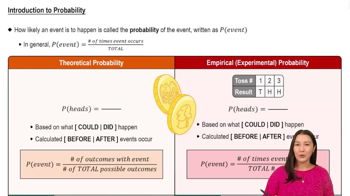
Introduction to Probability
관련 실천
교과서 질문

The Centers for Disease Control and Prevention (CDC) is required by law to publish a report on assisted reproductive technology (ART). ART includes all fertility treatments in which both the egg and the sperm are used. These procedures generally involve removing eggs from a patient’s ovaries, combining them with sperm in the laboratory, and returning them to the patient’s body or giving them to another patient.

You are helping to prepare a CDC report on young ART patients and select at random 6 ART cycles of patients under 35 years of age for a special review. None of the cycles resulted in a live birth. Your manager feels it is impossible to select at random 10 ART cycles that do not result in a live birth. Use the pie chart at the right and your knowledge of statistics to determine whether your manager is correct.

a. How would you determine whether your manager is correct, that it is impossible to select at random six ART cycles that do not result in a live birth?

86
views
교과서 질문

In Exercises 13–16, find the indicated binomial probabilities. If convenient, use technology or Table 2 in Appendix B.

Seventy-two percent of U.S. civilian employees have access to medical care benefits. You randomly select nine civilian employees. Find the probability that the number who have access to medical care benefits is (b) at least six

89
views
교과서 질문

In Exercises 13–16, find the indicated binomial probabilities. If convenient, use technology or Table 2 in Appendix B.

Seventy-two percent of U.S. civilian employees have access to medical care benefits. You randomly select nine civilian employees. Find the probability that the number who have access to medical care benefits is (c) more than six.

74
views
교과서 질문

In Exercises 13–16, find the indicated binomial probabilities. If convenient, use technology or Table 2 in Appendix B.

Fifty-three percent of U.S. adults support attempting to land an astronaut on Mars. You randomly select eight U.S. adults. Find the probability that the number who support attempting to land an astronaut on Mars is (a) exactly three

128
views
교과서 질문

In Exercises 13–16, find the indicated binomial probabilities. If convenient, use technology or Table 2 in Appendix B.

Seventy-two percent of U.S. civilian employees have access to medical care benefits. You randomly select nine civilian employees. Find the probability that the number who have access to medical care benefits is (a) exactly six

87
views
교과서 질문

The Centers for Disease Control and Prevention (CDC) is required by law to publish a report on assisted reproductive technology (ART). ART includes all fertility treatments in which both the egg and the sperm are used. These procedures generally involve removing eggs from a patient’s ovaries, combining them with sperm in the laboratory, and returning them to the patient’s body or giving them to another patient.

You are helping to prepare a CDC report on young ART patients and select at random 6 ART cycles of patients under 35 years of age for a special review. None of the cycles resulted in a live birth. Your manager feels it is impossible to select at random 10 ART cycles that do not result in a live birth. Use the pie chart at the right and your knowledge of statistics to determine whether your manager is correct.

b. What probability distribution do you think best describes the situation? Do you think the distribution of the number of live births is discrete or continuous? Explain your reasoning.

84
views