
Ch. 4 - Discrete Probability Distributions
Larson - Elementary Statistics: Picturing the World 8th Edition
Larson8th EditionElementary Statistics: Picturing the WorldISBN: 9780137493470당신이 사용하는 게 아니라요?교과서 변경
4장, 문제 4.2.39

Multinomial Experiments In Exercises 39 and 40, use the information below.
A multinomial experiment satisfies these conditions.
The experiment has a fixed number of trials n, where each trial is independent of the other trials.
Each trial has k possible mutually exclusive outcomes:
Each outcome has a fixed probability. So, . The sum of the probabilities for all outcomes is
The number of times occurs is , the number of times occurs is , the number of times occurs is , and so on.
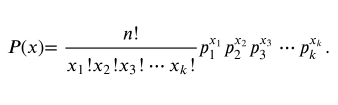
The discrete random variable x counts the number of times that each outcome occurs in n independent trials where . The probability that x will occur is
Formula for the probability of outcomes in a multinomial experiment, showing factorials and probabilities.
Genetics According to a theory in genetics, when tall and colorful plants are crossed with short and colorless plants, four types of plants will result: tall and colorful, tall and colorless, short and colorful, and short and colorless, with corresponding probabilities of , and . Ten plants are selected. Find the probability that 5 will be tall and colorful, 2 will be tall and colorless, 2 will be short and colorful, and 1 will be short and colorless.

검증된 단계별 안내
1
Step 1: Identify the components of the multinomial probability formula. The formula is P(x) = (n! / (x1! * x2! * x3! * ... * xk!)) * (p1^x1 * p2^x2 * p3^x3 * ... * pk^xk), where n is the total number of trials, x1, x2, ..., xk are the counts of each outcome, and p1, p2, ..., pk are the probabilities of each outcome.
Step 2: Assign the given values to the formula. Here, n = 10 (total number of plants), x1 = 5 (tall and colorful), x2 = 2 (tall and colorless), x3 = 2 (short and colorful), x4 = 1 (short and colorless). The probabilities are p1 = 0.5, p2 = 0.25, p3 = 0.2, and p4 = 0.05.
Step 3: Compute the factorials for n and each xi. For example, calculate n! = 10!, x1! = 5!, x2! = 2!, x3! = 2!, and x4! = 1!. These factorials will be used in the denominator of the formula.
Step 4: Raise each probability to the power of its corresponding xi. For example, calculate p1^x1 = 0.5^5, p2^x2 = 0.25^2, p3^x3 = 0.2^2, and p4^x4 = 0.05^1. These values will be multiplied together in the formula.
Step 5: Substitute all computed values into the formula and simplify. Multiply the factorials and probabilities together to find the probability P(x) for the given outcomes.

비슷한 문제에 대한 검증된 영상 답변:

이 영상 해법은 위 문제에 도움이 된다고 튜터들이 추천한 것입니다.
영상 길이:
2m
도움이 되었나요?

주요 개념

질문에 올바르게 답하기 위해 반드시 이해해야 하는 핵심 개념들은 다음과 같습니다.

Multinomial Experiment

A multinomial experiment is a statistical experiment that consists of a fixed number of independent trials, each with multiple possible outcomes. Each trial can result in one of k mutually exclusive outcomes, and the probabilities of these outcomes remain constant across trials. The experiment is characterized by counting the occurrences of each outcome, which is essential for calculating probabilities associated with the results.
추천 영상:
가이드 코스
06:00
The Binomial Experiment

Probability Distribution

In the context of multinomial experiments, the probability distribution describes the likelihood of obtaining a specific combination of outcomes across the trials. The formula provided illustrates how to calculate the probability of observing a particular set of counts for each outcome, using factorials to account for the different arrangements of outcomes. This distribution is crucial for understanding the behavior of the random variable representing the counts of each outcome.
추천 영상:
가이드 코스
06:39
Calculating Probabilities in a Binomial Distribution

Factorials

Factorials are mathematical expressions that represent the product of all positive integers up to a given number n, denoted as n!. In multinomial experiments, factorials are used to calculate the number of ways outcomes can occur in a given arrangement. They play a vital role in the probability formula, allowing for the correct computation of probabilities by accounting for the different permutations of the outcomes across the trials.
추천 영상:
05:22
Combinations
관련 실천
교과서 질문

Finding and Interpreting Mean, Variance, and Standard Deviation In Exercises 31–36, find the mean, variance, and standard deviation of the binomial distribution for the given random variable. Interpret the results and determine any unusual values.


Late for Work Thirty-one percent of U.S. employees who are late for work blame oversleeping. You randomly select 12 U.S. employees who are late for work and ask them whether they blame oversleeping. The random variable represents the number who are late for work and blame oversleeping. (Source: CareerBuilder)

121
views
교과서 질문

Finding and Interpreting Mean, Variance, and Standard Deviation In Exercises 31–36, find the mean, variance, and standard deviation of the binomial distribution for the given random variable. Interpret the results and determine any unusual values.


Life on Other Planets Seventy-nine percent of U.S. adults believe that life on other planets is plausible. You randomly select eight U.S. adults and ask them whether they believe that life on other planets is plausible. The random variable represents the number who believe that life on other planets is plausible. (Source: Ipsos)

67
views
교과서 질문

Determining a Missing Probability In Exercises 25 and 26, determine the missing probability for the probability distribution.

116
views
교과서 질문

"Multinomial Experiments In Exercises 39 and 40, use the information below.

A multinomial experiment satisfies these conditions.

The experiment has a fixed number of trials n, where each trial is independent of the other trials.

Each trial has k possible mutually exclusive outcomes:

Each outcome has a fixed probability. So, . The sum of the probabilities for all outcomes is

The number of times occurs is , the number of times occurs is , the number of times occurs is , and so on.

The discrete random variable x counts the number of times that each outcome occurs in n independent trials where . The probability that x will occur is


Genetics Another proposed theory in genetics gives the corresponding probabilities for the four types of plants described in Exercise 39 as , and . Ten plants are selected. Find the probability that 5 will be tall and colorful, 2 will be tall and colorless, 2 will be short and colorful, and 1 will be short and colorless."

63
views
교과서 질문

Graphical Analysis In Exercises 9–12, determine whether the graph on the number line represents a discrete random variable or a continuous random variable. Explain your reasoning.


The distance a baseball travels after being hit

75
views
교과서 질문

Finding Binomial Probabilities In Exercises 19–26, find the indicated probabilities. If convenient, use technology or Table 2 in Appendix B.


Civil Rights Fifty-nine percent of U.S. adults think that civil rights for Black Americans have improved during their lifetime. You randomly select seven U.S. adults. Find the probability that the number who think that civil rights for Black Americans have improved during their lifetime is (a) exactly one and (b) exactly five. (Source: Gallup)

159
views