
Ch. 4 - Discrete Probability Distributions
Larson - Elementary Statistics: Picturing the World 8th Edition
Larson8th EditionElementary Statistics: Picturing the WorldISBN: 9780137493470당신이 사용하는 게 아니라요?교과서 변경
4장, 문제 4.2.40

"Multinomial Experiments In Exercises 39 and 40, use the information below.
A multinomial experiment satisfies these conditions.
The experiment has a fixed number of trials n, where each trial is independent of the other trials.
Each trial has k possible mutually exclusive outcomes:
Each outcome has a fixed probability. So, . The sum of the probabilities for all outcomes is
The number of times occurs is , the number of times occurs is , the number of times occurs is , and so on.
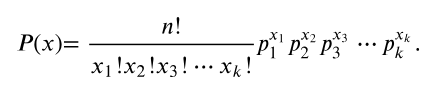
The discrete random variable x counts the number of times that each outcome occurs in n independent trials where . The probability that x will occur is


Genetics Another proposed theory in genetics gives the corresponding probabilities for the four types of plants described in Exercise 39 as , and . Ten plants are selected. Find the probability that 5 will be tall and colorful, 2 will be tall and colorless, 2 will be short and colorful, and 1 will be short and colorless."

검증된 단계별 안내
1
Step 1: Identify the parameters of the multinomial experiment. Here, the total number of trials is n = 10 plants, and there are k = 4 possible outcomes (types of plants): tall and colorful, tall and colorless, short and colorful, and short and colorless.
Step 2: Assign the probabilities for each outcome as given in the problem. Let p₁, p₂, p₃, and p₄ represent the probabilities for tall and colorful, tall and colorless, short and colorful, and short and colorless plants respectively.
Step 3: Identify the counts for each outcome from the problem: x₁ = 5 (tall and colorful), x₂ = 2 (tall and colorless), x₃ = 2 (short and colorful), and x₄ = 1 (short and colorless). Verify that the sum of these counts equals n (5 + 2 + 2 + 1 = 10).
Step 4: Use the multinomial probability formula: P(x)=n!x1!x2!x3!...xk!p1p2p3...pk where each pi is raised to the power of the corresponding xi.
Step 5: Substitute the values of n, x₁, x₂, x₃, x₄, and p₁, p₂, p₃, p₄ into the formula to express the probability of observing exactly 5 tall and colorful, 2 tall and colorless, 2 short and colorful, and 1 short and colorless plants.

비슷한 문제에 대한 검증된 영상 답변:

이 영상 해법은 위 문제에 도움이 된다고 튜터들이 추천한 것입니다.
영상 길이:
4m
도움이 되었나요?

주요 개념

질문에 올바르게 답하기 위해 반드시 이해해야 하는 핵심 개념들은 다음과 같습니다.

Multinomial Experiment

A multinomial experiment consists of a fixed number of independent trials, each with multiple mutually exclusive outcomes. Each outcome has a fixed probability, and the sum of these probabilities equals one. The experiment counts how many times each outcome occurs across all trials.
추천 영상:
가이드 코스
06:00
The Binomial Experiment

Multinomial Probability Formula

The multinomial probability formula calculates the probability of a specific combination of outcomes in a multinomial experiment. It uses factorials of the total trials and counts of each outcome, multiplied by the product of each outcome's probability raised to the power of its count.
추천 영상:
5:37
Introduction to Probability

Application to Genetics Problem

In genetics, multinomial experiments model the distribution of different plant types with known probabilities. Given the number of plants and their types, the multinomial formula helps find the probability of observing a specific combination of plant types, such as tall/colorful or short/colorless.
추천 영상:
03:06
Conditional Probability Rule Example 1
관련 실천
교과서 질문

Finding and Interpreting Mean, Variance, and Standard Deviation In Exercises 31–36, find the mean, variance, and standard deviation of the binomial distribution for the given random variable. Interpret the results and determine any unusual values.


Late for Work Thirty-one percent of U.S. employees who are late for work blame oversleeping. You randomly select 12 U.S. employees who are late for work and ask them whether they blame oversleeping. The random variable represents the number who are late for work and blame oversleeping. (Source: CareerBuilder)

121
views
교과서 질문

Finding and Interpreting Mean, Variance, and Standard Deviation In Exercises 31–36, find the mean, variance, and standard deviation of the binomial distribution for the given random variable. Interpret the results and determine any unusual values.


Life on Other Planets Seventy-nine percent of U.S. adults believe that life on other planets is plausible. You randomly select eight U.S. adults and ask them whether they believe that life on other planets is plausible. The random variable represents the number who believe that life on other planets is plausible. (Source: Ipsos)

67
views
교과서 질문

Multinomial Experiments In Exercises 39 and 40, use the information below.

A multinomial experiment satisfies these conditions.

The experiment has a fixed number of trials n, where each trial is independent of the other trials.

Each trial has k possible mutually exclusive outcomes:

Each outcome has a fixed probability. So, . The sum of the probabilities for all outcomes is

The number of times occurs is , the number of times occurs is , the number of times occurs is , and so on.

The discrete random variable x counts the number of times that each outcome occurs in n independent trials where . The probability that x will occur is

Genetics According to a theory in genetics, when tall and colorful plants are crossed with short and colorless plants, four types of plants will result: tall and colorful, tall and colorless, short and colorful, and short and colorless, with corresponding probabilities of , and . Ten plants are selected. Find the probability that 5 will be tall and colorful, 2 will be tall and colorless, 2 will be short and colorful, and 1 will be short and colorless.

124
views
교과서 질문

Using a Distribution to Find Probabilities In Exercises 11–26, find the indicated probabilities using the geometric distribution, the Poisson distribution, or the binomial distribution. Then determine whether the events are unusual. If convenient, use a table or technology to find the probabilities.


Immigration The mean number of people who immigrated to the United States per hour was about 5.5 in April 2021. Find the probability that the number of people who immigrate to the U.S. in a given hour in April 2021 was (a) zero, (b) exactly five, and (c) exactly eight. (Source: U.S. Census Bureau)

81
views
교과서 질문

Discrete Variables and Continuous Variables In Exercises 13–18, determine whether the random variable x is discrete or continuous. Explain.

Let x represent the fitted hat sizes of members of a softball team.

152
views
교과서 질문

Independent and Dependent Random Variables Two random variables x and y are independent when the value of x does not affect the value of y. When the variables are not independent, they are dependent. A new random variable can be formed by finding the sum or difference of random variables. If a random variable x has mean and a random variable y has mean , then the means of the sum and difference of the variables are given by . If random variables are independent, then the variance and standard deviation of the sum or difference of the random variables can be found. So, if a random variable x has variance and a random variable y has variance , then the variances of the sum and difference of the variables are given by In Exercises 43 and 44, the distribution of SAT mathematics scores for college-bound male seniors in 2020 has a mean of 531 and a standard deviation of 121. The distribution of SAT mathematics scores for college-bound female seniors in 2020 has a mean of 516 and a standard deviation of 112. One male and one female are randomly selected. Assume their scores are independent. (Adapted from College Board)


Find the mean and standard deviation of the sum of their scores.

202
views