Ch. 5 - Normal Probability Distributions
Larson - Elementary Statistics: Picturing the World 8th Edition
Larson8th EditionElementary Statistics: Picturing the WorldISBN: 9780137493470당신이 사용하는 게 아니라요?교과서 변경
5장, 문제 5.CR.1c

A survey of adults in the United States found that 61% ate at a restaurant at least once in the past week. You randomly select 30 adults and ask them whether they ate at a restaurant at least once in the past week. (Source: Gallup)


c. Is it unusual for exactly 14 out of 30 adults to have eaten in a restaurant at least once in the past week? Explain your reasoning.

검증된 단계별 안내
1
Step 1: Recognize that this is a binomial probability problem. The survey indicates that the probability of success (an adult eating at a restaurant at least once in the past week) is p = 0.61, and the probability of failure is q = 1 - p = 0.39. The number of trials is n = 30, and we are interested in the probability of exactly x = 14 successes.
Step 2: Use the binomial probability formula to calculate the probability of exactly 14 successes: P(X = x) = (n choose x) * p^x * q^(n-x). Here, (n choose x) is the binomial coefficient, which can be calculated as (n! / (x! * (n - x)!)).
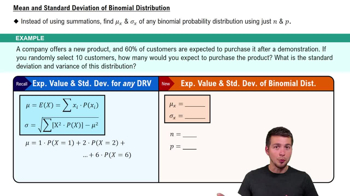
Step 3: Calculate the mean (μ) and standard deviation (σ) of the binomial distribution to assess whether 14 is unusual. The mean is given by μ = n * p, and the standard deviation is given by σ = sqrt(n * p * q).
Step 4: Determine the range of usual values using the rule of thumb: usual values typically fall within μ ± 2σ. Calculate the lower bound (μ - 2σ) and the upper bound (μ + 2σ).
Step 5: Compare the value of x = 14 to the range of usual values. If 14 falls outside the range, it is considered unusual. If it falls within the range, it is not unusual. Provide reasoning based on this comparison.

비슷한 문제에 대한 검증된 영상 답변:

이 영상 해법은 위 문제에 도움이 된다고 튜터들이 추천한 것입니다.
영상 길이:
11m

주요 개념

질문에 올바르게 답하기 위해 반드시 이해해야 하는 핵심 개념들은 다음과 같습니다.

Binomial Distribution

The binomial distribution models the number of successes in a fixed number of independent Bernoulli trials, each with the same probability of success. In this context, each adult's response to whether they ate at a restaurant can be seen as a trial, with 'success' defined as having eaten at a restaurant. The parameters for this distribution are the number of trials (30 adults) and the probability of success (61% or 0.61).
추천 영상:
가이드 코스
03:28
Mean & Standard Deviation of Binomial Distribution

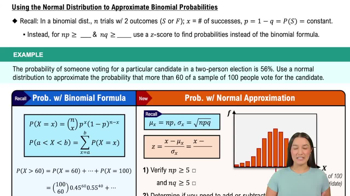
Normal Approximation

For large sample sizes, the binomial distribution can be approximated by a normal distribution, which simplifies calculations. This approximation is valid when both np and n(1-p) are greater than 5. In this case, with n=30 and p=0.61, we can use the normal distribution to assess the likelihood of observing exactly 14 successes.
추천 영상:
가이드 코스
06:23
Using the Normal Distribution to Approximate Binomial Probabilities

Unusual Events

An event is considered unusual if its probability of occurrence is less than 5%. To determine if having exactly 14 out of 30 adults eating at a restaurant is unusual, we can calculate the probability of this outcome using the binomial distribution or its normal approximation. If this probability is below 0.05, we would classify it as unusual.
추천 영상:
가이드 코스
05:54
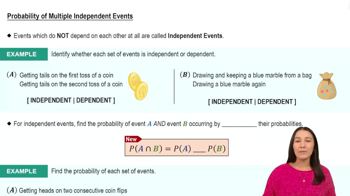
Probability of Multiple Independent Events