Ch. 5 - Normal Probability Distributions
Larson - Elementary Statistics: Picturing the World 8th Edition
Larson8th EditionElementary Statistics: Picturing the WorldISBN: 9780137493470당신이 사용하는 게 아니라요?교과서 변경
5장, 문제 5.CR.12b

Forty-nine percent of U.S. adults think that human activity such as burning fossil fuels contributes a great deal to climate change. You randomly select 25 U.S. adults. Find the probability that the number who think that human activity contributes a great deal to climate change is (b) between 8 and 11, inclusive,

검증된 단계별 안내
1
Step 1: Recognize that this is a binomial probability problem. The problem involves a fixed number of trials (n = 25), two possible outcomes (success: the person thinks human activity contributes a great deal to climate change, and failure: they do not), and a constant probability of success (p = 0.49).
Step 2: Define the random variable X as the number of U.S. adults in the sample of 25 who think human activity contributes a great deal to climate change. X follows a binomial distribution: X ~ Binomial(n = 25, p = 0.49).
Step 3: To find the probability that the number of successes is between 8 and 11 inclusive, calculate P(8 ≤ X ≤ 11). This can be expressed as the sum of individual probabilities: P(8 ≤ X ≤ 11) = P(X = 8) + P(X = 9) + P(X = 10) + P(X = 11).
Step 4: Use the binomial probability formula to calculate each term: P(X = k) = (n choose k) * p^k * (1-p)^(n-k), where (n choose k) = n! / [k! * (n-k)!]. Substitute n = 25, p = 0.49, and k = 8, 9, 10, and 11 to compute each probability.
Step 5: Add the probabilities calculated in Step 4 to find the total probability P(8 ≤ X ≤ 11). Alternatively, use statistical software or a calculator with a binomial probability function to compute the cumulative probability directly.

비슷한 문제에 대한 검증된 영상 답변:

이 영상 해법은 위 문제에 도움이 된다고 튜터들이 추천한 것입니다.
영상 길이:
6m
도움이 되었나요?

주요 개념

질문에 올바르게 답하기 위해 반드시 이해해야 하는 핵심 개념들은 다음과 같습니다.

Binomial Distribution

The binomial distribution models the number of successes in a fixed number of independent Bernoulli trials, each with the same probability of success. In this context, each selected adult either believes that human activity contributes to climate change (success) or does not (failure). The parameters of the distribution are the number of trials (n = 25) and the probability of success (p = 0.49).
추천 영상:
가이드 코스
03:28
Mean & Standard Deviation of Binomial Distribution

Probability Mass Function (PMF)

The probability mass function gives the probability of obtaining a specific number of successes in a binomial distribution. For a given number of successes k, the PMF is calculated using the formula P(X = k) = (n choose k) * p^k * (1-p)^(n-k). This function is essential for determining the probability of observing between 8 and 11 adults who believe in the contribution of human activity to climate change.
추천 영상:
가이드 코스
5:37
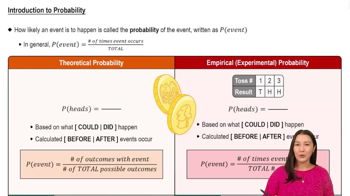
Introduction to Probability

Cumulative Probability

Cumulative probability refers to the probability that a random variable takes on a value less than or equal to a certain number. To find the probability that the number of adults believing in human activity's contribution to climate change is between 8 and 11, one would calculate the cumulative probabilities for 11 and 7, then subtract the two. This approach allows for the determination of the probability of a range of outcomes.
추천 영상:
가이드 코스
5:37
Introduction to Probability
관련 실천